A "skill game" is a competition where your ability — strategy, knowledge, reflexes, or pattern recognition — decides the outcome, not luck. That single sentence is what separates the category from gambling, what lets it operate legally in most US states, and what powers a global market that hit $46.39 billion in 2025 and is projected at $52.71 billion in 2026 (Fortune Business Insights, 2025). I run player trust at Atay Games — below is the plain-English version of what skill games are, how they're legally classified, the five categories they break into, and how real-money tournaments actually work.
- Definition. A skill game is a competition where player ability — not random chance — predominantly determines who wins. Over repeated play, skilled players reliably outperform less skilled ones (Klein Moynihan Turco, 2024).
- Big market, broad demographic. Global skill gaming reached $46.39 billion in 2025 and is projected to hit $52.71 billion in 2026 en route to $121.57 billion by 2034 at an 11% CAGR (Fortune Business Insights, 2025). Boomers (61–79) and the Silent Generation prefer puzzle (73%) and skill-and-chance (55%) games more than younger cohorts (ESA 2025).
- Five real categories. Card, puzzle, word, arcade & sports, and bingo-style speed games — every one of them is built on identical-board (or shared-clock) tournament mechanics.
- Legal in most of the US. Federal law does not prohibit skill gaming. Most states use the predominance test; a minority (notably Virginia, Kentucky) currently restrict or ban it — Virginia's governor vetoed legalization in April 2026 (Office of the Governor of Virginia, April 2026).
- Real money is normal in this category. Licensed platforms — Atay Games, Skillz, AviaGames — pay verified cash withdrawals to tournament winners. Skillz alone posted $95.5M in 2024 revenue with 816,000 monthly active users (Skillz Inc., February 2025).
What Is a Skill Game?
A skill game is a competition in which the outcome is determined primarily by a player's ability — strategy, knowledge, reaction time, pattern recognition, or learned technique — rather than by random chance. Over time, more skilled players reliably outperform less skilled ones. This statistical reliability is the defining feature that separates a skill game from a game of chance, and it's the test US courts apply when deciding whether an activity is gambling (Klein Moynihan Turco LLP, 2024).
The "statistical reliability" test in plain English
Play any skill game one time and a beginner might beat an expert. Play it a hundred times and the expert wins the vast majority. That's the test in practice. Chess, crosswords, billiards, competitive solitaire, head-to-head bubble shooters — all show this pattern. Slots, roulette, and the lottery don't. Skilled lottery players don't exist; skilled crossword solvers do.
What skill games are NOT
The phrase "skill game" gets used loosely on app stores, so it's worth being precise. Slots, lottery, roulette, and craps are games of chance, not skill — the random number generator decides, not the player. Casual mobile games that don't have a competitive head-to-head structure aren't real-money skill games either, even when the developer markets them with "win cash" language. Pure single-player score-chasers without a verified opponent and a structured prize pool fall outside the category as US law defines it.
Where skill games sit on the spectrum
Imagine a continuum: pure skill on one end (chess), pure chance on the other (lottery). Most real-money skill games sit far on the skill side, but not all the way. Bingo, for example, has a chance element (which ball is drawn) blended with a skill element (how fast you spot and mark patterns under time pressure), and we weigh both in is bingo a game of skill or luck? The predominance test asks: where on the line does this game fall? If skill dominates, it's a skill game (Klein Moynihan Turco, 2024).
A skill game is a competition where the outcome is determined primarily by a player's ability — strategy, knowledge, reaction time, or pattern recognition — rather than by random chance. Over enough plays, skilled players reliably outperform less skilled ones. This statistical-reliability test is what US courts apply when classifying an activity as a skill game versus gambling. (Klein Moynihan Turco LLP, 2024)
Skill Games vs. Games of Chance
One factor separates skill games from games of chance: which input — player ability or randomness — predominantly drives the outcome. Most US courts apply the predominance test: if skill dominates on a skill-to-chance continuum, courts classify the activity as a skill game and gambling statutes don't apply (Klein Moynihan Turco, 2024). A minority of states use the stricter material-element test or the any-chance test, both of which pull more activities under the gambling umbrella.
Skill Game vs. Game of Chance — How They Differ
Source: Klein Moynihan Turco LLP, Games of Skill v. Games of Chance, 2024.
The predominance test (most US states)
The dominant approach. Picture a line with pure skill on one end and pure chance on the other. If the game lands predominantly on the skill side, courts call it a skill game and gambling statutes don't apply. Most state courts use this standard, which is why bubble shooters, solitaire tournaments, and word search cash apps can legally pay real winnings in most of the country.
The material-element test (a minority of states)
A stricter standard. Even if skill predominates, chance cannot be more than a "mere incidental" factor in the outcome. This pulls some skill-with-chance hybrids — daily fantasy sports being the most-litigated example — closer to the gambling line. Whether a given game passes depends on how the court weighs the chance component.
The "any chance" test (a few strict states)
The strictest standard. If chance plays any role at all, the game can be treated as gambling. Few states still apply this rigorously, but it's the reason the same exact mobile app can be a legal skill game in one state and prohibited in another.
Want the full head-to-head? Our deep dive on the difference between skill games and online gambling breaks down rake vs. house edge, RNG, and risk. For the legal mechanics of real-money play, see our pillar guide on whether real cash skill games are legit.
Most US states apply the predominance test to classify skill games — if skill is the dominant factor on the skill-to-chance continuum, the activity is outside gambling statutes. A minority of states use the material-element test (chance cannot be more than incidental) or the any-chance test. This is why the same game can be a legal skill game in one state and gambling in another. (Klein Moynihan Turco, 2024)
What Are the Main Types of Skill Games?
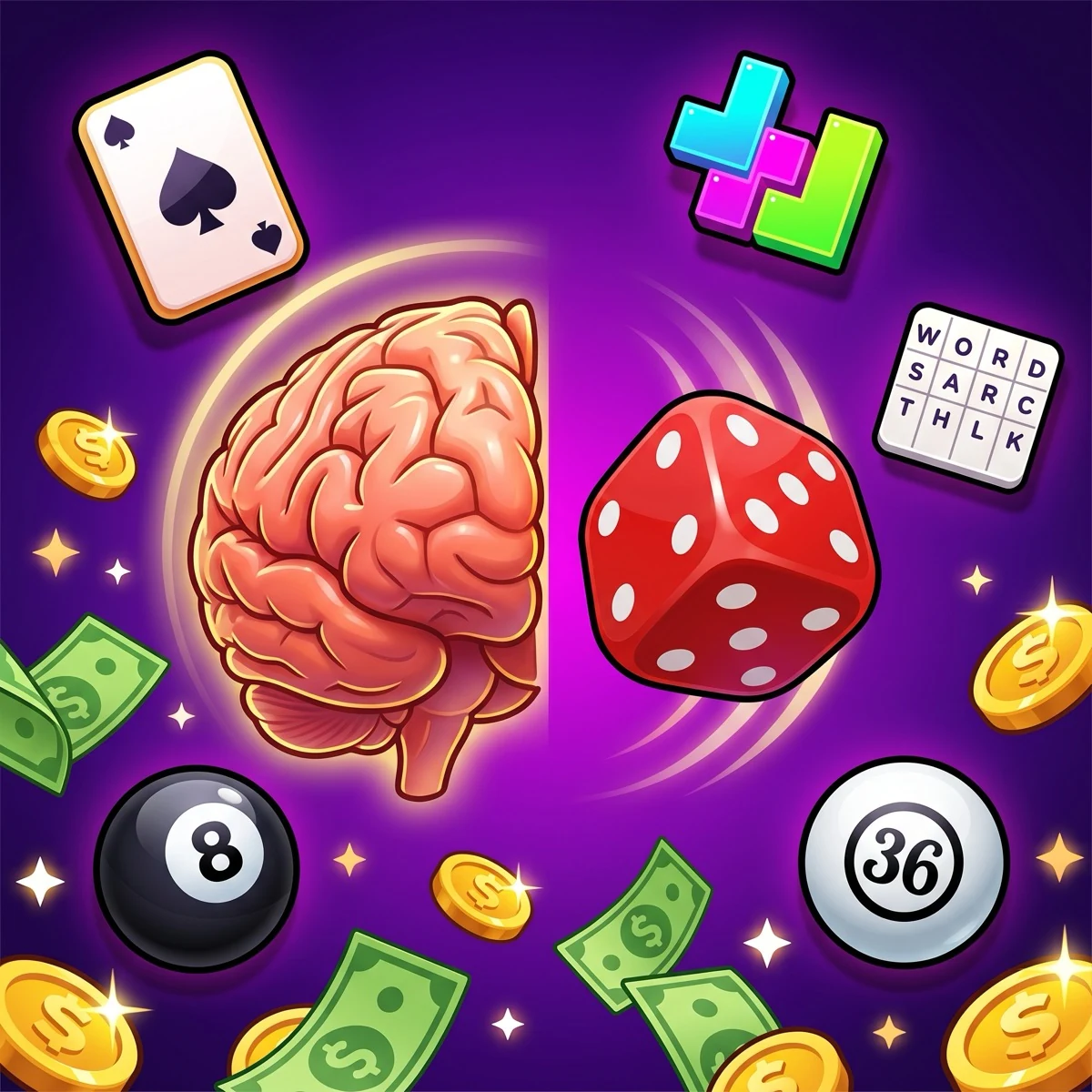
Skill games span five broad categories: card games, puzzle games, word games, arcade and sports games, and bingo-style speed games. Each rewards a different mix of memory, pattern recognition, reflexes, and strategy. Older cohorts are actually the heaviest skill-game players — boomers (61–79) and the Silent Generation (80–90) prefer puzzle (73%) and skill-and-chance (55%) games more than any other format (ESA 2025 Essential Facts). The category is bigger than the "Gen Z mobile money" framing suggests.

1. Card games
Solitaire, gin rummy, spades, blackjack-style speed formats. Skill comes from card-counting, hand evaluation, and bidding logic. The genre fits tournaments naturally because both players see the same deal in head-to-head modes. Examples on Atay: Solitaire, Gin Rummy.
2. Puzzle games
Block puzzles, match-3, and grid-based logic challenges. Skill comes from pattern recognition, multi-step planning, and combo timing. Two players on the identical piece queue running the same clock is structurally fair. Examples on Atay: Block Puzzle, Sugar Cash.
3. Word games
Word search, crosswords, anagram games. Skill comes from vocabulary breadth, pattern recognition under time pressure, and tap-speed efficiency. Examples on Atay: Word Search, Crossword, Word Money.
4. Arcade and sports skill games
Bubble shooters, bowling, pool, carrom. Skill comes from aim, angle calculation, and reflex consistency. Modern cash-tournament implementations use identical-physics boards to eliminate RNG advantage. Examples on Atay: Bubble Prizes, Carrom, Ball Pool.
5. Bingo-style speed games
The hybrid category. Bingo balls draw at random, but in a head-to-head cash tournament both players receive the same draws — so the only variable is how fast you spot and daub the patterns. Skill predominates because reaction speed and pattern recognition decide the result. Example on Atay: Bingo Prizes.
What ties all five together is the tournament shape: identical conditions for both players, with the prize pool determined by entry fees and the operator's rake. On Atay, rank-based matchmaking means new players are not matched against high-ranked players for cash — which is what "skill predominates" looks like in operation, not just on paper. Browse all Atay skill games →
Skill games break into five categories — card, puzzle, word, arcade and sports, and bingo-style speed games. Each rewards a different ability profile, but all five use identical-board (or shared-clock) tournament mechanics for cash play. ESA 2025 data shows boomers and the Silent Generation prefer puzzle (73%) and skill-and-chance (55%) games — the demographic is broader than the mobile-cash framing suggests. (ESA 2025 Essential Facts)
How Big Is the Skill Gaming Market?
The global skill gaming market was valued at $46.39 billion in 2025 and is projected to reach $52.71 billion in 2026, then $121.57 billion by 2034, growing at an 11% CAGR (Fortune Business Insights, 2025). A separate Grand View Research forecast puts 2024 at $40.85B and projects $92.03B by 2030 at a 14.2% CAGR. The numbers don't match exactly — and that's worth understanding, which is exactly what our breakdown of how big the skill gaming market is explains. For the full picture — market size, player demographics, retention, and revenue — see our skill-based mobile gaming statistics hub.
Global Skill Gaming Market Size — 2024 to 2030 (USD Billions)
Sources: Fortune Business Insights, Skill Gaming Market, 2025 (2024–2026 figures); Grand View Research, Skill Gaming Market Report, 2024 (2030 projection).
Why the estimates disagree
Different analysts use different definitions. Some count only real-money tournament platforms; others include free-to-play games with optional skill challenges, eSports prize pools, or fantasy sports. Region coverage and currency baselines also differ. The honest take: every major forecaster shows double-digit annual growth, and the headline number for 2025 is in the mid-$40-billion range — choose the figure whose definition matches your question.
Why the category keeps growing
Mobile reach is the main driver — every skill game category has a strong mobile-native implementation, and smartphone adoption keeps expanding the addressable audience. Legal certainty matters too: as more states settle the skill-vs-chance question through the predominance test, operators can offer cash tournaments confidently in more places. And the demographic tailwind from the ESA 2025 data — older adults playing more skill games to stay sharp — is a structural growth source that competitive online slots simply don't have.
The global skill gaming market reached $46.39 billion in 2025 and is projected at $52.71 billion in 2026, growing to $121.57 billion by 2034 at an 11% CAGR. Forecaster estimates vary because definitions vary — some count only cash tournament platforms, others include eSports and skill-based free-to-play — but every major analyst shows double-digit annual growth. (Fortune Business Insights, 2025)
Are Skill Games Legal in the US?
Skill games are not prohibited at the federal level and are permitted in most US states under the predominance test. But the picture is fluid — Virginia's Governor Spanberger vetoed legislation to legalize electronic skill gaming devices in April 2026 after the state Supreme Court reinstated the ban (Office of the Governor of Virginia, April 2026). Kentucky's ban was also recently upheld in court. Pennsylvania moved the other way in June 2026: its Supreme Court held that physical skill game machines are slot machines, and the devices must be out of businesses by October 13, 2026 — we set out what Pennsylvania's 2026 skill games ruling covers, and what it does not. Texas and most other states continue to allow skill games (Walters Law Group, 2026).
Where skill games are clearly permitted
The majority of US states. The predominance-test states classify skill games outside gambling statutes, which is why apps like Solitaire Cash, Word Search Cash, Bubble Prizes, and Skillz-powered tournaments can legally pay real winnings to players in those states. Eligibility is enforced at sign-up — apps geofence based on registered state.
Where skill games are restricted or banned
The active watch list includes Virginia and Kentucky, both of which have recent court or executive actions restricting electronic skill gaming. A handful of other states impose narrower restrictions on specific game formats — daily fantasy sports legality, for example, has been litigated separately and varies independently. Always check current state law before depositing.
Why state status changes
Three forces move the line: court rulings (a state supreme court can reinterpret an existing statute), new legislation (lawmakers can explicitly legalize or ban a category), and gubernatorial action (vetoes and signings, as with Spanberger's April 2026 veto). The category is more legally stable than online casino gambling, but it isn't static — recent activity is what determines today's status, not what was true two years ago.
For state-by-state detail that we keep updated as laws change, see our state-by-state legality guide.
Skill games are not prohibited at the federal level and are permitted in most US states under the predominance test. Virginia reinstated its ban after a state Supreme Court ruling, and Governor Spanberger vetoed legalization legislation in April 2026. Kentucky's ban was also upheld in court. Pennsylvania's Supreme Court ruled in June 2026 that physical skill game machines are slot machines, with removal required by October 13, 2026. Texas and most other states currently permit skill-based games, but state law changes — check current status before depositing. (Office of the Governor of Virginia, April 2026; Walters Law Group, 2026)
Can You Win Real Money Playing Skill Games?
Yes. Many skill game platforms pay real cash prizes to tournament winners. Players deposit a small entry fee, compete head-to-head or in tournament pools, and the platform takes a 5–20% rake on each pool. Skillz Inc. — the publicly traded operator behind many Atay titles — posted $95.5 million in 2024 revenue with 816,000 monthly active users (Skillz Inc. 2024 Annual Report, February 2025). AviaGames (Pocket7Games) reports running approximately 100 million tournaments per month. This is a real category with real cash flows, not a marketing fiction.
How a cash skill tournament actually works
You enter a tournament by paying a fee — often $0.60, $1, $2, or more depending on the stake level. Your fee plus every opponent's fee forms a prize pool. The platform takes a rake (typically 5–20% of the pool) and the remainder is paid to the top finishers based on the published payout table. You play the same board, the same time window, and the same rules as your opponent. Whoever scores higher wins more of the pool.
Free play vs. cash mode — the on-ramp
Every legitimate platform offers a free-play mode (sometimes called "practice tournaments" or "Z-credit" matches on Skillz-powered apps). You can learn the scoring, the power-ups, and the matchmaking with zero deposit, then opt into cash tournaments only when you're ready. This is the right way to start — don't deposit real money on a game you haven't practiced.
Realistic earnings expectations
Earnings are modest for most players. NerdWallet (2025) measured typical hourly equivalents at $0.10–$0.80, and casual players who play across multiple apps tend to net $50–$200 per month. Top competitors in high-stakes tournaments can earn substantially more, but that's the long tail. Treat cash skill games as skilled entertainment with a modest payout, not a side income source. For honest numbers, see our detailed skill game earnings breakdown, or browse the best real cash skill game apps in 2026 if you're ready to pick a category to play.
Licensed skill game platforms pay real cash prizes to tournament winners. Skillz posted $95.5 million in 2024 revenue with 816,000 monthly active users, and AviaGames reports about 100 million tournaments per month. Players deposit, compete on identical conditions, and the platform takes a 5–20% rake. Earnings are modest for most casual players ($0.10–$0.80/hour equivalent per NerdWallet 2025) — treat cash skill games as skilled entertainment, not income. (Skillz Inc. 2024 Annual Report, February 2025)
Frequently Asked Questions
What is a skill game?
A skill game is a competition where the outcome is determined primarily by player ability — strategy, knowledge, reaction time, or pattern recognition — rather than random chance. Over enough plays, skilled players consistently outperform less skilled ones. This statistical reliability is what separates skill games from gambling (Klein Moynihan Turco, 2024).
What is the difference between a skill game and a game of chance?
The defining difference is which factor predominantly drives the outcome. Skill games reward learned ability — better players win more over time. Games of chance, like slots or the lottery, deliver random results no matter how experienced the player is. US courts apply the predominance test to make this distinction.
Are skill games considered gambling?
In most US states, no. Under the predominance test used by the majority of states, an activity where skill is the dominant factor falls outside gambling statutes. A minority of states apply a stricter material-element or any-chance test, which can classify the same game as gambling. State law determines the answer locally — see our state-by-state breakdown for current status.
What are some examples of skill games?
Common examples include solitaire, gin rummy, block puzzles, match-3 games, word search, crosswords, bubble shooters, bowling, pool, and bingo. Atay Games operates real-money tournaments in all of these categories. ESA 2025 data shows puzzle (73%) and skill-and-chance (55%) formats are the most-played categories among boomers and the Silent Generation.
Can you make real money playing skill games?
Yes — licensed skill game platforms pay real cash prizes to tournament winners. The skill gaming market was worth $46.39 billion in 2025 (Fortune Business Insights, 2025). Earnings vary widely by skill level — most casual players earn modest amounts, while top competitors can win meaningful sums in higher-stakes tournaments. For honest numbers, see our earnings breakdown.
The Bottom Line on Skill Games
A skill game is a competition where ability — not luck — decides the winner, verified by the legal predominance test US courts apply. The category powers a $46.39 billion global market in 2025 (Fortune Business Insights), spans five clear types from card to bingo, and pays real cash on licensed platforms in most US states. The fluid pieces are state legality (Virginia and Kentucky are the current watch list) and realistic earnings expectations (modest for most casual players).
Three things to carry forward:
- The test is statistical, not a legal abstraction. If skilled players reliably win more over enough plays, it's a skill game. If they don't, it's a game of chance. That's it.
- Pick a category that matches how you think. Pattern-spotter? Word search, bubble shooter. Multi-step planner? Block puzzle, solitaire. Reflex-and-reaction type? Carrom, ball pool. Each category rewards a different cognitive strength.
- Start free, then play for cash if you want. Every Atay title — and every Skillz-powered game — has practice mode. Learn the scoring, the power-ups, and the matchmaking before depositing. Cash mode is an option, not a requirement.
Ready to try one? Browse all Atay skill games →
Sources
- Fortune Business Insights, Skill Gaming Market Size, Share & Industry Analysis, 2034, 2025, retrieved 2026-06-03, fortunebusinessinsights.com
- Grand View Research, Skill Gaming Market Size And Share Industry Report, 2030, 2024, retrieved 2026-06-03, grandviewresearch.com
- Entertainment Software Association, 2025 Essential Facts About the U.S. Video Game Industry, 2025, retrieved 2026-06-03, theesa.com
- Klein Moynihan Turco LLP, Games of Skill v. Games of Chance — The Legal Analysis, 2024, retrieved 2026-06-03, kleinmoynihan.com
- Office of the Governor of Virginia, Governor Spanberger Vetoes Bill to Legalize Skill Games, April 2026, retrieved 2026-06-03, governor.virginia.gov
- Walters Law Group, Which States Allow Skill Gaming?, 2026, retrieved 2026-06-03, firstamendment.com
- Skillz Inc., 2024 Annual Report — full-year results, February 2025, retrieved 2026-06-03, investors.skillz.com
- NerdWallet, Game Apps That Pay Real Money — Are They Legit?, 2025, retrieved 2026-06-03, nerdwallet.com
- Atay Games internal operational notes on rank-based matchmaking, compiled June 2026 (first-party operational data).
Legal and financial disclaimer. This article is for general informational purposes only and does not constitute legal or financial advice. Skill gaming laws vary by state and change over time — verify the current status in your state before depositing. Market figures are forecaster estimates; methodology and definitions differ between research firms. Individual earnings vary widely by skill level, practice consistency, tournament selection, and stake amounts. Never deposit money into a gaming platform that you cannot afford to lose. Responsible play resources: National Council on Problem Gambling at ncpgambling.org or 1-800-522-4700.
Try a Skill Game on Atay
Free practice tournaments. Real-cash matches available where legal. Verified human opponents — never bots. Withdrawals to PayPal, Visa, or Apple Pay.
Browse All Atay Skill Games