The short answer is yes, in most US states. Skill-based cash gaming is legal across the majority of the country because it passes the "predominance of skill" test that courts and regulators apply to distinguish games of skill from gambling. The global skill gaming market was valued at $46.39 billion in 2025 and is projected to reach $121.57 billion by 2034 (Fortune Business Insights). That growth depends on a legal foundation that is more solid than most players realize. Here is the plain-English breakdown of how it works and what it means for you.
- Cash play in 45 states. Skillz, operated by Firy Inc. (NYSE: FIRY), lists five US states with no cash matches as of September 2026: Arkansas, Connecticut, Delaware, Louisiana, and South Dakota. Indiana and Maine switch off cash play only in card games.
- The three-element test matters. US law treats a game as gambling only when it combines prize, consideration, and chance. Skill games remove "chance" from that equation.
- Shared conditions, skill-first design. Skillz gives developers tools to give both players in a match the same random setup (board, deal or puzzle), so neither starts luckier. Luck isn't gone, but skill is meant to decide most results.
- No bots, ever. Every opponent on Atay Games is a real human player, which is what makes the skill test meaningful.
- The platform checks automatically. Skillz reads your device location at login and disables cash options if you're in a restricted state. You don't need to look anything up. (Skillz Legal Docs)
What Makes a Game "Skill-Based" Under US Law?
Under US law, a game is considered gambling only when all three of these elements are present: prize, consideration (an entry fee or wager), and chance as the dominant factor in the outcome. Skill-based games satisfy the first two but eliminate the third. Most states use the "predominance test," asking whether skill or chance is the primary driver of results. The skill gaming market's projected growth to $121.57 billion by 2034 (Fortune Business Insights) reflects how many regulators and courts have accepted this framework.
The predominance test works differently from the "any chance" standard. Under an "any chance" rule, even chess could be called gambling because the first player has a statistical edge. The predominance test asks a more practical question: does a skilled player consistently outperform an unskilled one over time? If yes, the game is classified as skill-based, not gambling. For the full conceptual contrast — rake vs. house edge, RNG, and risk — see our guide on the difference between skill games and online gambling.
Courts have applied this logic to card games, puzzle games, and sports simulations for decades. The legal category is well established, not new or experimental.
Under the predominance test applied by most US states, a game escapes gambling classification when player skill is the primary factor determining outcomes over a meaningful sample of play. The US skill gaming market, valued at $46.39 billion in 2025 and forecast to reach $121.57 billion by 2034, has grown directly because this legal standard is recognized across the majority of states. (Fortune Business Insights, 2025)
How Do States Decide Whether a Game Is Skill or Chance?
There is no single national test. Each state applies its own gambling laws, and courts have used different yardsticks to decide how much chance is too much. Three come up most often:
- Dominant factor (predominance) test. Asks whether skill or chance mostly decides the result over many plays. Skillz's help center calls it the most commonly used test.
- Material element test. Asks whether chance plays a material role in the result, even when skill matters more. Skillz's help center says 8 states rely on it. A game can pass the dominant factor test and still fail this one.
- Any chance test. The strictest approach: if chance affects the outcome at all, a paid contest with a prize can be treated as gambling.
Which test applies, and how strictly, depends on the state and sometimes on the type of game. That is one reason a platform can offer cash play in one state, switch it off next door, or allow some games but not others, as Skillz does with card games in Indiana and Maine. The Skillz help center describes the first two tests. This is a general summary, not legal advice.
How Is Atay Games Structured for Legal Compliance?
Atay Games is built on the Skillz platform, whose legal and compliance team has actively maintained documentation and worked through state-by-state compliance since 2012. Entry fees on Atay Games are tournament participation fees, not wagers. That distinction matters legally: you are paying to compete, not betting on an uncertain outcome controlled by a random mechanism.
The design that supports the skill argument is the shared-setup format. Skillz's developer tools let a game give every player in the same match the same board layout, card arrangement or puzzle configuration, so neither player starts with a luckier draw. Luck doesn't disappear, since the setup itself is still random, but both players face the same luck, and the result mostly comes down to speed, accuracy, strategy and decision quality.
There are no bots or AI opponents on the platform. Every match is against a real human player. That is not just a user-experience choice. It is what makes the skill claim meaningful: you are not beating a fixed algorithm, you are outperforming another person in the same conditions.
Skill vs. Chance: The Legal Test Spectrum
Illustrative framework based on the predominance-of-skill test applied by US state courts and regulators.
Where Is Cash Play Available, and Where Isn't It?
Cash play is not available in every state, and we won't pretend otherwise. As of September 2026, the Skillz help center lists five US states where cash matches are not available: Arkansas, Connecticut, Delaware, Louisiana, and South Dakota. In Indiana and Maine, cash matches are off in card-based games but on in all other games; for Atay Games, that means Solitaire Real Cash and Gin Rummy Cash are free play only there. In New Jersey, only domino-based games lose cash play, and Atay Games has no domino game. These restrictions reflect Skillz's reading of each state's rules, not a judgment about those states' players. For the wider context, including market size, who plays, and platform revenue, see our skill-based mobile gaming statistics hub.
Outside those five, Skillz offers cash play in the remaining 45 states, which is why you'll see the claim that skill gaming is available "in most of the US." Individual games can still switch cash play off in more states, because each game's App Store listing can print its own list: our Ball Pool Cash listing, for example, also names Arizona, Montana, South Carolina, and Tennessee. Free-to-play modes are available everywhere, without restriction, regardless of your location.
Correction, September 24, 2026: an earlier version of this guide listed 12 restricted states. Skillz's help center lists cash play as available in Arizona, Iowa, Montana, South Carolina, and Tennessee, and in Indiana and Maine for every game except card games.
The state list isn't permanent. Regulatory postures shift. Several states that previously restricted skill gaming have updated their frameworks as the distinction between skill and chance has become better established in case law. The platform list reflects current status; it's worth rechecking periodically if you're in a state on that list.
Cash Skill Gaming Availability: US States at a Glance (2026)
Based on the Skillz help center's US eligibility list, checked September 24, 2026. Source: Skillz Help Center
As of September 2026, the Skillz help center lists five US states with no cash matches: Arkansas, Connecticut, Delaware, Louisiana, and South Dakota. Indiana and Maine have no cash matches in card-based games, and New Jersey has none in domino-based games. Cash play is available at the platform level in the other 45 states, though individual games can switch it off in more. Free-to-play modes carry no geographic restriction. (Skillz Help Center, support.skillz.com)
Check Cash Play Status by State
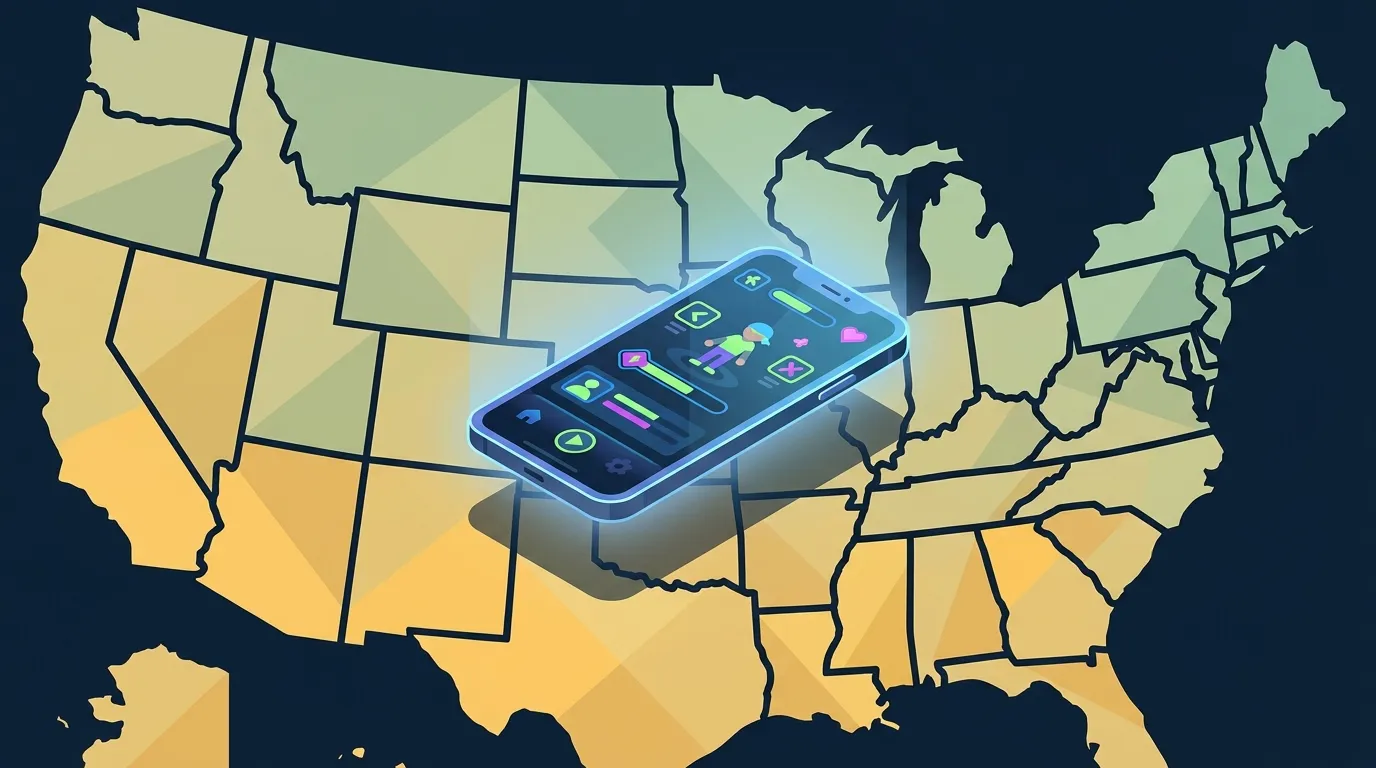
Select your state for its current cash-play status, which Atay games offer cash there, how prizes are taxed, and nearby states. Red marks the five states with no cash play; amber marks Indiana and Maine, where card games have no cash play.
Pennsylvania, June 2026: the state Supreme Court ruled that physical skill game machines in bars and stores are slot machines, and they must be removed by October 13, 2026. That case was about hardware, not apps. We break down what the Pennsylvania ruling covers, what it does not, and where the October 13 deadline stands. As of September 26, 2026, that date had not moved.
App-store age checks, 2026 to 2027: Texas now makes app stores verify the age of new accounts, and Alabama and California follow on January 1, 2027. These laws change how you sign up, not where cash play is allowed. See our app-store age verification tracker.
Sweepstakes casinos, 2025 to 2026: a separate wave of state statutes has targeted dual-currency sweepstakes casinos, which are a different product from skill tournaments. See which states have acted, and why, including Oklahoma's law on online casino games, which takes effect November 1, 2026.
● cash play available · ● no cash play in card games · ● no cash play (free play only). Status per the Skillz help center, checked September 24, 2026.
What Does the "Predominance of Skill" Test Actually Mean for Players?
The predominance of skill test is the legal standard most states apply, and it translates directly into how Atay Games is designed. The core question regulators ask is simple: over a meaningful number of matches, does a skilled player consistently beat an unskilled one? If yes, skill predominates. If results are essentially random across players, chance predominates. For a worked example with a real card game, see is gin rummy a game of skill or luck?
For Atay Games, the case for skill rests on shared conditions. Skillz's tools let every player in a match start from the same random setup, so the luck of the draw falls on both players equally. Luck still exists within a deal, but speed, accuracy and strategic decisions are what separate winners over many matches.
Players who compete consistently on the platform show win-rate variance that clusters around individual skill levels rather than random distributions. That is the observable footprint of a skill-dominant game: results improve with practice, stabilize with experience, and degrade with distraction or fatigue. Random outcomes don't do that.
How Does Skillz Handle Jurisdiction Compliance Automatically?
The Skillz platform has maintained legal and compliance infrastructure since its founding in 2012, and the Skillz legal documentation covers this in detail. The compliance mechanism for players is automatic and passive: you don't need to know the law of every state, because the platform handles it for you at the device level.
Here is how it works in practice. When you open the app, Skillz reads your device's location. If that location falls within a restricted jurisdiction, cash entry options are automatically hidden or disabled. You will not see a cash tournament entry button if cash play is unavailable where you are. Free-to-play modes remain active regardless. If you travel to a different state, the platform re-checks on your next session and adjusts accordingly.
This is not a workaround or a gray area. It's how the platform was designed to operate: compliance built into the architecture, not enforced after the fact.
The Skillz platform automatically detects device location at login and disables cash entry options for players in restricted jurisdictions. No manual check is needed. This jurisdiction-aware compliance system has been part of Skillz's infrastructure since 2012, per the platform's published legal documentation at docs.skillz.com/docs/legal-skillz/.
Common Questions About Skill Gaming Legality
Is it gambling?
Under most US state laws, no. The classic definition of gambling requires prize, consideration, and chance working together. Skill gaming satisfies the first two but removes the dominant role of chance. Courts in the majority of states have held that games where skill is the primary factor fall outside gambling statutes. The federal UIGEA (Unlawful Internet Gambling Enforcement Act) explicitly carves out an exemption for games in which outcomes "reflect the relative knowledge and skill of the participants."
Do I need a license to play?
No. Players do not need any license or registration beyond the standard app account. Licensing obligations, where they exist, fall on operators and platforms, not individual players. If the platform is compliant in your state, you can play without any additional steps.
What about federal law?
Federal law does not broadly prohibit skill gaming. The Wire Act, which some players have heard about, covers sports betting, not skill games. The UIGEA, passed in 2006, defines a bet as staking something of value on a contest of others, a sporting event or "a game subject to chance," and it says it doesn't alter any state gambling law. Its best-known carve-out, for contests whose outcomes reflect "the relative knowledge and skill of the participants," was written for fantasy sports. Games where skill dominates generally fall outside the federal definition, which is why state law, not the UIGEA, decides where you can play. The global skill gaming market is projected to reach $121.57 billion by 2034 (Fortune Business Insights).
Frequently Asked Questions
Is playing cash games on Atay Games legal?
Yes, in the majority of US states. Skill-based cash gaming is legal where the outcome is predominantly determined by player skill rather than chance. Atay Games is built on the Skillz platform, which has maintained legal compliance documentation since 2012. Cash play is automatically disabled in the five states where Skillz does not offer it (Arkansas, Connecticut, Delaware, Louisiana, and South Dakota), and in card games in Indiana and Maine.
How do I know if cash play is available in my state?
You don't need to check manually. The Skillz platform reads your device's location at login and automatically disables cash entry options if you are in a restricted jurisdiction. If cash play options are visible in the app, they are available where you are. Free-to-play modes are always available everywhere.
Is skill-based gaming considered gambling?
Not under most US state laws, and federal law doesn't ban skill games outright. Gambling generally needs three elements: prize, consideration and chance. In a skill game, player ability is meant to be the dominant factor, which is why most states treat it differently, though each state applies its own test. The federal UIGEA defines a bet around games "subject to chance" and says it doesn't change any state law.
What happens if I'm in a restricted state?
The Skillz platform automatically detects your location and hides or disables cash entry options. You can still play all games for free with no restrictions. No action is needed on your part. If you travel to a state where cash play is permitted, cash options become available again automatically on your next session.
Legal disclaimer. This article is provided for general informational purposes only and does not constitute legal advice. Skill gaming laws vary by jurisdiction and change over time. The state list in this article reflects the Skillz help center as of September 24, 2026 and may not be exhaustive. If you have specific legal questions about your situation, consult a qualified attorney. Real-money play is not available in every jurisdiction. Never wager funds you cannot afford to lose, and use the responsible play tools available in-app.
Ready to Play Where Skill Wins?
Browse the games on Atay Games, where you're matched against real players.
Explore Our Games