The difference between a skill game and online gambling comes down to one question: what decides who wins? In a skill game, your ability does — better players reliably win more over time. In online gambling, a random number generator does, and the house holds a fixed mathematical edge no skill can overcome. I run player trust at Atay Games, and this is the question players ask me most. Below is the honest breakdown — the legal test, the money, the RNG, the regulation, and the risk — so you can tell exactly which one you're looking at.
- The dividing line is the outcome. Skill games are decided by ability; gambling is decided by chance. US law draws the same line with the predominance test, used by more than 30 states, which asks whether skill provides over 50% of the result (Lexology, 2024).
- The money proves it. In a skill game you compete against other players for a prize pool and the platform takes a rake. In gambling you bet against the house, which keeps a fixed house edge — a 96% RTP slot keeps about 4% of all wagers long-term (Techopedia, 2025).
- RNG decides gambling, not skill games. A random number generator picks every spin and card in gambling, independent of the player (BetMGM, 2025). Reputable skill games never let an RNG pick the winner.
- The risk profile differs — but isn't zero. In 2024, about 8% of US adults showed at least one problem-gambling indicator, rising to 19% among online gamblers (NCPG NGAGE 3.0, 2024). Skill games lack the continuous RNG loss loop, but responsible limits still matter.
What's the Core Difference Between Skill Games and Gambling?
The core difference is what determines the outcome. In a skill game, the result is decided primarily by player ability — strategy, reflexes, knowledge, or pattern recognition — so skilled players reliably win more over time. In online gambling, outcomes are decided by chance, typically a random number generator, and no amount of skill changes the long-run result. This isn't a marketing distinction; it's the exact line US courts use to classify the two, with more than 30 states applying it (Lexology, 2024).
The one-sentence rule of thumb
Ask yourself: does practice make you win more? Play chess, solitaire, or a head-to-head bubble shooter a hundred times and the better player wins the vast majority. Pull a slot lever a hundred times and practice changes nothing — the machine doesn't care how long you've played. That's the whole test in plain English. If skill compounds, it's a skill game. If it doesn't, it's gambling.
Why "real money is involved" doesn't make it gambling
This trips up almost everyone. Paying an entry fee to compete for a cash prize is not, by itself, gambling — otherwise poker tournaments, golf skins, and chess prize pools would all be illegal. What matters legally is whether chance drives the payout. A $5 entry to a word-search tournament where the fastest accurate solver wins is structurally closer to a 5K race with a registration fee than to a roulette spin.
Where each sits on the spectrum
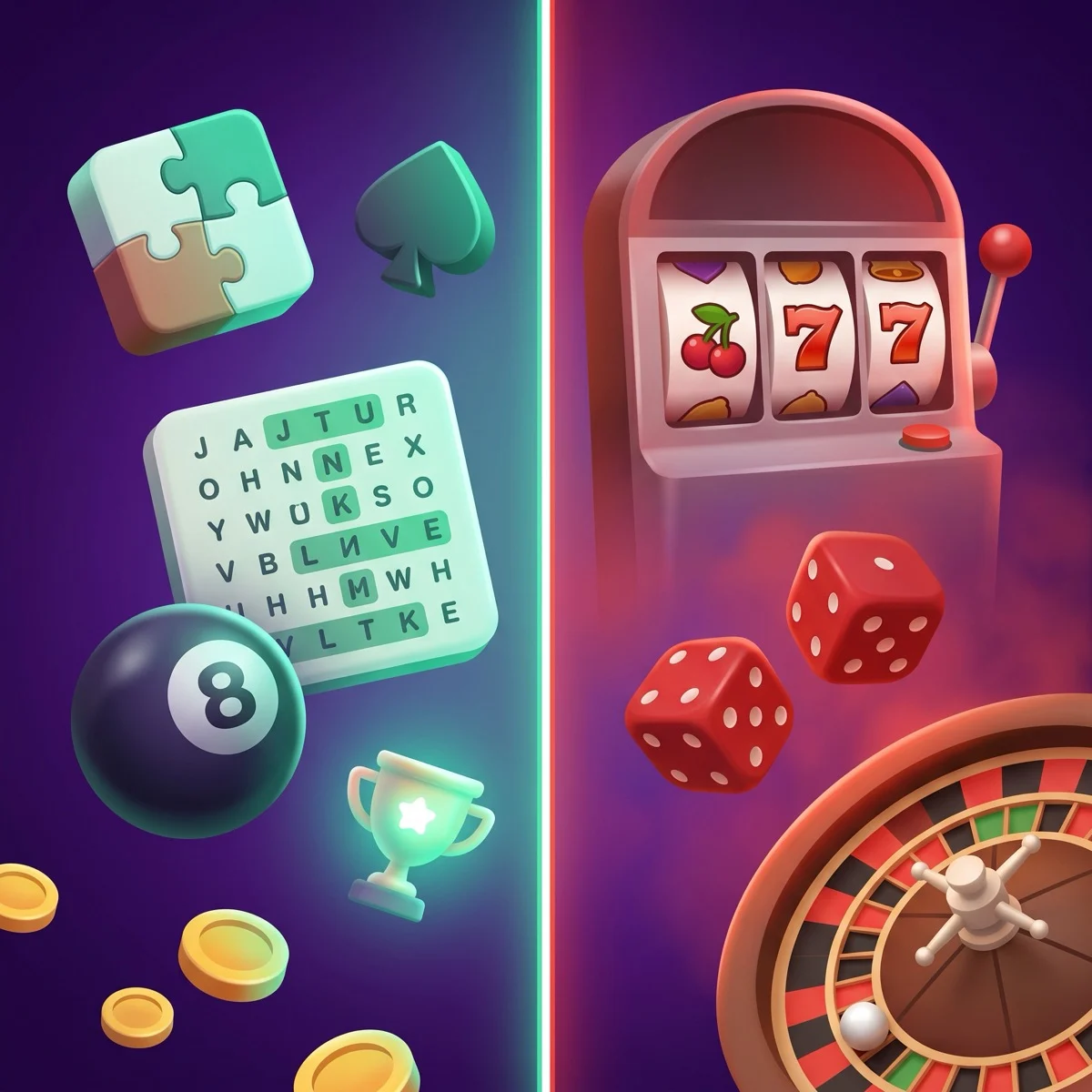
Picture a line: pure skill on one end (chess), pure chance on the other (the lottery). Online casino games — slots, roulette, baccarat — sit hard on the chance end. Real-money skill games sit far on the skill side. For a fuller definition of the category itself, see our plain-English guide to what skill games are. This article stays focused on the head-to-head: how they differ from gambling specifically.
The core difference between skill games and online gambling is what determines the outcome. Skill games are decided primarily by player ability, so skilled players reliably win more over time. Gambling outcomes are decided by chance — typically a random number generator — and no amount of skill changes the long-run result. More than 30 US states use this distinction as the legal test. (Lexology, 2024)
The Legal Test: How Courts Tell Them Apart
US law separates skill games from gambling using the predominance test, applied by more than 30 states including California, Illinois, Michigan and Ohio. It asks whether skill provides more than 50% of the reason for the outcome; if so, the activity is a game of skill and falls outside most gambling statutes (Lexology, 2024). A minority of states use the stricter material-element test or the any-chance test, which can classify the same game differently. A state can also write its own definition that overrides the test entirely, which is what happened in Pennsylvania's 2026 skill games ruling. States have done the same to dual-currency sweepstakes casinos, which we track in the 2026 sweepstakes crackdown map, along with how the two differ for your money. For how the test plays out in a real card game, see is gin rummy a game of skill or luck?, and for a game the law defines as chance, is bingo a game of skill or luck?
Skill Game vs. Online Gambling — How They Differ
Source: Lexology / Klein Moynihan Turco, Games of Skill v. Games of Chance, 2024.
The three legal elements of gambling
Courts define gambling by three ingredients: consideration (you pay to play), chance (a random factor decides the result), and a prize (you can win something of value). Remove any one and it isn't gambling (Klein Moynihan Turco, 2024). Skill games keep consideration and a prize but break the chance leg — the outcome turns on ability. That single missing ingredient is the whole legal story.
Why the same game can be legal in one state and not another
Because states don't all use the same test. The predominance-test majority asks only whether skill is the bigger factor. The any-chance minority treats any randomness as disqualifying. So a format that's a legal skill game in Ohio can be treated differently in a stricter state. The category is more legally settled than online casino gambling, but it isn't uniform — and it moves. Virginia's governor vetoed legislation to legalize electronic skill gaming devices in April 2026 (Office of the Governor of Virginia, April 2026). For current status where you live, see our state-by-state legality guide.
US law separates skill games from gambling with the predominance test, used by more than 30 states, which asks whether skill provides over 50% of the outcome. Gambling itself requires three elements — consideration, chance, and a prize. Skill games keep the payment and the prize but break the chance element, which is why they fall outside most gambling statutes. (Lexology / Klein Moynihan Turco, 2024)
How Does the Money Work: Rake vs. House Edge?
The money mechanics expose the difference most clearly. In a skill game, you compete against other players for their entry fees, and the platform takes a rake — a flat percentage (often 10–20%) of the prize pool — regardless of who wins. In online gambling, you play against the house, which holds a fixed mathematical house edge: a 96% return-to-player slot keeps about 4% of all wagers long-term, no matter how you play (Techopedia, 2025). One is a competition with a fee; the other is a bet against built-in odds.
Skill game (rake). You and one opponent each pay $1 to enter a head-to-head match. The pool is $2. The platform keeps a ~10% rake ($0.20) and the winner takes ~$1.80. You're competing for your opponent's dollar — the platform is the referee, not your opponent. Play better and your share of those pools grows.
Slot machine (house edge). You wager $1 against the house on a 96% RTP slot. Over thousands of spins the machine returns about $0.96 per $1 and keeps $0.04 — every time, forever. The house is your opponent, and the math guarantees it wins. No amount of skill moves that 4%.
Why skilled play can be profitable in skill games but never beats the house
In a rake model, the only edge that matters is how you compare to other players. Beat them often enough to overcome the rake, and you come out ahead — that's why pros exist in poker, chess, and competitive solitaire. In a house-edge model there are no other players to outclass; you're playing the math itself, and the math is fixed against you. That's the cleanest reason skill games aren't gambling: in one, effort changes your expected result; in the other, it can't. For how entry fees and pools are structured in practice, see our breakdown of free cash games vs. paid-entry tournaments.
In a skill game, players compete against each other for a prize pool and the platform takes a flat rake — often 10–20% — regardless of who wins. In online gambling, players bet against the house, which holds a fixed house edge; a 96% RTP slot keeps about 4% of all wagers long-term no matter how you play. One is a referee's fee; the other is the house always winning. (Techopedia, 2025)
Does It Use RNG? Randomness vs. Reliable Outcomes
Online gambling depends on a random number generator (RNG) to decide every spin, card, or roll — outcomes are designed to be unpredictable and independent of player skill (BetMGM, 2025). Legitimate skill games do not let an RNG decide who wins; the result comes from how well each human player performs. Some skill games randomize the starting board — the same piece sequence or letter grid for both opponents — but the winner is still decided by skill, not chance.

What RNG does in gambling
In a slot or online roulette game, the RNG generates the result the instant you commit — the reels or the wheel are just animation over a number that's already chosen. You cannot read it, time it, or influence it. That's the point: regulators require gambling RNGs to be unpredictable so the advertised odds hold. Skill is irrelevant by design.
How skill games use shared randomness for fairness, not to pick winners
Here's the nuance most explainers miss. A block-puzzle tournament might generate a random piece queue — but it gives both players the identical queue, so the randomness cancels out and the better player still wins. The seed creates a level field; it doesn't decide the result. That's the opposite of gambling, where randomness is the result.
The fairness question: humans, not bots
A fair skill game also has to guarantee you're playing real people, not house-controlled bots. That's an integrity issue the industry has had to confront directly — see our look at the AviaGames lawsuit and bot controversies. On Atay, head-to-head matches are decided between two rank-matched humans — there is no RNG choosing the winner and the platform is never the counterparty. You can read how we enforce that in how Atay ensures fair play and why we use verified human opponents, never bots.
Online gambling depends on a random number generator to decide every spin, card, or roll, independent of player skill. Legitimate skill games never let an RNG pick the winner — they may seed an identical starting board for both opponents so the randomness cancels out, but the outcome turns on how well each human performs. In gambling, randomness is the result; in skill games, it's only the setup. (BetMGM, 2025)
Regulation: Who Oversees Each?
Online gambling is regulated as gambling — licensed and overseen by state gaming commissions, confined to states that have legalized it, with mandated age verification, geofencing, and responsible-gaming controls. Skill games are generally not regulated as gambling because skill predominates (Lexology, 2024), but reputable platforms still apply many of the same safeguards voluntarily. The oversight model is the practical, day-to-day difference players actually feel.
How online gambling is licensed
A legal online casino or sportsbook holds a license from a state regulator — the New Jersey Division of Gaming Enforcement, the Pennsylvania Gaming Control Board, and so on. That license dictates payout audits, RNG certification, advertising limits, and self-exclusion programs. Cross a state line and the same app often goes dark, because the license is state-bound.
Why skill games fall outside gambling regulators
If skill predominates, the activity isn't gambling, so gambling commissions generally don't license it. That doesn't mean "no rules" — consumer-protection, payments, and advertising laws still apply. It means the category isn't gated behind a state gambling license, which is why a skill app can operate in far more states than a licensed casino.
What responsible skill platforms do anyway
The reputable operators don't treat the lighter regulatory load as license to cut corners. They run identity and age verification, geofence the states where skill gaming is restricted, and enforce withdrawal compliance. If you're weighing whether a given platform is trustworthy, our guide on whether real cash skill games are legit walks through exactly what to check.
Online gambling is regulated as gambling — licensed by state gaming commissions, confined to legalized states, with mandated age checks, geofencing, and responsible-gaming controls. Skill games generally fall outside gambling regulators because skill predominates, but reputable platforms still apply age verification, identity checks, and restricted-state geofencing voluntarily. The oversight model is the difference players feel day to day. (Lexology, 2024)
Risk Profile: Are Skill Games Safer Than Gambling?
No real-money activity is risk-free, but the structures differ. NCPG's 2024 survey found problem-gambling risk concentrated in high-frequency, chance-based play: 19% of online gamblers and 28% of people who gambled on 10 or more activities reported problematic behavior, versus about 8% of adults overall (NCPG NGAGE 3.0, 2024). Skill games' fixed-entry, head-to-head format lacks the continuous RNG loss loop that drives chasing — but responsible play still matters, and the same resources apply.
Share Reporting Problematic Gambling Behavior by Group — US, 2024
Source: National Council on Problem Gambling, NGAGE 3.0 Survey, 2024 (n=3,013 US adults).
What actually drives gambling harm
The research points to mechanics, not morality: speed of play, continuous re-betting, near-miss design, and the ability to chase a loss with the next spin seconds later. RNG products are built around that loop. Overall problem-gambling risk eased to about 8% of adults in 2024 from 11% during the 2021 pandemic peak, but it stays concentrated in the fastest, most chance-driven formats (NCPG NGAGE 3.0, 2024).
Why fixed-entry skill tournaments have a different velocity
A skill tournament has a defined start, a defined end, and a known entry cost before you commit. There's no slot reel to pull again the instant you lose. That structure caps the loss-chasing loop in a way RNG gambling doesn't — which is a real, structural difference, not a marketing claim. It does not mean skill games can't be played irresponsibly. Any real-money activity can.
Responsible play for skill games
Treat entry fees as the cost of competing, set a weekly limit before you start, and keep expectations honest — most casual players earn modest amounts, as our realistic earnings breakdown spells out. If play ever stops feeling optional, the National Council on Problem Gambling helpline (1-800-522-4700) covers skill-money play too, not just casino gambling.
No real-money play is risk-free, but structures differ. NCPG's 2024 survey found problem-gambling risk concentrated in high-frequency, chance-based products — 19% of online gamblers and 28% of those who gambled on 10 or more activities reported issues, versus about 8% of adults overall. Skill games' fixed-entry format lacks the continuous RNG loss loop that drives chasing, though responsible limits still matter. (NCPG NGAGE 3.0, 2024)
Frequently Asked Questions
Are skill games considered gambling?
In most US states, no. Under the predominance test used by more than 30 states, an activity where skill provides over 50% of the outcome falls outside gambling statutes (Lexology, 2024). Because skilled players reliably win more over time, skill games are legally distinct from gambling — though a minority of states apply stricter tests.
What makes a game gambling instead of a skill game?
Gambling requires three elements: consideration (you pay), chance (a random outcome), and a prize. Skill games break the chance element — outcomes are decided by player ability, not a random number generator. When skill predominates over chance, the activity is classified as a game of skill rather than gambling in most states (Klein Moynihan Turco, 2024).
Do skill games use RNG like slot machines?
Not to decide winners. Gambling relies on a random number generator for every result, independent of skill (BetMGM, 2025). Skill games may randomize a shared starting board for fairness, but the winner is determined by how well each human player performs — not by chance.
What's the difference between rake and house edge?
Rake is a flat fee a skill platform takes from the prize pool while players compete against each other. House edge is the built-in mathematical advantage the house holds when you bet against it — a 96% RTP slot keeps about 4% long-term (Techopedia, 2025). One is a referee's fee; the other is the house always winning.
Are skill games safer than online gambling?
No real-money play is risk-free, but the structures differ. NCPG's 2024 survey found problem-gambling risk concentrates in high-frequency, chance-based products — 19% of online gamblers reported issues versus about 8% of adults overall (NCPG NGAGE 3.0, 2024). Skill games' fixed-entry format lacks the continuous RNG loss loop, though responsible-play limits still matter.
The Bottom Line: Skill vs. Chance
Strip away the marketing and one question settles it: does your ability change the result? In a skill game it does — you compete against other people, the platform takes a rake, and skilled players win more over time. In online gambling it can't — a random number generator decides, you bet against the house, and the house edge wins long-term. That's why US law, through the predominance test used in more than 30 states, treats them as two different categories (Lexology, 2024).
Three things to carry forward:
- Apply the practice test. If getting better makes you win more often, it's a skill game. If practice changes nothing, it's gambling. Everything else follows from that.
- Follow the money. Rake means you're competing against players. House edge means you're betting against the math. Knowing which one you're in tells you whether effort can pay off.
- Stay honest about risk. Skill games have a different, lower-velocity risk structure than RNG gambling — but "different" isn't "none." Set limits, and use NCPG resources if you need them.
Want to see the difference firsthand? Browse all Atay skill games →
Sources
- Lexology / Klein Moynihan Turco LLP, Games of Skill v. Games of Chance — The Legal Analysis, 2024, retrieved 2026-06-24, lexology.com
- Klein Moynihan Turco LLP, Games of Skill v. Games of Chance — The Legal Analysis, 2024, retrieved 2026-06-24, kleinmoynihan.com
- National Council on Problem Gambling, NGAGE 3.0 National Survey on Gambling Attitudes and Gambling Experiences, 2024, retrieved 2026-06-24, ncpgambling.org
- Techopedia, RNG Casino Gaming: All You Need to Know in 2025, 2025, retrieved 2026-06-24, techopedia.com
- BetMGM, Understanding Random Number Generators at Casinos, 2025, retrieved 2026-06-24, casino.betmgm.com
- Office of the Governor of Virginia, Governor Spanberger Vetoes Bill to Legalize Skill Games, April 2026, retrieved 2026-06-24, governor.virginia.gov
- Atay Games internal operational notes on rank-based, human-only matchmaking, compiled June 2026 (first-party operational data).
Legal and financial disclaimer. This article is for general informational purposes only and does not constitute legal or financial advice. The classification of a game as skill or gambling varies by state and changes over time — verify the current status in your state before depositing. Individual earnings vary widely by skill level, practice, and tournament selection. Never deposit money you cannot afford to lose. Responsible play resources: National Council on Problem Gambling at ncpgambling.org or 1-800-522-4700.
Play Skill, Not Chance
Free practice tournaments. Real-cash matches available where legal. Verified human opponents — never bots, never an RNG deciding who wins. Withdrawals to PayPal, Visa, or Apple Pay.
Browse All Atay Skill Games