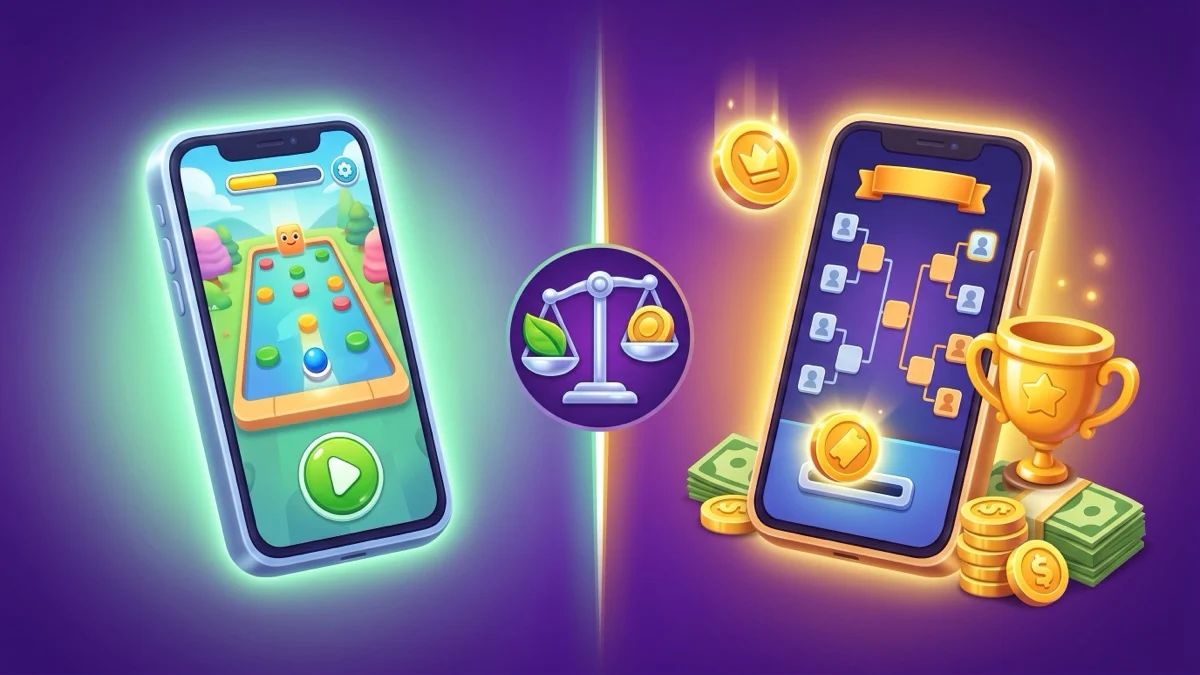
The real-money skill games market is worth roughly $25.27 billion in 2026 and is projected to more than triple by 2035 (Global Growth Insights, 2026). Almost every app inside it offers two ways to play: free games and paid-entry tournaments. That leaves new players stuck on one question. Do you have to pay to win, or can you just play the free stuff? This guide compares the two head-to-head. It shows you where your entry fee goes, and gives you a clear signal for when paying becomes the smarter move.
- Free = zero risk, low ceiling. Free practice and free-entry tournaments can't lose you money, but most casual players top out around $10–$60 a month.
- Paid = higher ceiling, real downside. Entry fees usually run $0.60–$10, and the platform keeps a 20–30% rake, so paid play only profits skilled, consistent winners.
- The magic number isn't 50%. Because of the rake, you need to win 62.5% of head-to-head cash matches at a 20% rake (about 71.4% at 30%) just to break even. Below that, fees slowly drain your bankroll.
- It's a ladder, not a choice. Master the game free, confirm a real payout, then step up to low stakes. Never risk more than 5% of your bankroll in a single competition.
Free Cash Games vs Paid Tournaments: What's the Difference?
The core difference is risk. Free cash games let you play at no cost. You win through free-entry tournaments, ad-supported prizes, or sweepstakes, with zero deposit and nothing to lose. Paid-entry tournaments charge a fee, typically $0.60 to $10 per game, then pool that money and pay the winners a larger share. The ceiling is higher, but you can lose your stake to a better player.
Crucially, these aren't rival apps you pick between. Most legit skill platforms offer both. You download free, practice without paying, and only enter a paid bracket when you choose to. The format is identical either way: a timed, skill-based match where speed and accuracy decide the winner, not a random draw. That skill-versus-chance distinction is also the legal foundation for the category. It's why skill-based cash games are treated differently from gambling in most US states.
So the real question isn't "which app." It's "which mode, and when." To answer that, you need to understand three things competitors rarely spell out: how much each mode actually pays, where your entry fee goes, and the win rate that makes paying worthwhile.
How Much Can You Actually Win With Each?
Free play pays modestly and predictably; paid play pays more but only with skill. Most casual players earn roughly $10–$60 per month from free and low-stakes games (The Penny Hoarder, 2026). Paid tournaments have no fixed ceiling. But your earnings rise with practice, not with the size of your deposit.
The gap widens over time. Industry data shows a Solitaire-style cash player earning around $2 an hour in month one. By month three, after mastering the scoring and strategy, that can climb to roughly $12 an hour (Bonus.com, 2026). Free-only players don't see that climb, because the small fixed prizes cap their upside no matter how good they get. The chart below shows the divergence.
The takeaway: free play is a fine, no-risk way to pocket small money and learn a game. But if you want the ceiling to rise, that only happens in paid brackets, and only if your skill is genuinely improving. Which raises the obvious worry: doesn't the app take a cut? It does. And that cut is the most important number in this whole comparison.
Where Does Your Entry Fee Actually Go?
When you pay an entry fee, you're not handing it all to the prize pool. On most skill-gaming platforms, winners receive about 70–80% of the pot, and the platform keeps 20–30% as its cut, known as the "rake." Some formats take up to 25% of the entry fee itself. That rake funds matchmaking, payment processing, and fraud prevention, but it's also the exact toll you have to beat to come out ahead.
This isn't unique to mobile games. Poker rooms charge a comparable commission, typically 8–12% of the buy-in on tournaments (So Much Poker, 2026). Any skilled poker player will tell you the rake is the silent factor that separates long-term winners from breakeven grinders. A transparent platform tells you its rake up front. If an app hides how the pool is split, that's a red flag worth more attention than the prize numbers it advertises. For the full money-flow, see our explainer on where the prize money actually comes from.
Once you can see the rake clearly, the profitability question stops being a feeling and becomes arithmetic. So let's run the actual math.
The Break-Even Math: When Paid Tournaments Pay Off
Here's the number that decides everything: because of the rake, you must win well over half your cash matches to come out ahead. Win less than that and entry fees quietly erode your balance, even though the games feel "close." A 50/50 player is a slow loser, not a break-even one, and that surprises almost everyone.
Work a simple head-to-head. Two players each pay a $1 entry, making a $2 pool. The platform takes a 20% rake, so the winner collects $1.60 (2 × $1 × 0.80). To break even over many games, winning half isn't enough. You need to win often enough that your $1.60 payouts cover all your $1 entries. That tipping point is a 62.5% win rate ($1 ÷ $1.60). At a 25% rake it's about 66.7%, and at 30% about 71.4%. Here's the break-even math, worked out for any prize.
This is why "just deposit and play" is bad advice. The fee structure means a coin-flip player loses steadily, and only a genuine edge turns paid tournaments profitable. The good news: you can measure your edge for free before risking a cent. That's exactly what the smart progression below is built around. For the bigger picture on realistic income, see how much you can earn playing skill games.
The Free→Paid Ladder: The Smart Way to Progress
Don't think of free versus paid as an either/or decision. Think of it as a ladder. Free play and paid tournaments are sequential phases of the same skill, and the only real mistakes are climbing too fast or never climbing at all. Here are the four rungs.
Rung 1: Practice free until your win rate stabilizes above the break-even rate (62.5% at a 20% rake). Every competitive app offers a free mode; use it relentlessly. Practice time is an investment, not a warm-up. Don't pay a cent until you're consistently beating real opponents in free matches, because your free win rate is the cheapest possible preview of your paid results.
Rung 2: Enter the lowest-stakes paid bracket (from ~$0.60–$1). This tests whether your free results hold up against opponents who are now playing for money and tend to focus harder. If your win rate survives the jump, you're genuinely ready. If it collapses, drop back to free and keep sharpening. That's information, not failure.
Rung 3: Scale stakes with your bankroll, slowly. The standard discipline borrowed from poker: never risk more than 5% of your total bankroll in a single competition (ReadWrite, 2026). Even strong players hit losing streaks, and a long runway is what keeps variance from wiping you out before your edge plays out.
Rung 4: Specialize. Being in the top 10% at one game pays more than being average at five (Bonus.com, 2026). Pick one or two titles and go deep. Depth is what pushes your win rate past break-even and into the comfortably profitable range.
This ladder is also where the platform you choose matters. On Atay Games, the free rooms use the same human-only, identical-board matchmaking as the cash tournaments. So your free win rate is a real predictor of paid results, and you climb the whole ladder on one app without switching. One player's full climb is documented in our free-to-finals bingo journey, and the tips to win more cash matches guide covers how to raise that win rate.
Which Should You Choose?
It depends on where you are. If you're brand new or risk-averse, start free, full stop. If you're a skeptic who suspects fees are a trap, play free until your win rate clears the break-even rate for your match. Then test the lowest paid bracket with money you can afford to lose, capped by a monthly entry budget. If you're already a confident, consistent winner, paid tournaments are where the real ceiling lives. The table sums it up.
Notice there's no universally "right" answer, only a right sequence. The costly errors are paying before your free win rate has earned it, or grinding free forever and leaving the higher ceiling untouched. If you want a curated starting point by game type, our best real cash games of 2026 roundup is the place to begin. For the same field ranked purely by payout, see the highest-paying games ranked.
Start Free, Then Climb When You're Ready
Atay Games lets you practice every title free against real human opponents, then step up to low-stakes cash tournaments from $1, all on one app, with no deposit needed to learn.
Browse All Atay GamesAre Paid Skill Tournaments Safe and Fair?
Reputable paid tournaments are legitimate skill-based contests, not gambling, with transparent rake, real human opponents, and identical starting conditions for every player. They're legal in most US states precisely because skill, not chance, decides the outcome. A handful of states restrict cash entry, so check whether skill-cash games are legal in your state before depositing.
Before you pay an entry fee anywhere, verify four things: the app matches you against real people, not bots; both players get the same starting board so the contest is genuinely fair; the payout terms and minimums are clear; and real users report being paid. Atay's fair-play system is built around exactly these guarantees, and our broader explainer on whether real-cash skill games are legit walks through how to vet any app. If you can't confirm how a platform splits the pool or who you're playing, treat that as your answer and keep your money out.
Play responsibly. Treat tournament entry fees as entertainment spending, set a monthly budget, and never chase losses. If gaming stops being fun or starts to feel compulsive, free and confidential help is available 24/7 from the National Council on Problem Gambling at ncpgambling.org or 1-800-522-4700.
Frequently Asked Questions
Can you win real money in free game tournaments?
Yes. Many skill apps run free-entry tournaments with small real-cash or ticket prizes, and free practice mode is always available. The trade-off is the ceiling: most casual players earn roughly $10–$60 a month this way. It's the safest way to confirm an app actually pays before you ever deposit.
Are paid-entry game tournaments worth it?
Only if you win consistently. Because platforms keep a 20–30% rake on the pot, you need to win well over half your head-to-head cash matches just to break even: 62.5% at a 20% rake, and about 71.4% at 30%. Above that, paid tournaments pay far more than free play. Below it, the entry fees slowly drain your bankroll, so practice free until your win rate clears the bar.
How much are skill game entry fees?
Entry fees for mobile skill tournaments typically range from about $0.60 to $10 per game, with most popular brackets sitting between $1 and $3. The platform takes its cut from the combined pool, then pays the rest to the winners. Start at the lowest bracket while you confirm your skill transfers to paid play.
Should beginners play free or paid skill games first?
Free, always. Practice exclusively in free mode until you are consistently winning well over half your matches, then step up to the lowest paid bracket. Entering cash tournaments before your free win rate is stable is the single most common way beginners lose money on skill apps.
What percentage of the entry fee does the platform keep?
On most skill-gaming platforms, winners receive about 70–80% of the prize pool and the platform keeps 20–30% as its rake. Some formats take up to 25% of the entry fee. That cut funds matchmaking, payouts, and fraud prevention, but it's also the exact number that decides whether paid play is profitable for you.
Sources
- Global Growth Insights, "Real Money Skill Games Market Size, Share 2035," retrieved 2026-06-11, globalgrowthinsights.com
- Fortune Business Insights, "Skill Gaming Market Size, Share & Industry Analysis," retrieved 2026-06-11, fortunebusinessinsights.com
- Bonus.com, "Best Money Skill Games (2026) — Top Real-Money Skill Apps Ranked," retrieved 2026-06-11, bonus.com
- The Penny Hoarder, "26 Legit Real Money Games to Play in 2026," retrieved 2026-06-11, thepennyhoarder.com
- EarnifyHub, "Gaming Tournaments for Cash 2026: Platforms That Pay," retrieved 2026-06-11, earnifyhub.com
- So Much Poker, "Poker Tournament Fees: How They Affect Your Game & Profits," retrieved 2026-06-11, somuchpoker.com
- ReadWrite, "Poker Bankroll Management Tips," retrieved 2026-06-11, readwrite.com
- IRS, Topic No. 419 Gambling Income and Losses, retrieved 2026-06-11, irs.gov