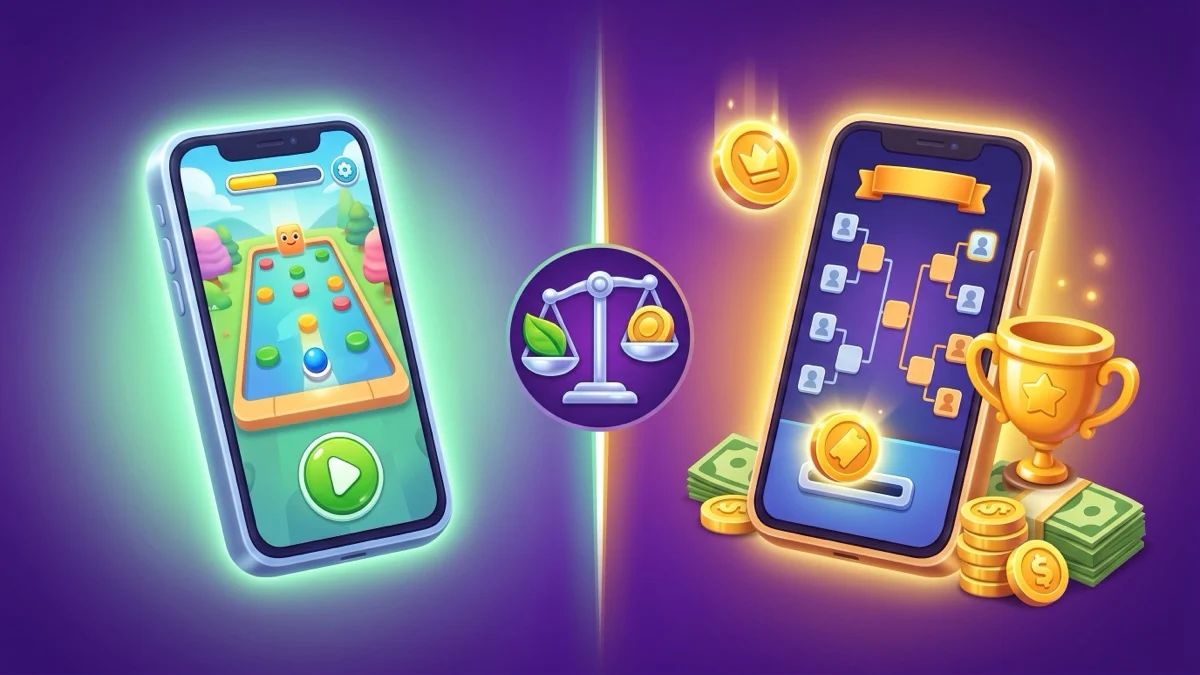

The real-money skill games market is worth roughly $25.27 billion in 2026 and is projected to reach $81.66 billion by 2035, a 13.9% annual growth rate (Business Research Insights, 2026). The money is real. But it is not spread evenly, and almost every "highest paying" list online makes the same mistake: it ranks apps by affiliate payout instead of by what you can actually earn. This guide fixes that. We rank the highest paying mobile games for cash by their real earning ceiling — and the gap between the two tiers is bigger than you'd think.
- Two tiers, very different ceilings. Passive reward apps pay reliably but cap near $40–$60 a month. Skill-based cash tournaments scale to $100–$200/mo for steady players and $1,000–$3,000/mo for grinders.
- "Highest paying" really means "highest ceiling." Reward apps are capped by an ad budget; skill games are capped only by your win rate — so that's where the top payouts live.
- The effective hourly rate flips the ranking. Reward apps pay about $1–$3 an hour flat; a practiced skill player can climb from ~$2 to ~$12 an hour over three months.
- Be realistic. Most players earn small amounts and some lose entry fees. These are entertainment with a chance to win, not a paycheck.
What Makes a Mobile Game "Highest Paying"?
A game is "highest paying" only if its earning ceiling is high — not its advertised payout. That distinction is the whole game. Most listicles rank apps by the bounty they earn for referring you, which has nothing to do with what you'll actually pocket. We rank instead on three things: how high your earnings can realistically climb, your effective rate per hour, and whether payouts are reliable and transparent.
Once you rank that way, cash games split cleanly into two tiers. Tier 1 is skill-based cash tournaments: you enter a contest, compete on an identical board, and the winners split the pool. Tier 2 is passive reward apps: you play games, earn points for time spent, and redeem points for cash or gift cards. Both can pay you. But they top out in completely different places, because one is funded by the players' entry fees and the other by an advertising budget.
Across the whole category, the honest numbers are modest for most people: casual players earn about $5–$50 a month, while competitive skill-game players reach $100–$200+ a month with consistent practice (EarnLab, 2026). Hold those two anchors in mind as we go tier by tier.
Why Do Skill Tournaments Pay the Most? (Tier 1)
Skill tournaments hold the highest payout ceiling of any mobile game type, because your winnings scale with your skill rather than an advertiser's budget. On platforms powered by Skillz, prizes run from $1 to $500 per win, with daily and weekly leaderboards reaching up to $10,000, and top players can earn $1,000–$3,000 a month by grinding many matches (EarnifyHub, 2026). That's an order of magnitude beyond what any reward app allows. Once you've won, getting the money out is simple — see our guide on how to cash out from skill game apps.
Here's how it works. You pay an entry fee — usually $0.60 to $10 — into a pool, play a timed match against real opponents on the exact same board, and the higher score wins a larger share back. Because the contest is decided by speed and accuracy rather than chance, these are legally treated as skill-based games rather than gambling in most US states. The catch is honest and important: you're competing against real people, so casual players often break even at best, and only a genuine edge turns a profit. From what we see in Atay's own low-stakes brackets, the players who reach the higher end of that range almost never get there on rare jackpots — they stack dozens of small $1–$3 placements a week, which is exactly why steady volume and a stable win rate beat occasional big swings. The chart below shows the ceiling difference once you put both tiers on the same axis.
Tier 2: Passive Reward Apps (Reliable but Capped)
Reward apps pay reliably but cap out fast — realistically $1–$3 an hour, which adds up to roughly $10–$60 a month. On a popular play-to-earn app, casual users logging about 30 minutes a day earn around $10–$15 a month, while dedicated users putting in two to three hours can reach $40–$60 a month — and the platform caps total annual earnings near $550 per user (Eneba, 2026). That annual cap is the clearest proof of the ceiling: no amount of skill moves it. (If that's the app you're on, see our guide to apps like Mistplay but better for higher-paying alternatives.)
The model explains the limit. You earn points for time spent in sponsored games, then convert points to cash or gift cards. Because the payout comes from advertisers paying for installs and engagement, your reward is fixed to a schedule, not to how well you play. That makes reward apps genuinely useful for one thing — low-effort, zero-risk pocket money while you play games you'd play anyway. If that's your goal, they're a fine pick. If your goal is the highest payout, they structurally can't get you there.
What Pays More Per Hour: Reward Apps or Skill Games?
When you divide earnings by hours, the "highest paying" label flips decisively toward skill games for anyone willing to practice. A reward app pays a flat rate of roughly $1–$3 an hour forever. A skill player starts lower but climbs: industry data shows a Solitaire-style cash player earning about $2 an hour in month one, rising to roughly $12 an hour by month three as they master scoring and strategy (Bonus.com, 2026).
This is the number affiliate listicles never show, because it reframes everything. A reward app's hourly rate is the same on day 500 as on day one. A skill player's rate compounds with their win rate. The chart makes the divergence obvious.
So if you're optimizing for the best return on your time, the ranking is clear: a reward app wins for the first hour, and a practiced skill game wins for every hour after that. For a deeper breakdown of realistic income by play style, see how much you can earn playing skill games. And if payout speed matters more to you than prize size, here's which games pay instantly to PayPal.
Which Game Types Pay the Most Cash?
Within skill games, the highest ceilings sit in card, bingo, and fast-puzzle formats that have deep tournament ladders and large player pools. The bigger the pool, the bigger the prizes, and the more brackets there are to climb. Solitaire-style card games have the highest earning ceiling among card formats, paying consistent players $50–$200+ a month with real practice (The Penny Hoarder, 2026).
Here's how the most popular paying formats stack up, with the Atay titles that run human-only cash brackets in each:
- Card / Solitaire — highest card-game ceiling; rewards memory and quick sequencing. Play Solitaire Cash or Gin Rummy.
- Bingo — fast, pattern-and-speed driven, with frequent low-stakes brackets and big leaderboards. Play Bingo Prizes.
- Match-3 / Puzzle — high match volume means steady earning chances for sharp players. Play Sugar Cash or Block Puzzle.
- Word — rewards vocabulary and speed; popular, accessible brackets. Play Word Search.
- Pool / Skill-arcade — precision and angles decide it; satisfying head-to-head play. Play Ball Pool.
No single format pays everyone the most — the highest-paying game is the one you can get genuinely good at, because depth in one title beats being average across five. For a category-by-category shortlist, our best real cash games of 2026 roundup is the place to start.
Play the Highest-Ceiling Games Free First
Atay Games lets you practice every title free against real human opponents, then step up to low-stakes cash tournaments from $1 — all on one app, with no deposit needed to learn.
Browse All Atay GamesAre High-Paying Cash Game Apps Legit?
The legitimate ones are, and they share four traits: real human opponents, an identical starting board for every player, transparent payout terms, and a clearly published split of the pool. On reputable skill platforms, winners receive about 70–80% of the prize pool and the platform keeps the rest as its operating cut (EarnifyHub, 2026). That transparency is exactly what separates a real cash game from a trap.
Before you deposit anywhere, verify the basics: that you're matched against real people, not bots; that both players get the same board; that withdrawal minimums and timelines are stated up front; and that real users report being paid. Atay's fair-play system is built around those guarantees, and our explainer on whether real-cash skill games are legit walks through how to vet any app. If you can't confirm how a platform splits the pool or who you're playing against, treat that uncertainty as your answer and keep your money out.
Play responsibly. Treat entry fees as entertainment spending, set a monthly budget, and never chase losses. Most players earn small amounts and some lose their entry fees. If gaming stops being fun or starts to feel compulsive, free and confidential help is available 24/7 from the National Council on Problem Gambling at ncpgambling.org or 1-800-522-4700.
How to Actually Maximize What You Earn
To reach the high ceiling, pick one skill format, master it free, and only then move to paid brackets. The reliable path is a ladder, not a leap. Practice free until you're consistently winning more than half your matches, then enter the lowest-stakes paid bracket — and never risk more than 5% of your bankroll in a single competition. That sequence is laid out in full in our free play vs paid-entry tournaments guide.
Two more levers matter. First, specialize: being in the top 10% at one game pays more than being average at several, so go deep instead of wide. Our tips to win more cash matches cover how to raise your win rate. Second, track the tax side: cash winnings can be reportable income, so keep records from the start — see how skill-game winnings are taxed. Do those three things — specialize, climb gradually, keep records — and you'll capture the real ceiling instead of leaving it on the table.
Frequently Asked Questions
What mobile game pays the most real money?
Skill-based cash tournaments hold the highest payout ceiling, not reward apps. Strong, consistent players on skill platforms earn roughly $100–$200 a month, and dedicated grinders can reach $1,000–$3,000 a month. Reward apps like the popular play-to-earn titles cap out near $40–$60 a month no matter how good you get, because their payout is funded by an advertising budget instead of your win rate. For a close look at one, see our honest Mistplay review.
Are high-paying cash game apps legit?
The legitimate ones run on transparent infrastructure such as Skillz, match you against real human opponents, give every player an identical starting board, and publish clear payout terms. On those platforms winners typically receive 70–80% of the prize pool. Apps that hide how the pot is split, or that can't confirm you're playing real people, are the ones to avoid.
How much money can you realistically make playing mobile games?
For most people the honest range is small. Casual players earn about $5–$50 a month, and steady skill-game players reach $100–$200 a month with practice. Only a small group of dedicated, highly skilled players clear $1,000+ a month, and they grind hundreds of matches to do it. Treat these apps as entertainment with a chance to win, not as income.
Can you make a living playing mobile games for cash?
No, for almost everyone the answer is no. Most players earn small amounts and some lose their entry fees. Even top skill players who reach $1,000–$3,000 a month do so by grinding huge volumes of matches with a genuine competitive edge. The realistic goal is supplemental spending money from a game you enjoy, not a salary.
What is the difference between reward apps and skill cash games?
Reward apps pay you points for time spent playing, then convert points to cash or gift cards — earnings are reliable but capped by an advertiser budget, often around $1–$3 an hour. Skill cash games pool entry fees and pay the winners, so your earnings scale with how often you win. That's why skill games have a far higher ceiling for players willing to practice.
Sources
- Business Research Insights, "Real Money Skill Games Market Size, Share, Growth Report [2035]," retrieved 2026-06-14, businessresearchinsights.com
- EarnLab, "Best Game Apps That Pay Real Money in 2026 (Tested & Verified)," retrieved 2026-06-14, earnlab.com
- EarnifyHub, "Gaming Tournaments for Cash 2026: Platforms That Pay," retrieved 2026-06-14, earnifyhub.com
- Eneba, "Does Mistplay Actually Work: Full Review of Earnings, Payouts, and Legitimacy," retrieved 2026-06-14, eneba.com
- Bonus.com, "Best Money Skill Games (2026) — Top Real-Money Skill Apps Ranked," retrieved 2026-06-14, bonus.com
- The Penny Hoarder, "Best Solitaire Apps for Real Money (2026): Legit Picks + Payout Info," retrieved 2026-06-14, thepennyhoarder.com
- Precedence Research, "Mobile Gaming Market Size, Share, and Trends 2026 to 2035," retrieved 2026-06-14, precedenceresearch.com