
Two things are both true right now. The global skill gaming market hit $40.85 billion in 2024, on track toward $92.03 billion by 2030 (Grand View Research, 2024, retrieved May 2026). And the FTC recorded over 20,000 game-like scam complaints in just the first half of 2024, with losses topping $220 million (FTC, December 2024, retrieved May 2026). So the honest answer to "are cash skill games legit?" is: some absolutely are, and some absolutely aren't. By the end of this guide, you'll know which platforms are real, which warning signs expose a scam, what your state allows, and what you can actually earn.
- Legitimate platforms exist and are large. The skill gaming market was $40.85B in 2024 and is growing at 14.2% annually (Grand View Research).
- Fraud is surging too. FTC complaints about game-like scams jumped from ~5,000 in 2023 to 20,000+ in H1 2024 alone, with $220M+ in losses.
- Legal in 35+ US states under the predominance-of-skill test, banned or restricted in 10 states including AZ, AR, CT, DE, LA, MT, SC, SD, TN, and WA.
- Realistic earnings are modest. Most players earn the equivalent of $0.10-$0.80 per hour (NerdWallet, 2025), not life-changing income.
- Winnings are taxable. The IRS requires reporting all skill game income; platforms issue a 1099-MISC for payouts over $600 cumulative (IRS Topic 419).
What Are Real Cash Skill Games?

Real cash skill games are competitive mobile or web games where players pay an entry fee, compete based on ability, and receive cash payouts from the resulting prize pool. They're distinct from gambling because player skill, not chance, determines the winner. With 205 million Americans playing video games in 2025 and 89% having played online (ESA 2025 Essential Facts), the audience is enormous. The platform formats range from solitaire and bubble shooters to word games and trivia.
If you're new to the category and want the plain-English version of the definition, the statistical-reliability test, and the five game-type categories, start with our explainer on what skill games are. The rest of this pillar focuses on the legitimacy and operational checks for real-cash play specifically.
The Skill vs. Chance Distinction
US law classifies a game as gambling only when three elements combine: prize, consideration (an entry fee), and chance as the dominant outcome driver. Cash skill games satisfy the first two elements but remove the third. Most states apply what's called the predominance test. The question is simple: does a skilled player consistently beat an unskilled one over many matches? If yes, skill dominates. That's not gambling under most state statutes — and if you want that distinction drawn in full, see our breakdown of the difference between skill games and online gambling.
The architecture that makes this work is the identical-board format. Both players in a match receive the exact same starting layout, whether that's a card arrangement, tile board, or puzzle configuration. Randomness is equalized between the two players, so it cancels out. The only remaining variable is how well each player performs. Speed, accuracy, strategy, pattern recognition: those are skill attributes, not luck.
How Cash Tournaments Work
The basic structure is straightforward. A player selects a tournament, pays an entry fee (often $0.60 to $5.00), and competes for a score. That entry fee flows into a prize pool. The platform keeps a percentage, called the rake. Winners receive cash payouts proportional to their finish. The higher your score relative to other entrants, the larger your share.
Withdrawals on legitimate platforms go to PayPal, Venmo, Apple Pay, or direct bank transfer. Payouts typically process within 24-72 hours. That paper trail, entry in, cash out, is one of the clearest signals separating real platforms from fakes. Can you find documented withdrawal screenshots from real users? That matters more than marketing copy. We keep our red-flag checklist for fake money apps updated as new scam patterns appear.
Are Real Cash Skill Games Legit?
Yes, genuine legitimate platforms exist and operate at significant scale. The global skill gaming market was valued at $40.85 billion in 2024, growing at a 14.2% compound annual rate toward a projected $92.03 billion by 2030 (Grand View Research, 2024). That's not the footprint of a niche scam category. It's an established industry with publicly traded companies, SEC-audited financials, and millions of active players.
What Separates Legit Platforms from Fakes
The challenge is that scam apps mimic the look of legitimate platforms. Both show leaderboards and prize pools. The difference is in the infrastructure underneath. Here's a 7-point checklist to run on any platform before depositing money.
- Verified official listing. Real platforms have a named developer presence on the Apple App Store, and on Android they install as a direct download from the developer's own website — real-money skill games aren't carried on Google Play, so a site-hosted APK (scanned by Google Play Protect on install) is normal and safe. The warning sign isn't sideloading itself; it's an unverifiable source, like a random "free APK" mirror site or a web-only "game" with no official app anywhere.
- Verifiable company identity. Search the company name in state business registries. Legitimate operators are registered legal entities. Anonymous operators are red flags.
- SEC or BBB registration. Publicly traded platforms (like Skillz on NYSE) have audited annual reports. Others should have at least a Better Business Bureau profile with verified reviews.
- Documented payout history. Search Reddit, Trustpilot, and YouTube for "did [platform] pay me" content. Real users leave real trails. Absence of any third-party payout confirmation is suspicious.
- Transparent rake disclosure. Legitimate platforms show you exactly how much they take per match. Hidden fees or opaque prize pool math signal manipulation.
- Real human opponents. Ask: are you playing against real players matched by skill level, or against a fixed algorithm set to let you win early and lose later? Bots are a common scam mechanic.
- No task-gate before withdrawal. Legitimate platforms don't require you to complete a set number of paid matches before your first withdrawal. That structure is designed to extract money, not pay it out.
The global skill gaming market was valued at $40.85 billion in 2024 and is projected to reach $92.03 billion by 2030 at a 14.2% CAGR, reflecting established industry scale and regulatory acceptance across 35+ US states. Legitimate platforms are publicly traded, SEC-audited, and operate transparent rake models with documented payout histories. (Grand View Research, 2024)
Skill Gaming Global Market Size (Billions USD)
Source: Grand View Research / Fortune Business Insights, 2024. Projected values are estimates.
Is It Legal? Your State-by-State Guide
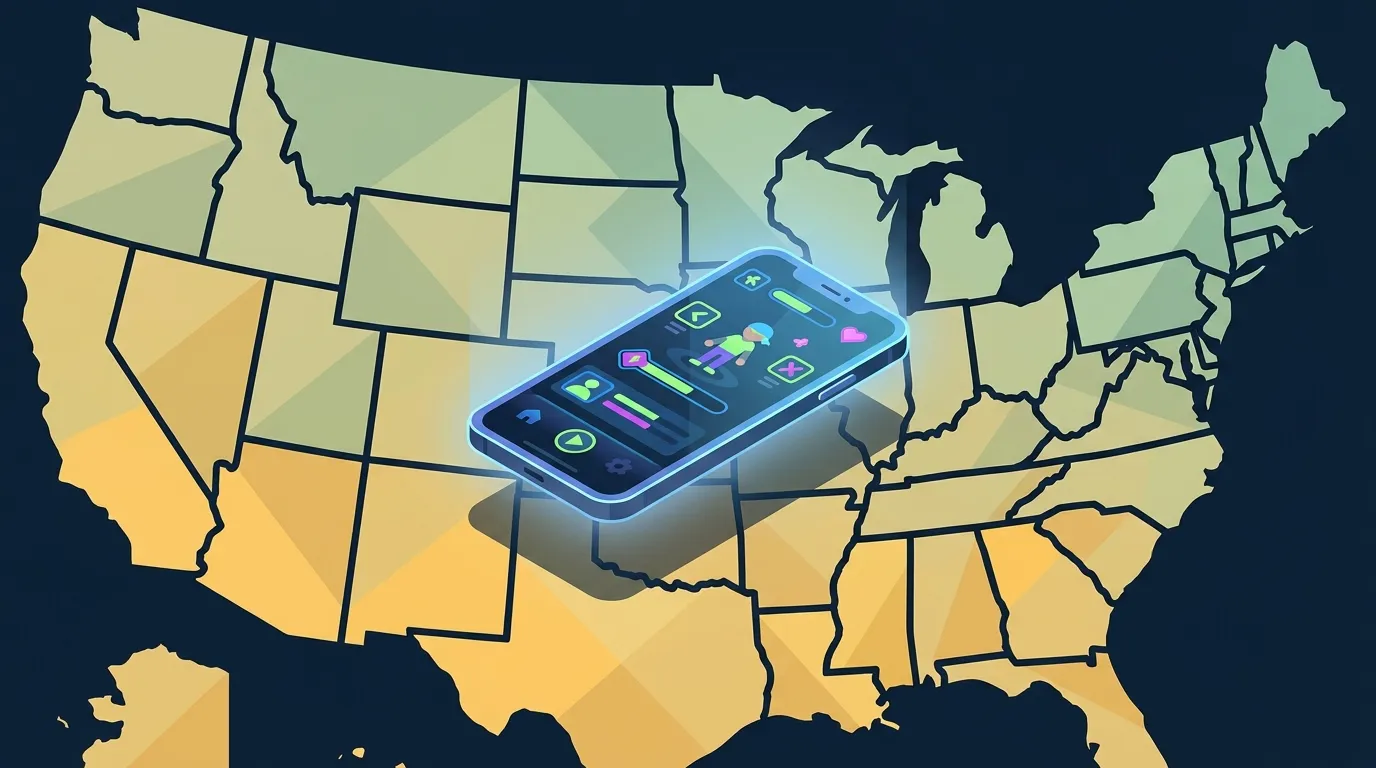
Cash skill gaming is legal in 35+ US states and banned or significantly restricted in 10 states as of 2026. The legal foundation is the predominance-of-skill test, recognized by courts across most of the country. Ten states currently represent the highest legal risk: Arizona, Arkansas, Connecticut, Delaware, Louisiana, Montana, South Carolina, South Dakota, Tennessee, and Washington. (Artaev at Law, January 2024, retrieved May 2026)
For a deeper breakdown of how each state's statutes apply, see the state-by-state legality guide on this site. For a live example of a state rewriting its rules, see Pennsylvania's 2026 skill machine ruling and what it did and didn't cover.
The Predominance Test Explained
The predominance test asks one question: is skill or chance the primary factor that determines who wins? Under this standard, a game escapes gambling classification if a skilled player reliably beats an unskilled one over a meaningful sample of matches. That's different from the stricter "any element of chance" standard a handful of states use. Most US states follow the predominance approach, which is why the legal footprint for skill gaming is wide.
The practical test is whether a player's win rate improves with practice. Random outcomes don't improve with practice. Skill does. Solitaire, bubble shooter, and word game formats all pass this test cleanly because the same tiles, cards, or letters appear for both players simultaneously. Skill, not luck, decides who scores higher.
Which States Currently Restrict Cash Skill Games
The 10 states with the highest legal risk have either specific statutes prohibiting fee-based competition games or broad gambling definitions that haven't yet carved out skill games explicitly. Washington state is included on this list despite having large gaming activity; the specific legal posture around online cash skill competitions makes it high-risk for operators.
US State Legal Status for Cash Skill Gaming (2026)
| Status | States | Play? |
|---|---|---|
| Generally Legal | CA, TX, NY, FL, IL, MI, GA, OH, CO, NV, OR, MN, WI, NC, IN, MD, NE, NH, NM, ND, OK, RI, UT, VT, KS, KY, VA, WV, ID, HI, AK, ME (some areas), and others (~35+ states) | Yes |
| Banned / High Risk | AZ, AR, CT, DE, LA, MT, SC, SD, TN, WA | No |
Source: Artaev at Law, January 2024. State classifications subject to change; verify current status before playing for cash.
Cash skill gaming is legal in 35+ US states under the predominance-of-skill test, which exempts games from gambling statutes when player ability is the primary outcome driver. Ten states, including AZ, AR, CT, DE, LA, MT, SC, SD, TN, and WA, represent the highest legal risk for real-money skill competition as of 2026. (Artaev at Law, January 2024)
How Do Legitimate Platforms Make Money?
Legitimate skill game platforms make money through the rake: a percentage of each tournament entry fee pool that the platform keeps before distributing prizes to players. This model doesn't require manipulating outcomes. Skillz, the largest publicly traded skill gaming platform, reported $95.5 million in 2024 revenue, down from $152.1 million in 2023. Those figures come from SEC-audited annual filings. (Skillz Inc. 2024 Annual Report, February 2025)
The Entry Fee Rake Model Explained
The rake model works like this. A $1.00 tournament might have $0.80 go to the prize pool and $0.20 kept by the platform. Play 100 tournaments and the platform earns $20 regardless of who wins. That structure aligns the platform's incentives with player engagement, not with manipulating individual match outcomes. The more people play, the more the platform earns. Cheating individual players would reduce long-term engagement, which directly hurts platform revenue.
This is meaningfully different from a casino model, where the house's edge is baked into every spin or hand. In the rake model, the platform is a neutral marketplace. It takes its cut, then players compete fairly for the remaining prize. A player with consistently higher skill consistently earns more. That's the core legitimacy claim.
Why Declining MAUs Can Be a Trust Signal
Skillz's 2024 results showed monthly active users fell from 1.045 million in 2023 to 816,000, and paying MAUs dropped from 179,000 to 118,000. That's a real business contraction. But here's the insight most commentators miss: a platform that reports declining user numbers in audited SEC filings is demonstrating transparency, not fraud. Scam operations don't file truthful public documents. Declining honest metrics are more trustworthy than inflated ones from an opaque operator.
Skillz Platform: 2023 vs. 2024 at a Glance
Source: Skillz Inc. 2024 Annual Report, February 2025. SEC-audited figures.
How Do You Spot a Fake Cash Game App? 7 Red Flags

The FTC recorded 20,000+ game-like scam complaints in H1 2024 alone, a 4x increase from approximately 5,000 in all of 2023, with consumer losses topping $220 million. (FTC, December 2024) These aren't edge cases. Scam apps are a mainstream consumer harm, specifically designed to look like the real thing. Here are the 7 red flags that distinguish them. For the courtroom side of this, read the AviaGames bot-lawsuit explainer.
The Red Flags in Detail
- Earnings promises that aren't credible. Any app claiming you'll earn hundreds of dollars per hour is lying. Legitimate platforms like NerdWallet-reviewed apps show realistic figures of $0.10-$0.80 per hour equivalent. Outsized promises are the scam's opening move.
- Withdrawal gates. Scam apps require you to reach a minimum balance (say, $100) before withdrawing, and the games are rigged to stall just below that threshold indefinitely. Real platforms process withdrawals at low minimums with no artificial progress gates.
- No verifiable source. If an app is only available through a link a stranger sent you, or from a random "free APK" mirror site, that's a serious structural warning. (Installing a real-money game's official APK from the developer's own website is different and normal — these games aren't on Google Play, and Google Play Protect still scans a site-hosted APK on install.)
- Anonymous company identity. Legitimate platforms have named executives, business registration records, and physical addresses. Scam apps are operated by entities with no verifiable identity anywhere.
- You're always winning early. A scam app lets you win frequently at first to build confidence, then adjusts difficulty or rigging to ensure you lose. Real skill platforms use verified human opponents matched to your skill level.
- Pressure to recruit others. When an app's reward system pushes you to refer friends before unlocking payouts, that's a multi-level structure, not a skill gaming platform. Referral mechanics aren't inherently bad, but mandatory referral-before-payout is a red flag.
- No verifiable reviews from real people. Search YouTube, Reddit, and Trustpilot for actual payout confirmation. Scam apps generate fake five-star app store reviews. Real platforms have documented community discussions with withdrawal screenshots.
The Task Scam Variant
The FTC has specifically documented a variant where apps present themselves as rating tasks or watching video clips that also incorporate game-like elements. Players complete dozens of tasks expecting payout, only to be told they need to pay fees to "unlock" earnings. This structure is always a scam. No legitimate platform charges fees to release earnings you've already accumulated.
The CFPB found that 63% of gamers feel their accounts lack adequate protection, and 1 in 3 report being hacked in the past two years. (CFPB Issue Spotlight, April 2024) Those numbers reflect a real environment of platform vulnerability. They make the checklist above more important, not less.
FTC data from December 2024 shows game-like scam complaints jumped from approximately 5,000 in all of 2023 to more than 20,000 in just the first half of 2024, with total reported consumer losses exceeding $220 million. The FTC documents specific mechanics including fake task completion gates and mandatory recruitment before payout release. (FTC, December 2024)
Platform Comparison: 5 Legitimate Cash Skill Game Apps
The legitimate end of the skill gaming market has several established operators, each with different game formats, rake structures, and player bases. Here's how they compare as of 2026. AviaGames (Pocket7Games) reports running 100 million tournaments per month with an estimated $125 million in annual revenue. (AviaGames, 2024-2025)
One useful legitimacy benchmark is SEC filing status. A publicly traded company must publish audited financials. That audit process, however imperfect, creates a verification mechanism that private operators lack. When evaluating any platform, checking whether it's publicly traded, or at minimum whether it has independently verified third-party reviews, narrows your risk significantly.
| Platform | Games | Min Entry | Withdrawal | Legitimacy Signal |
|---|---|---|---|---|
| Atay Games | Solitaire, Word Search, Bubble Shooter, Match-3, Block Puzzle | $0.60 | PayPal, Venmo, Apple Pay | Verified human-only matchmaking; Skillz infrastructure |
| Skillz | Multi-genre SDK platform (not consumer-facing directly) | Varies by partner app | PayPal, bank transfer | NYSE-listed (FIRY, formerly SKLZ); SEC-audited annual reports; $95.5M revenue 2024 |
| Pocket7Games | Bingo, Solitaire, 21 Gold, Tonk, 2048 Solitaire | $0.25 | PayPal, Apple Pay, Venmo | 100M tournaments/month; App Store Top Charts presence |
| WorldWinner | Solitaire, Scrabble, Wheel of Fortune, Bejeweled | $2.00 | Check, bank wire | Operating since 2000; GSN Games subsidiary (Sony Pictures) |
| Solitaire Cash | Classic Solitaire cash tournaments | $1.00 | PayPal, Venmo | Papaya Gaming operator; documented payout history on community forums |
Looking to try solitaire cash tournaments? That's one of the most accessible entry points in the category, with low entry fees and a format most players already know. For a broader look at how Atay Games ensures fair play, that detail covers the identical-board and human-only matchmaking architecture in full, and our dedicated Atay Games trust review runs the full legitimacy checklist on the platform with App Store and SEC evidence. And if you're specifically evaluating Pocket7Games — whose parent AviaGames settled an $80M Skillz patent case in 2024 (Bloomberg Law) and is the defendant in the active Pandolfi v. AviaGames RICO class action alleging bot use — our 10 best Pocket7Games alternatives ranked by trust walks through the legal context and the per-game substitution map.
We have also reviewed the major platforms one at a time, using the same red-flag checklist above. Before you deposit anywhere, read our full review of whether Skillz is legit, whether Blackout Bingo is legit, and our honest Mistplay review. Each one covers payout speed, the bot question, and what the operator's public filings do and do not prove.
What Can You Realistically Earn?
The honest answer is: less than most ads suggest. NerdWallet's 2025 analysis of cash game apps puts typical player earnings at the equivalent of $0.10 to $0.80 per hour. (NerdWallet, 2025) That's a realistic range for casual players. Competitive players who specialize in one format, reach top-tier skill brackets, and compete in higher-stake tournaments can earn meaningfully more. But that requires consistent practice and real skill development.
Think of it on a spectrum. Casual players, perhaps 30-60 minutes of play a few times a week, generally cover their entry fees and earn modest net winnings or break even. Consistent competitive players who treat it like a part-time skill-building activity can reach positive returns over time. Neither group should quit their job based on it.
For a full breakdown of earning tiers by skill level and game type, see the detailed earnings breakdown on this site. And if you want to improve your results, the winning strategies for cash tournaments guide covers the tactical side.
What about the outliers? Every category has top earners who do unusually well. Those stories are real but not representative. The relevant question isn't what's possible at the absolute peak. It's what's likely for someone of your current skill level, playing your intended volume, at the stakes you're considering. Start with free practice mode. Build win rate. Then move to cash play when your results are consistently strong.
Do You Pay Taxes on Skill Game Winnings?
Yes, skill game winnings are taxable income in the United States. IRS Topic 419 classifies these winnings as ordinary income. Platforms are required to issue a 1099-MISC for cumulative payouts over $600 in a calendar year. (IRS, current) Even if your annual winnings fall below $600, you're still legally required to report them on your federal return.
The practical implication: track your entries and winnings throughout the year. Your taxable income is your net profit, meaning winnings minus entry fees paid. Keep records of both sides. If a platform sends you a 1099-MISC, the IRS already has that information. Failing to report it is a compliance risk, not just an oversight.
For a full walkthrough of how to report skill game income, deduct entry fees, and handle state tax implications, see the complete tax guide for skill game winnings.
Under IRS Topic 419, skill game winnings are taxable as ordinary income in the United States. Platforms must issue a 1099-MISC for cumulative payouts exceeding $600 in a calendar year. Players must report all winnings, net of entry fees paid, on their federal return regardless of whether they receive a formal tax document. (IRS, current)
Frequently Asked Questions
Are real cash skill games legitimate?
Yes. Legitimate cash skill games operate within a $40.85 billion global market (Grand View Research, 2024), are legal in 35+ US states, and pay real winnings. The key is identifying verified platforms with transparent rake models and documented payout histories. Use the 7-point checklist in this guide to separate real platforms from scam apps.
What states ban skill-based real-money games?
Ten states currently represent the highest legal risk or outright restriction: Arizona, Arkansas, Connecticut, Delaware, Louisiana, Montana, South Carolina, South Dakota, Tennessee, and Washington. Cash skill gaming is generally permitted in the remaining 35+ states. Laws can shift, so verify your state's current status before playing for real money. (Artaev at Law, January 2024)
How do I know if a cash game app is a scam?
Seven red flags signal a scam: unrealistic earnings promises, withdrawal gates requiring impossible thresholds, no app store listing, anonymous company identity, early wins followed by rigged losses, mandatory recruitment before payout, and no real user withdrawal reviews anywhere online. The FTC recorded 20,000+ such complaints in H1 2024 with $220M+ in losses. (FTC, December 2024)
Do you pay taxes on skill game winnings?
Yes. The IRS classifies skill game winnings as taxable income under Topic 419. Platforms must issue a 1099-MISC for cumulative payouts over $600 per calendar year. Report all winnings, net of entry fees paid, on your federal return. Keep records throughout the year. State tax obligations vary by location. (IRS Topic 419, current)
Is Skillz a legitimate platform?
Yes. Skillz is publicly traded on NYSE (ticker: FIRY, formerly SKLZ) and files SEC-audited annual reports. Its 2024 revenue was $95.5 million, down 37% from $152.1 million in 2023, which is a real business contraction reported transparently. That level of financial disclosure makes Skillz one of the most verifiable skill gaming operators available. (Skillz 2024 Annual Report, February 2025)
So Are Real Cash Skill Games Worth Playing?
Yes — if you're on the right platform. Real cash skill games are legitimate businesses with audited financials, transparent rake models, and documented payout histories. The scam apps that flood app stores are a separate category entirely: designed to extract money under false pretenses, and more prevalent than ever.
Here's what to carry forward from this guide:
- The $40.85 billion market is real. Legitimate platforms do exist, pay out, and operate legally in 35+ states. (Grand View Research, 2024)
- The scam surge is also real. FTC complaints jumped 4x in 2024, to 20,000+ in H1 alone. Use the 7-point red flag checklist before depositing anything.
- Earnings are modest for most players. Expect $0.10-$0.80 per hour equivalent. Real income requires real skill development over time. (NerdWallet, 2025)
Responsible play matters regardless of platform. Set a budget before you start. Play with money you're comfortable losing. If the fun stops, the playing should too. The National Council on Problem Gambling helpline is available 24/7 at ncpgambling.org or 1-800-522-4700.
Legal and financial disclaimer. This article is for general informational purposes only and does not constitute legal or financial advice. Skill gaming laws vary by state and change over time. State classifications in this guide reflect sources available as of May 2026 and may not be exhaustive or current for your jurisdiction. Earnings figures are illustrative ranges, not guarantees. Individual results depend on skill, game selection, competition level, and stake amounts. Never wager money you cannot afford to lose. Real-money play is not available in every jurisdiction. If you have specific legal questions, consult a qualified attorney in your state.
Ready to Play Where Skill Wins?
Browse skill games with verified human opponents, transparent prize pools, and no bots.
Explore Our Games