
A phone game that pays you real cash sounds like the setup to a scam. So it's a fair question, maybe the fairest one you can ask before depositing a dollar: if you win $40 in a cash tournament, whose $40 is that? The honest answer surprises most people, and it explains both why these contests aren't a scam and why they aren't free money either, the piece that makes the easy-money promise in most "win money" game ads misleading. Full disclosure up front: Atay Games' titles run on the Skillz platform, so we sit inside this money-flow. That's exactly why the explanation below sticks to mechanics you can verify, not to reassurance. Let's follow a single $5 entry fee from your wallet all the way to a winner's payout.
- The money comes from players. In a paid-entry tournament, your entry fees are pooled, the platform keeps a disclosed cut (the "rake," commonly 10 to 20%), and winners split the rest (Rivals, 2026).
- You're not playing the house. The platform earns the same rake no matter who wins, so it has no reason to make you lose. A casino profits when you lose; a tournament doesn't.
- It's not a Ponzi. Prizes come from the same event's fees, not from recruiting new depositors.
- The honest catch: after the rake, a paid pool is negative-sum, so treat it as paid entertainment where skill tilts the odds, not as income.
Most explainers stop at "you win real cash!" and leave the mechanism a mystery, which is exactly what makes people suspicious. So let's do the opposite and open the box. Where does the pot actually come from, who keeps a slice, and what's the part nobody likes to mention? Here's the whole flow, honestly.
Where Does Cash Tournament Prize Money Come From?
From the players. In a paid-entry tournament, everyone pays a fee, and those fees form a single prize pool. The platform keeps a disclosed cut, and the rest is paid back to the top finishers (Rivals, 2026). You aren't winning the company's money. You're winning a share of a pot that you and your opponents all chipped into.
That single fact answers most of the fear. You're competing against other people for their pooled entry fees, refereed by a platform that takes a slice off the top. This isn't a fringe niche, either. The real-money skill-games market was worth an estimated $22.19 billion in 2025. It's on track for roughly $25.27 billion in 2026 (Global Growth Insights, 2026). For a sense of the wider category, see our breakdown of how the skill gaming market works.
Where Your $5 Entry Fee Actually Goes
Illustrative split based on a typical skill-platform rake of 10 to 20% (Rivals, 2026; Naavik, 2024).
In a paid-entry cash tournament, the prize money is the players' own entry fees pooled together. Everyone pays a fee, those fees form a single prize pool, the platform keeps a disclosed cut, and the remainder is paid to the top finishers (Rivals, 2026). You are competing for a share of a pot that every entrant funded, not for money from the platform's own pocket.
How Can a Game App Afford to Pay Real Cash?
It isn't paying out of its own pocket. In a paid tournament, the cash handed to winners is the same cash entrants paid in, minus a commission. On platforms like Skillz, the operator withholds roughly 16 to 20% of the total entry fees and splits the remainder between the game developer and the platform (Naavik, 2024). The app makes money on the cut, not on beating you.

The arithmetic is the whole trick. Picture a tournament where 100 players each pay $5. That's $500 collected. If the platform's rake is 10%, it keeps $50, and the remaining $450 becomes the prize pool paid out to winners (Rivals, 2026). Now scale that across millions of small entries, some as low as about $0.60 on Skillz (Inc.). A modest slice of each one adds up to a real business. That "slice of each entry" is the rake, the engine underneath the whole model.
Here's the part that flips the intuition. Because revenue is the rake, the platform actually wants lots of games played and winners paid. Every entry adds to its cut. Who shares that cut? The platform and the game developer, which is where a studio like Atay sits. We earn a portion of the fees on our own titles, disclosed plainly. For the full breakdown of how the money moves through a platform, see our guide on how skill-based gaming platforms work.
Game apps pay winners with entrants' own fees and earn revenue on the commission, or rake, rather than by beating players. If 100 players each pay $5, the pool is $500; a 10% rake leaves $450 for winners (Rivals, 2026). On platforms like Skillz, the operator keeps roughly 16 to 20% of entry fees and splits the rest with the game's developer (Naavik, 2024).
Am I Playing Against the House?
No, and this is the difference that matters most. In a cash tournament, the platform's revenue is a fixed rake it collects no matter who wins, so it's financially indifferent to your result. A casino is the opposite: it profits when you lose, because the house edge is built into every wager. A tournament is you versus other players, with a platform refereeing and taking its slice off the top.
Why does that distinction matter so much for trust? Because it removes the motive to rig anything. If the operator earns the same cut whether you finish first or last, it has no reason to tilt the game against you. The one thing it does control, matchmaking, is built to pair you with players of similar ability, which you can read about in how matchmaking works in cash games. And the fairness isn't just a promise. Skillz is the company that sued rivals for using bots and won. We cover the whole story in our review of whether Skillz is legit.
| Prize model | Who funds the prize? | You compete against | Operator wins when you lose? |
|---|---|---|---|
| Paid-entry skill tournament | The players' entry fees | Other players | No |
| Casino / house game | The house pays winners, funded by losers | The house | Yes |
| Free / rewards app | The platform or an advertiser | A leaderboard of players | No |
Skill contests sit in a different legal box from gambling for the same reason: outcomes turn on ability, not chance. We unpack that line in the difference between skill games and online gambling. The short version is that when you enter a cash tournament, the house isn't your opponent. Your opponent is the person in the next seat trying to score higher than you.
In a paid cash tournament you compete against other players, not the house. The platform collects the same fixed rake no matter who wins, so it is financially indifferent to your result and has no built-in reason to rig outcomes. That is the structural opposite of a casino, where the house edge means the operator profits directly from your losses on every wager.
Is a Cash Tournament a Pyramid or Ponzi Scheme?
No, and the distinction is precise enough to check yourself. A Ponzi scheme has no real product and pays earlier participants out of newer deposits, which is why it collapses the moment sign-ups slow down. A cash tournament has an actual game, a disclosed rake, and prizes drawn from the same event's entry pool. Nobody new has to be recruited for you to get paid.
Run any money app through three quick tests. Is there a real product you're actually using? Do prizes come from this contest's entry fees, or from a stream of new depositors? And are the terms, the rake, and the payout rules disclosed before you pay? A legitimate player-funded pool passes all three. A scam usually fails at least one, and the classic tell is an app that happily takes deposits but invents reasons never to let you withdraw. We built a full checklist for exactly that in how to spot fake money game apps.
A cash tournament is not a Ponzi or pyramid scheme. A Ponzi has no real product and pays earlier participants from newer deposits, so it collapses when recruitment stops. A cash tournament pays prizes from the same event's entry fees, has a real game, and discloses its rake and payout rules, so it does not depend on constant new sign-ups to pay existing winners.
Where Does the Money Come From in Free Tournaments?
Somewhere else entirely. When there's no entry fee, there's no pool of fees to pay from, so the platform or a sponsor subsidizes the prize instead. Some organizers add their own funds or sponsorship money on top of entry fees to inflate a headline pool, and free contests lean on that same idea: a marketing budget spent to attract new players (Rivals, 2026).
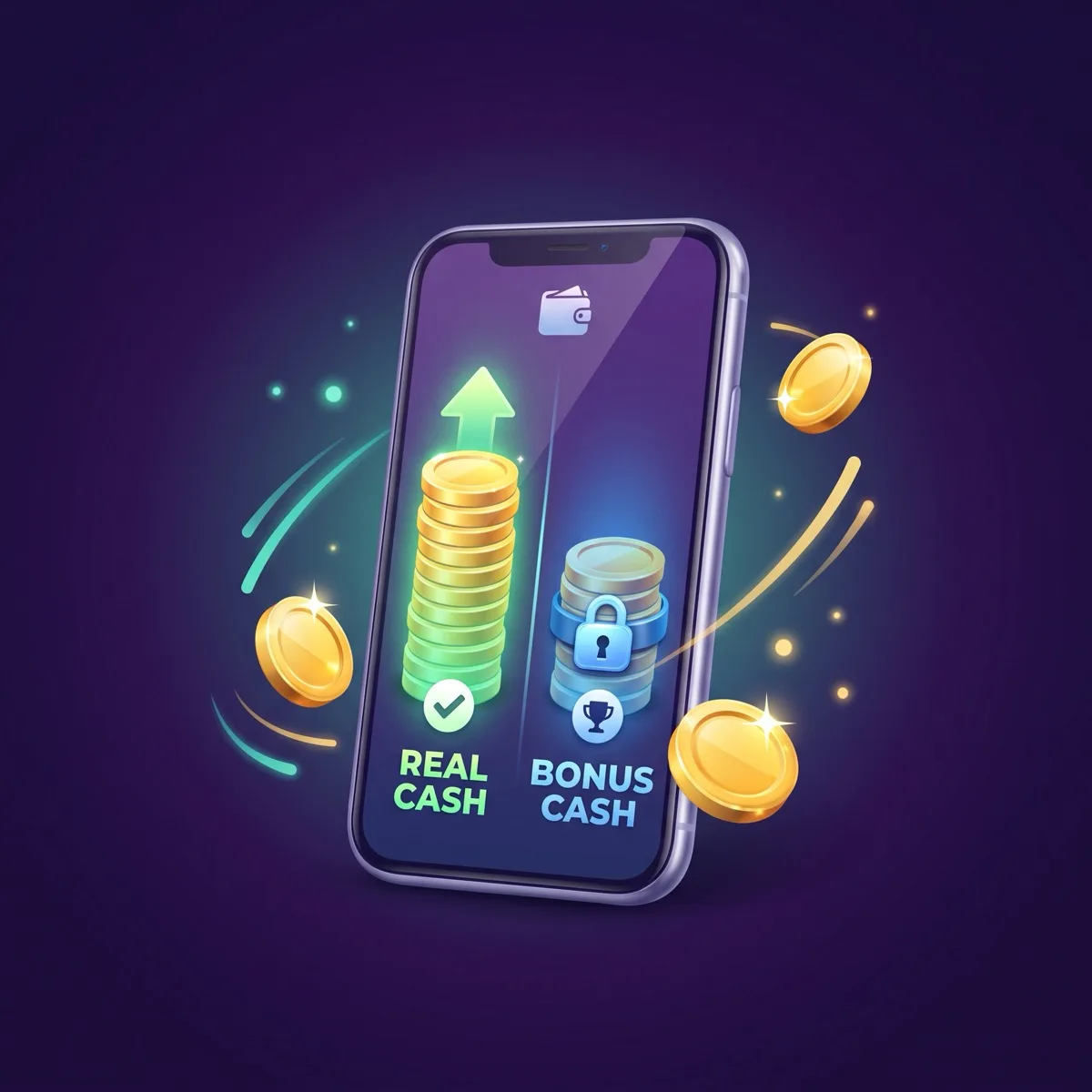
This is the fork worth remembering. Paid tournaments are player-funded; free ones are platform-funded or advertiser-funded. That difference is why no-fee prize pools are usually smaller, and why their winnings often arrive as "bonus cash," a promotional credit you can play with but not always withdraw. We explain that currency in bonus cash versus real cash, cover bonus cash from promos and referrals on Skillz, and compare the two formats head to head in free cash games versus paid-entry tournaments. Neither is a scam, but knowing which one you're in tells you where the money is really coming from.
Free tournaments do not draw prizes from entry fees, because there are none. Instead the platform or a sponsor subsidizes the prize, often using a marketing budget or bonus-cash credits to attract new players (Rivals, 2026). That is why no-fee prize pools are usually smaller than paid ones and are frequently paid in non-withdrawable bonus currency rather than withdrawable cash.
What's the Catch?
Because the platform takes a cut, a paid pool pays out less than players put in. That makes it negative-sum overall: the fees of the players who lose fund the prizes of the players who win. Over time, the average player pays in a little more than they take out. It's the same math as a poker room. Poker rooms keep a comparable 8 to 12% of each tournament buy-in (So Much Poker, 2026). Skill genuinely tilts the odds in your favor, but it doesn't turn the pool positive. In a head-to-head, the cut sets a precise bar; here's what win rate you need to break even.
Does that make it a scam? Not at all. It's disclosed, and it's simply how any pooled competition works, from office March Madness brackets to professional poker. What it means is that a cash tournament is paid entertainment with an upside, not a paycheck. Set expectations accordingly, and you'll enjoy it; expect a salary, and you won't. For a grounded look at real numbers, see how much you can actually earn playing skill games. The prizes themselves go to a small set of top finishers, in shares set before you ever enter.
Who Gets Paid: A Typical Prize Split by Finishing Place
Illustrative distribution; skill games publish a fixed prize hierarchy per contest (UNR Ozmen Center, 2025).
One last honest note, on where your balance lives. We could find no evidence that player balances are insured or held in segregated accounts, so treat money sitting in a game app like cash in a locker, not funds in a bank. The simple habit that removes almost all of that risk: withdraw promptly and keep your on-platform balance small.
The catch is that a paid pool is negative-sum after the rake: the losing players' fees fund the winners' prizes, so the average player pays in slightly more than they take out over time. Prizes are split among only the top finishers in shares set before entry (UNR Ozmen Center, 2025). It is legitimate, disclosed entertainment with an upside, not guaranteed income, so cash out promptly.
See a Player-Funded Prize Pool for Yourself
Atay's Skillz-powered titles run transparent, skill-based cash tournaments against real human opponents, with the rules published up front. Free to start, with optional real-cash brackets when you want them.
Browse Atay GamesFrequently Asked Questions
Where does the prize money in a cash tournament come from?
From the entry fees all the players pay in. Those fees form a prize pool, the platform keeps a disclosed cut, commonly 10 to 20% (Rivals, 2026), and the rest is paid to the top finishers. You're competing for a share of a pot every entrant funded, not the platform's own money.
How can game apps afford to pay real cash?
They pay winners with entrants' own fees and earn on the commission, or rake, not by beating players. On platforms like Skillz, the operator keeps roughly 16 to 20% of entry fees and splits the rest with the developer (Naavik, 2024).
Am I playing against the house?
No. You compete against other players for a share of a shared pool, and the platform collects the same rake no matter who wins. That's the opposite of a casino, where the house profits from your loss through a built-in edge on every wager.
Is a cash tournament a pyramid or Ponzi scheme?
No. A Ponzi pays earlier participants from newer deposits and has no real product. A cash tournament has an actual game and pays prizes from the same event's entry fees, not from recruiting new depositors, so it doesn't depend on constant sign-ups. See how to spot fake money game apps.
Do free tournaments pay real money, and who funds those?
Some do, but those prizes are subsidized by the platform or a sponsor, often as bonus cash, rather than by player entry fees. That's why no-fee pools are usually smaller and sometimes paid in non-withdrawable credits. See bonus cash versus real cash.
The Bottom Line
So whose $40 is it when you win? It was the players', pooled from entry fees, redistributed to the people who finished on top, minus a cut the platform disclosed before anyone paid. That's the honest mechanism, and it's why a cash tournament is neither the scam skeptics fear nor the free money the ads imply. Five things to carry forward:
- Paid pools are player-funded. Your prize is other entrants' fees, redistributed.
- The platform earns the rake, not your loss. It's you versus players, not the house.
- It isn't a Ponzi. Prizes come from this event's fees, not from new recruits.
- Free pools are different. Those prizes are subsidized by the platform or a sponsor.
- Mind the catch. After the rake it's negative-sum, so play for fun and cash out promptly.
If you want to see a transparent, player-funded pool in action, that's the kind we run. For the wider question of whether the category is trustworthy at all, our review of whether real cash skill games are legit pulls the evidence together.
Sources
- Rivals, What Is a Prize Pool and How Does It Work in Gaming Tournaments?, retrieved 2026-07-11, getrivals.com
- Rivals, How Do Prize Pools Work? A Complete Guide for Players (entry-fee pool, rake examples), retrieved 2026-07-11, getrivals.com
- University of Nevada, Reno (Ozmen Center for Entrepreneurship), Skill-Based Games: What Are They? (prize hierarchy set in advance; winners take most of the pot), retrieved 2026-07-11, unr.edu
- Naavik, A Look Under the Hood of Skillz (platform withholds roughly 16 to 20% of entry fees), retrieved 2026-07-11, naavik.co
- Inc., The Booming Business of Cash Prize Gaming (entry fees as low as about $0.60), retrieved 2026-07-11, inc.com
- Global Growth Insights, Real Money Skill Games Market Size, Share 2035 (market about $22.19B in 2025, about $25.27B in 2026), retrieved 2026-07-11, globalgrowthinsights.com
- So Much Poker, Understanding Poker Tournament Fees (tournament rake typically 8 to 12% of the buy-in), retrieved 2026-07-11, somuchpoker.com
- Skillz, Fueling Epic Wins: Skillz Puts Developers First With Innovative Revenue Model (developer revenue share), retrieved 2026-07-11, skillz.com
Disclosure and a note on real-cash play. Atay Games is a Skillz platform developer; our titles run on Skillz, and this guide is written by the Atay player-trust team, sourced to public records you can verify. Atay's cash tournaments are skill-based contests, not games of chance, and entry to paid brackets is always optional. Real-money play is entertainment with optional upside, not an income source or investment, and no earnings are promised. Paid contests are not available in every U.S. state; check your local eligibility first. Play responsibly and only with money you can afford to spend on entertainment.
Ready to Play a Fair, Player-Funded Cash Game?
Atay's Skillz-powered titles match you against real human opponents in transparent tournaments. Free to play, with optional real-cash brackets whenever you want them.
Play Atay Games Free