The global skill-gaming market is projected to reach roughly $52.71 billion in 2026 and more than double by 2034 (Fortune Business Insights, 2026). Yet most people who download a cash-prize game have no idea what actually happens after they tap "enter." Where does your fee go? Who do you play against? Why isn't this gambling? This guide opens the hood on the whole model — the money, the matchmaking, the fairness controls, and the law — so you know exactly how these platforms work before you trust one with a dollar.
- Players fund the prizes. Your entry fee joins every other entrant's into one pool. The platform keeps a small rake (≈10–20%) and pays the rest to top finishers.
- Skill matchmaking, not bots. Reputable apps pair you with real humans of similar ability on an identical starting board, so performance — not luck or a mismatch — decides the result.
- Fairness is engineered. A shared random seed equalizes luck, server-side validation rejects impossible scores, and anti-cheat telemetry flags manipulation.
- It's legally not gambling. Gambling needs prize + payment + chance. Skill games fail the chance test, which is why they're legal in most US states — though a few restrict them.
What Is a Skill-Based Gaming Platform?
A skill-based gaming platform is software that hosts paid competitions where player ability — strategy, speed, accuracy, knowledge — decides the winner, not chance. The platform then pays a prize pool out to the top finishers. The platform is the layer underneath the games: it handles sign-ups, deposits, matchmaking, scoring, anti-cheat, and payouts. The individual titles (puzzle, word, cards, pool, bingo) just sit on top of it.
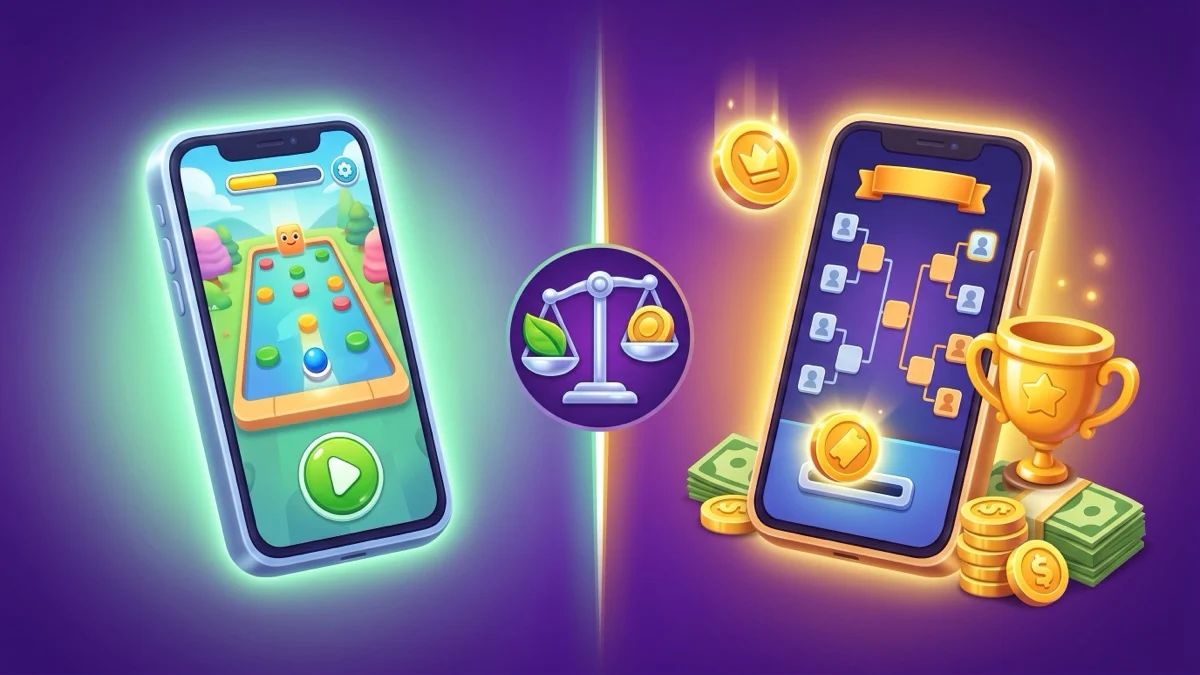
The whole category exists because of one distinction: skill versus chance. In a slot machine, the machine decides. In a skill game, you decide — your moves, under time pressure, against a real opponent on the same board. That line is more than philosophical. It's the legal and economic foundation of the entire model, and it's why skill-based cash games are treated differently from a casino. The sector is also growing fast: the broad skill-gaming market climbed from $43.99 billion in 2024 to $50.96 billion in 2025, a 15.9% annual rate (The Business Research Company, 2025). Our statistics page collects market size and player behavior benchmarks in one place.
So when you open one of these apps, you're really interacting with five systems working together: a wallet, a matchmaker, a game engine, a referee (anti-cheat plus score validation), and a cashier. The clearest way to understand the platform is to follow a single dollar through all five. It starts with how the platform makes its money.
How Do Skill-Based Games Make Money? (The Rake)
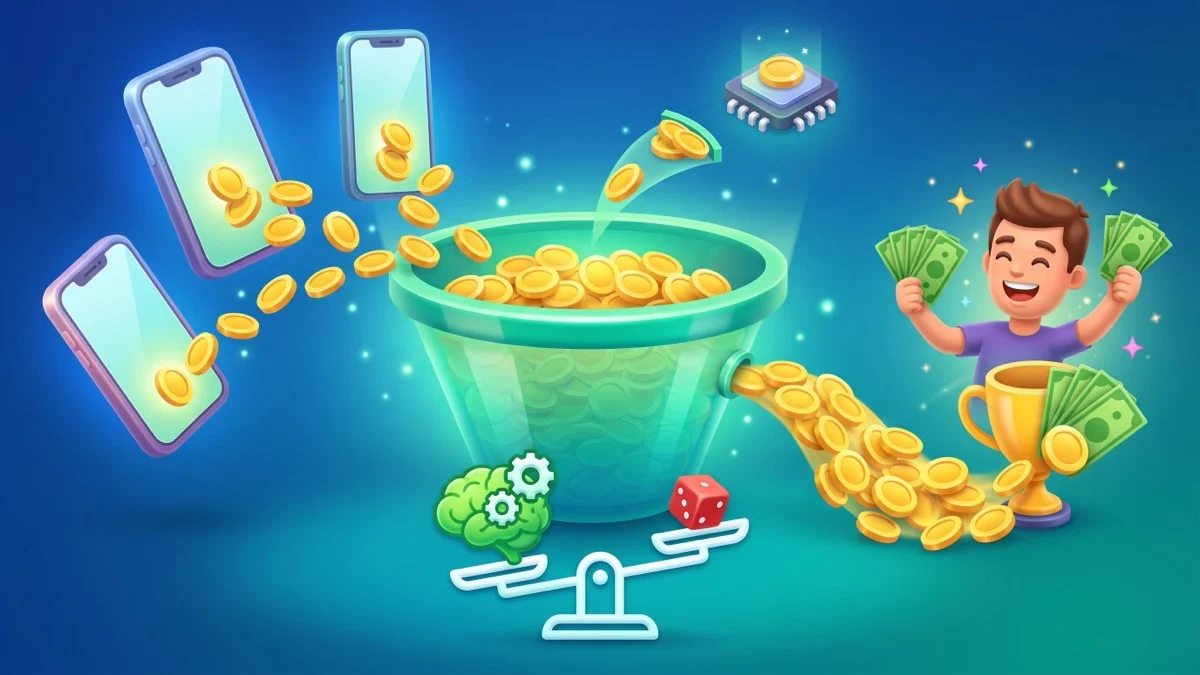
Skill-based platforms make money by keeping a small service fee — the "rake" — from each prize pool, typically 10–20% of the pooled entry fees. Players fund the prizes; the platform earns on the volume and frequency of competition, not on anyone losing (Gamixlabs, 2026). That single design choice is why a fair skill platform's incentives line up with yours: it profits when you keep playing, which means it needs the games to feel honest. It also means you're competing against other players, not the house; we unpack where tournament prize money comes from in a dedicated guide.
Here's the mechanic in plain numbers. Say two players each pay a $1 entry. That makes a $2 pool. The platform takes its rake — call it 15%, or $0.30 — and pays the winner the remaining $1.70. Scale that across thousands of simultaneous matches and the rake becomes the platform's revenue, while the prize fund stays fully player-funded. Entry fees in the real world commonly run anywhere from $0.60 to $20 or more, with prize pools from a dollar to $200+, and typically only the top 3–20% of a field takes home money (Bonus.com, 2026). The diagram below follows one entry through the system.
This is exactly how Atay's lowest head-to-head brackets are built: two players, identical boards, a $1 entry each, and the bulk of the pool returned to the winner with the rake disclosed before you join. In the payout records I verify, every settled match reconciles to that published split — which is the entire reason we show it. This is the cleanest signal of a trustworthy app: it tells you the rake up front. If a platform hides how the pool is split, that opacity matters more than any prize number it advertises. Once you can see where the cut goes, the next question is how the rest of your money physically moves — in and out of your account.
How Does the Money Flow? Deposits, Pools, and Withdrawals
Money moves through a skill platform in three stages. First you fund your account (or play free). Then your entry fee joins a held prize pool for that match. Finally, once the match settles, the platform sends your winnings to a withdrawal method. Deposits typically run through familiar rails — Apple Pay, Google Pay, PayPal, or a debit card — and reputable platforms keep prize funds separate from operating cash so payouts are always covered.
The payout step is where legitimate platforms separate themselves. Before a first cash-out, most run an identity check (KYC) to confirm you're a real, of-age player in an eligible location — the same compliance step banks and fintechs use to prevent fraud and underage play. Withdrawal timelines range from near-instant to a few business days depending on the method. This all happens on mobile, which is where the category lives: mobile holds about 52% of the entire gaming market, with roughly $107 billion in projected 2026 revenue (Icon Era, 2026).
One more flow worth knowing: nearly every platform runs free entry alongside paid. Free practice and free-roll tournaments use the same engine and matchmaking but cost nothing, which is how you should test any app before depositing. For the realistic earnings picture once you do play for cash, see how much you can earn playing skill games — and remember that winnings are taxable income, covered in our guide to taxes on skill-game winnings.
How Does Matchmaking Pair Players?
Matchmaking groups players of similar skill so the outcome hinges on performance, not on the luck of who you're drawn against. The system rates each player using signals like win rate, recent results, and an internal skill score. It then pairs you with opponents inside a defined skill band, constantly balancing match fairness against how long you wait for a game (Grokipedia, 2026).
Under the hood, a common approach is "greedy" matching: the system takes the highest-rated player waiting and pairs them with the closest suitable opponent within an allowed skill gap, then repeats down the queue. The longer you play, the more your rating reflects your true ability, so brackets keep adjusting — a new player isn't thrown straight to the sharks, and a strong player isn't farming beginners for easy pots. That's the entire point: a competitive contest where two evenly matched people race the same challenge. For the full mechanics — ratings, skill bands, same-seed matches, and whether it's rigged — see our deep dive on how matchmaking works in cash games. The chart shows the main inputs a matchmaker weighs.
Good matchmaking is also the answer to the most common suspicion players have: "Am I even playing a real person?" On a legitimate platform, yes — and you can verify it. Atay Games uses human-only matchmaking with identical boards, no bots padding the brackets. But matchmaking is only half of fairness. The other half is making sure nobody can cheat the result once the match begins.
Are Skill Platforms Fair? RNG, Anti-Cheat, and Real Opponents
Reputable skill platforms keep play fair through three engineered controls: identical starting conditions (a shared random seed, so every competitor gets the exact same board), server-side score validation (the server, not your phone, confirms results and rejects impossible scores), and anti-cheat telemetry (systems that inspect input patterns and gameplay data to flag manipulation). Match balance, latency control, and anti-cheat are considered the core pillars of fair competitive play (Harmonicode, 2026).
The "fair RNG" idea trips a lot of people up, so it's worth being precise. In a casino, randomness determines the outcome. In a skill game, the platform uses randomness to make the challenge identical for both players — the same puzzle, the same word board, the same shuffle. Then your skill decides who solves it better. The luck is equalized, not the result. That's why a strong player wins more often over time, while in a true game of chance they wouldn't. Server authority backs this up: because the platform validates scores centrally and can audit replays, a tampered client can't simply claim a fake win.
When you're vetting any app, look for the transparency signals experienced players check: Are you matched with real humans? Do both players get the same starting board? Are scores server-verified? Is the rake disclosed? Atay's fair-play system is built around exactly these guarantees, and our broader explainer on whether real-cash skill games are legit walks through how to vet any platform. If an app can't answer those questions, treat the silence as your answer.
See a Fair Platform in Action
Every Atay Games title is free to practice against real human opponents on identical boards — no bots, transparent rake, and low-stakes cash tournaments only when you're ready.
Browse All Atay GamesWhy Are Skill-Based Platforms Legal (and Not Gambling)?
Gambling, in legal terms, requires three elements together: a prize, consideration (you pay to enter), and an outcome determined by chance. Skill-based competitions clearly have the first two — there's a prize, and you pay an entry fee — but they fail the third, because the outcome is decided by skill. Remove the chance element and the activity falls outside most states' gambling statutes (Skillz legal documentation, 2026).
How do courts decide whether something is "skill" or "chance"? They generally apply one of three tests: the Dominant Factor Test (is skill or chance the bigger driver of the result?), the Material Element Test (is chance a meaningful element?), or the strict Any Chance Test (is any chance involved at all?). Most US states use the Dominant Factor Test, under which a game decided predominantly by skill is legal (Walters Law Group, 2026).
This is genuinely state-dependent, and the map is not uniform. Skill games for cash are restricted in a handful of states — and the rules keep moving. A Texas court ruled certain skill machines legal in February 2024, while other states have tightened their stance (Birches Health, 2024). In June 2026, Pennsylvania's Supreme Court held that bar-style skill machines are slot machines; we explain what that ruling covers and what it doesn't. Because the answer depends on where you live, always check whether skill-based gaming is legal in your state before you deposit. A transparent platform restricts cash entry in states where it isn't permitted — another signal worth checking.
How Big Is the Skill-Gaming Industry in 2026?
Skill-based gaming is a large, fast-compounding sector. The broad skill-gaming market is projected at $52.71 billion in 2026, on track to hit $121.57 billion by 2034 at an 11% annual rate (Fortune Business Insights, 2026). The narrower real-money slice — the cash-prize apps most readers picture — is valued at $25.27 billion in 2026 and forecast to reach $81.66 billion by 2035, growing about 13.92% a year (Business Research Insights, 2026). The trajectory is what's striking — for the full story on the size and growth of the skill gaming market, and why analyst estimates differ so widely, see our dedicated explainer.
Geographically, the market is led by Asia Pacific, which held about 41.70% of the global market in 2025 (worth roughly $19.37 billion), with North America the second-largest region at around 28% (Fortune Business Insights, 2026). The growth drivers are the same everywhere: wider smartphone access, secure payment rails, and social features that make competing with other people the draw. The regional split looks like this.
The scale matters to you as a player for one reason: a multi-billion-dollar, payment-processed, increasingly regulated industry has strong incentives to keep payouts real and play fair. For a deeper data dive, see our roundup of skill-based mobile gaming statistics, and when you're ready to play, our best real cash games of 2026 guide is the place to start.
Play responsibly. Treat any tournament entry fee as entertainment spending, set a budget, and never chase losses. If gaming stops being fun or starts to feel compulsive, free and confidential help is available 24/7 from the National Council on Problem Gambling at ncpgambling.org or 1-800-522-4700.
Frequently Asked Questions
How do skill-based games make money?
Skill-based platforms make money by keeping a small service fee, called the rake, from each prize pool — typically 10–20% of the pooled entry fees. Players fund the prizes; the platform earns on the volume of competition, not on players losing. That fee covers matchmaking, payment processing, and fraud prevention.
Where does the prize money in skill games come from?
The prize money comes from the players themselves. Every entrant in a paid tournament pays a fee, those fees are pooled into a single prize fund, and the platform pays the bulk of that fund out to the top finishers. The app keeps a small percentage as its rake and distributes the rest.
Do you play against real people or bots on skill platforms?
On reputable skill platforms you play against real, skill-matched humans, not bots. Matchmaking groups players of similar ability so the outcome turns on performance rather than on facing a far stronger opponent. Atay Games uses human-only matchmaking with identical starting boards for every competitor in a match.
Are skill-based gaming platforms rigged?
Reputable platforms are not rigged. Fairness rests on three controls: every player in a match gets the same random starting board so luck is equalized, the server validates scores to reject impossible results, and anti-cheat telemetry flags manipulation. Skill, not the platform, decides who wins.
Why are skill-based gaming platforms legal when gambling is not?
Gambling legally requires three elements together: a prize, consideration (paying to enter), and an outcome determined by chance. Skill-based competitions have the first two but fail the third, because outcomes are decided by player skill. That missing chance element places them outside most states' gambling laws, though a few states still restrict them.
Sources
- Fortune Business Insights, "Skill Gaming Market Size, Share & Industry Analysis, 2034," retrieved 2026-06-12, fortunebusinessinsights.com
- Business Research Insights, "Real Money Skill Games Market Size [2035]," retrieved 2026-06-12, businessresearchinsights.com
- The Business Research Company, "Gaming Global Market Report 2026," retrieved 2026-06-12, thebusinessresearchcompany.com
- Bonus.com, "Best Money Skill Games (2026) — Top Real-Money Skill Apps Ranked," retrieved 2026-06-12, bonus.com
- Gamixlabs, "How Skill-Based Games Are Shaping the Real-Money Gaming Industry," retrieved 2026-06-12, gamixlabs.com
- Icon Era, "Gaming Industry Revenue Statistics 2026," retrieved 2026-06-12, icon-era.com
- Grokipedia, "Skill-based matchmaking," retrieved 2026-06-12, grokipedia.com
- Harmonicode, "Behind the Tech-Based Scenes of Fair Play in Esports and RNG Integrity," retrieved 2026-06-12, harmonicode.com
- Skillz, "The Legality of Skill Gaming," retrieved 2026-06-12, docs.skillz.com
- Walters Law Group, "Skill Gaming Legal Guide," retrieved 2026-06-12, firstamendment.com
- Birches Health, "What are Skill Games? Not just Slot Machines? Legal where?," retrieved 2026-06-12, bircheshealth.com