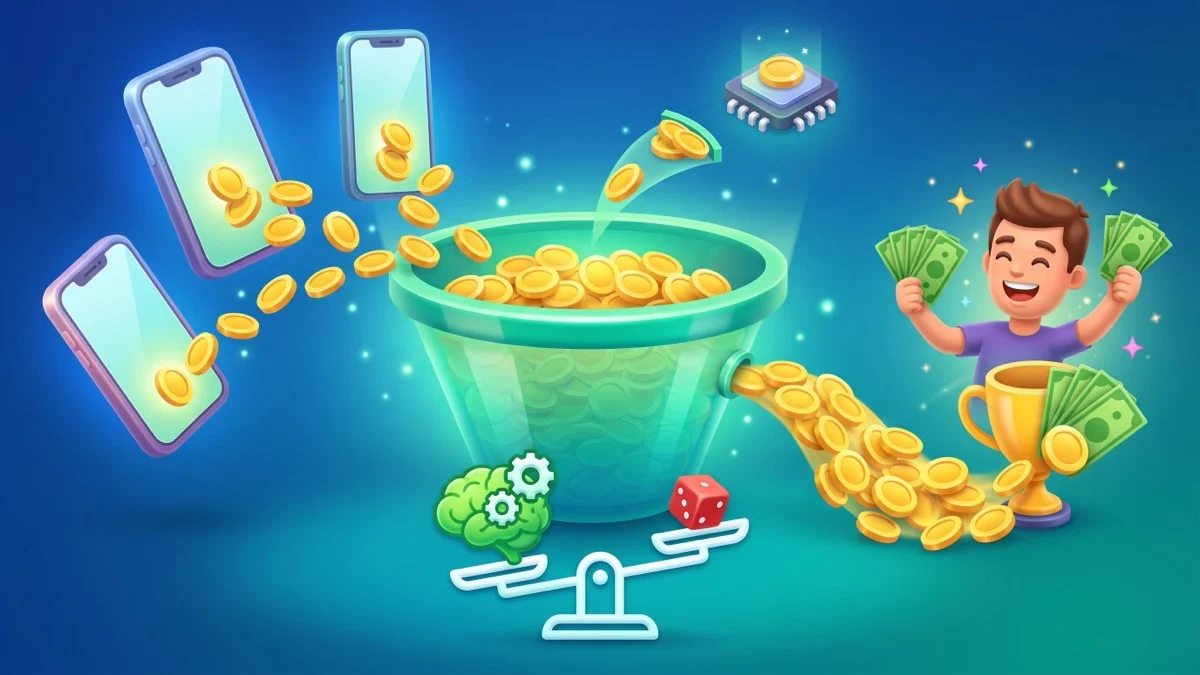

Here's a number that surprises most players: in well-balanced skill matches, the average person wins about 50.7% of the time (I3D 2024 matchmaking study). That's not an accident — it's the entire goal. Cash-game matchmaking is engineered to turn each match into a near coin-flip that your skill decides, not the luck of who you're drawn against. So why does it sometimes feel like the app hand-picks your toughest opponent right after a win? This guide opens the hood: how your skill is measured, how you're paired, what "same seed" really means, and whether the matching is honestly fair.
- A hidden rating runs everything. Cash games score your skill with an Elo-style rating (MMR) that rises when you beat stronger players and falls when you lose to weaker ones.
- You're paired inside a skill band. The system finds the closest-rated opponent available, widening the band only to cut your wait time.
- Same seed equalizes luck. In asynchronous matches you and your opponent get the identical board, so only skill can decide the result.
- ~50% is the sign of fairness, not sabotage. Balanced matchmaking targets a roughly 50.7% win rate; rigged-feeling matches drive players away, so honest balance is the profit-maximizing choice.
What Is Matchmaking in a Cash Game?
Matchmaking is the system that decides which opponent you face when you enter a paid match. In cash games it's skill-based: instead of pairing players at random, it groups people of similar ability so the entry fee buys a fair, winnable contest rather than a mismatch. Skill-based matchmaking sorts players with comparable ability — and comparable connection latency — into the same lobbies (PubNub, 2026).
Why does paid play demand this when a free-for-all party game doesn't? Because money raises the stakes on fairness. If you paid a dollar to enter and got dropped against someone five skill tiers above you, the entry was never really a contest — it was a donation. Skill-based matchmaking exists to make sure your fee buys a real shot. That's why it underpins every legitimate skill-based cash game, whether it's a head-to-head solitaire race, a word puzzle, or a bracketed tournament.
The format varies — some matches are live one-on-one, some are larger brackets, and many puzzle and card games run asynchronously — but the principle is constant. Find players of like ability, put them on equal footing, and let skill break the tie. To do that, the platform first needs a way to measure how good you actually are. That's where the rating comes in.
How Does the System Measure Your Skill?
Every player gets a hidden skill rating — conceptually an Elo or Matchmaking Rating (MMR) — that climbs when you beat stronger players and drops when you lose to weaker ones, drifting toward your true ability over time. Beating a higher-rated opponent earns a bigger rating gain, while losing to a lower-rated one costs you more, the core mechanic behind modern MMR (Elo rating system, 2026).
The idea was born in chess, where physicist Arpad Elo built a rating that predicted match outcomes from the gap between two players' scores. Modern cash games adapt the same math. Most keep the rating hidden and proprietary on purpose — if players could see and reverse-engineer the exact formula, some would game it instead of just playing well (EloFactory, 2025). What the system actually weighs is less mysterious than it sounds, and it's mostly your results.
So what feeds the rating? Win and loss results carry the most weight, adjusted by how strong your opponent was. Recent form matters too — a system that notices you're on a hot streak can pair you up faster than your lifetime average would. Some games also factor your score margin, not just the win. The chart below shows the typical mix of signals a cash-game matchmaker leans on.
One practical takeaway falls out of this: you can move your rating before you ever risk a cent. Playing free practice rounds still generates results the system can read, so your rating already reflects roughly the right band by the time you enter a paid match. If you want to climb deliberately, our guide to tips that raise your skill is the practical companion to this section. Once the system has your number, it can find your opponent.
How Are You Actually Paired With an Opponent?
When you tap enter, the system searches your skill band for an available opponent of comparable rating and pairs you with the closest match — widening the acceptable skill gap only if no one suitable turns up quickly. Matchmaking typically pairs the highest-rated waiting player with a suitable opponent inside a predefined skill gap, then repeats down the queue (Grokipedia, 2026). That last part — widening the band — is the source of nearly every "why did I get a hard opponent?" complaint.
Here's the trade-off no matchmaker can escape. A perfectly fair pairing might not exist in the queue at that exact second, so the system has two choices: make you wait for an ideal match, or loosen the skill gap and pair you now with someone slightly stronger or weaker. Wait too long and players quit in frustration; loosen too far and matches feel unfair. Every platform tunes that dial, balancing fairness against queue time. The flow below traces what happens in those few seconds after you hit enter.
This also answers the suspicion players hate to say out loud: "Am I even playing a real person?" On a legitimate platform, yes. Atay Games uses human-only matchmaking with identical boards — no bots quietly padding the brackets. But there's a wrinkle worth understanding, because the most common cash-game format doesn't pair two people in real time at all. It pairs your score against someone else's.
Synchronous vs. Asynchronous: The Same-Seed Model
Cash games run two formats. Synchronous matches put you live against someone playing at the same moment. Asynchronous matches — the dominant model for puzzle, word, solitaire, and bingo cash apps — record your score, then match it against another similarly rated player's run on the identical board. In Skillz async play, a new entrant becomes the challenger to a pending host's match, and all the random variables from the host's match are recreated for the challenger (Skillz Support, 2026).
That recreation is the whole trick, and it's called the same seed. A "seed" is the starting value that generates a game's randomness — the shuffle of a deck, the layout of a board, the order of pieces. When two players share the same seed, they get exactly the same challenge. So if you and your opponent both draw an awful solitaire deal, you both draw it. Luck is equalized, and the only thing that can separate your scores is how well each of you played the identical hand. It's the cleanest possible answer to "the game gave me a bad board."
The asynchronous design is also why these apps can offer a match any time of day without making you wait for a live human. There's a host-and-challenger system underneath: you might be the host whose score sits waiting, or the challenger who gets matched into an existing one. If no challenger of suitable skill appears, reputable platforms protect you — an unmatched host match is automatically cancelled and refunded after seven days on Skillz (Skillz async documentation, 2026). You're never charged for a contest that never found an opponent. Stuck waiting on one? Here's what to do while your result is pending. A match that starts and then crashes is a different case: here's what happens if your game crashes mid-match.
Is Matchmaking Fair, or Rigged to Make You Lose?
Let's address the conspiracy head-on. Honest skill matchmaking pushes most players toward a roughly 50% win rate, not a losing one — the average is about 50.7% when opponents are near-equal in skill (I3D 2024 matchmaking study). A system designed to make you lose would look nothing like that. So why would a platform want you to win half the time? Follow the incentive.
Players keep playing when matches feel winnable and quit when they feel predetermined. A peer-reviewed study of a competitive online game found that match experiences — both matchmaking quality and individual performance — measurably drive whether players churn or return (PMC / Royal Society Open Science, 2024). The effect is large enough to move millions of players. In a 2026 analysis of 5.4 million matches on the chess site Lichess, researchers found that smarter matchmaking — tuned for how players actually respond to wins and losses, not just raw skill parity — raised engagement by 4% to 6% over conventional skill-based matching (TechXplore, June 2026). The flip side is brutal for any platform that gets it wrong: in tests of one major shooter, roughly 90% of lower-skill players were less likely to return after a stretch of lopsided matches (Digital Trends, 2026).
Put those two findings together and the "rigged to lose" theory collapses on economics. A platform that stacked your matches would bleed exactly the players it needs to keep its prize pools full. Honest balance isn't charity — it's the profit-maximizing choice. From the payout and match data I review at Atay, the healthy signal we want to see is a win-rate distribution that clusters near 50%, not a population quietly grinding toward zero. A book that always beats you doesn't get a second visit.
That said, real unfairness does exist in this space — it just doesn't look like matchmaking. It looks like bots posing as humans, collusion between accounts, or manipulated scores. The defenses are the same ones a fair platform already runs: human-only matching, server-side score validation, and anti-cheat telemetry. Our deep dive on how Atay Games ensures fair play details those controls, and our broader guide to whether real-cash skill games are legit walks through vetting any app you don't yet trust.
Test the Matchmaking Yourself
Every Atay Games title lets you practice free against real, skill-matched humans on identical boards — no bots, no stacked lobbies. Play a few rounds and watch where your rating settles before you ever enter for cash.
Browse All Atay GamesWhat Matchmaking Means for Your Odds
Because the system targets balance, your long-run results reflect your skill relative to your band — you can't out-luck the field, but you can out-improve it. That's the honest version of "how to win more." Climbing means raising your rating through consistent play, which earns you tougher opponents and access to higher-stake brackets, where typically only the top 3% to 20% of a paid field takes home money (Bonus.com, 2026).
So a stubborn 50% win rate isn't a sign you're stuck. It's the system telling you you're correctly matched. To win net money, your skill has to outrun your band faster than the rating can recatalog you, which is why improvement beats volume every time. Grinding more entries at the same skill level just recycles your bankroll through the rake. A 50% record loses money once the rake comes out; here's what win rate you actually need. A few practical moves follow from that: practice free until your results are consistent, pick brackets that match your real ability rather than chasing big pools, and treat each rating bump as a signal you've earned harder games. For the realistic money picture, see how much you can earn playing skill games, and to decide where to put your entries, compare free cash games versus paid-entry tournaments.
Want the one-sentence version? Matchmaking can't make you win, and it isn't trying to make you lose — it's trying to make the result depend on you. If you want a fuller picture of how the rating, the rake, and the payouts all connect, our explainer on how skill-based gaming platforms work is the next read.
Play responsibly. Treat any tournament entry fee as entertainment spending, set a budget, and never chase losses. If gaming stops being fun or starts to feel compulsive, free and confidential help is available 24/7 from the National Council on Problem Gambling at ncpgambling.org or 1-800-522-4700.
Frequently Asked Questions
How are players matched in cash games?
Players are matched by a hidden skill rating, similar to Elo or MMR, that rises and falls based on results against rated opponents. The system groups players into skill bands and pairs you with someone of comparable ability, so the outcome turns on performance rather than on facing a far stronger or weaker player.
Does matchmaking make you lose on purpose?
No. Honest skill-based matchmaking targets a roughly 50% win rate for most players — the average in well-balanced matches is about 50.7%. Research shows players keep playing when matches feel winnable and quit when they feel stacked, so a system rigged to make you lose would drive players away and lose the platform money.
What does "same seed" mean in a cash game?
Same seed means you and your opponent play the identical board, shuffle, or puzzle. In asynchronous cash games, the system recreates every random variable from the first player's match for the second player, so luck is equalized for both. The only difference that can decide the match is skill.
Do cash games match you with real people or bots?
On reputable platforms you are matched with real, skill-rated humans, not bots. In asynchronous formats your opponent's run may have been recorded earlier, but it is still a real person who played the same board. Atay Games uses human-only matchmaking with identical starting boards for every competitor.
Why do opponents get harder as I keep winning?
Winning raises your hidden skill rating, so the system matches you against stronger players to keep games competitive. Beating higher-rated opponents lifts your rating more, while losing to lower-rated players costs more. Over time the rating settles near your true skill, which is why win rates drift back toward roughly 50%.
Sources
- Yuksel et al., "Skill-Based Matchmaking for Competitive Two-Player Games" (I3D 2024), retrieved 2026-06-12, cemyuksel.com
- TechXplore, "Smarter matchmaking — not just equal skill — could keep millions more gamers playing, study finds," retrieved 2026-06-12, techxplore.com
- Royal Society Open Science (via PMC), "Match experiences affect interest: impacts of matchmaking and performance on churn in a competitive game," retrieved 2026-06-12, pmc.ncbi.nlm.nih.gov
- Digital Trends, "Gaming study says skill-based matchmaking is fair, but it also quietly drives players away," retrieved 2026-06-12, digitaltrends.com
- PubNub, "What Is Skill-Based Matchmaking (SBMM)?," retrieved 2026-06-12, pubnub.com
- Wikipedia, "Elo rating system," retrieved 2026-06-12, en.wikipedia.org
- EloFactory, "Demystifying MMR and ELO: How League's Matchmaking System Really Works," retrieved 2026-06-12, elofactory.gg
- Grokipedia, "Skill-based matchmaking," retrieved 2026-06-12, grokipedia.com
- Skillz Support, "How does Skillz player matching work?," retrieved 2026-06-12, support.skillz.com
- Skillz, "Integrating the Skillz SDK for Async Competition," retrieved 2026-06-12, docs.skillz.com
- Bonus.com, "Best Money Skill Games (2026) — Top Real-Money Skill Apps Ranked," retrieved 2026-06-12, bonus.com