Deadwood is the cards in your gin rummy hand that aren't part of a set or run. Add up their points and you get your deadwood count, the number the whole game turns on: you may knock at 10 or less and go gin at zero. The catch is where you start. In September 2026 we dealt 2,000,000 random hands and found the average one carries 56.5 points of deadwood. Almost every hand is a race to shed about 47 points before the other player does.
This page defines 40 gin rummy terms, from deadwood to the undercut, with one worked example threaded through them. Where rulebooks use different words for the same thing, it says which book says what. If you'd rather learn the game in playing order, from the deal to the final score, start with the full rules walkthrough.
- Deadwood is your unmelded cards. Their point total is your deadwood count.
- Knock at 10 or less, go gin at zero. Only 1 dealt hand in 1,600 starts that low (Atay simulation, 2026).
- Bonuses split by region. North America tends to pay 25; the U.K. pays 20 for gin and 10 for an undercut (Gettysburg College).
- Most "rule fights" are vocabulary. Bicycle never says "deadwood," and Pagat never says "meld."
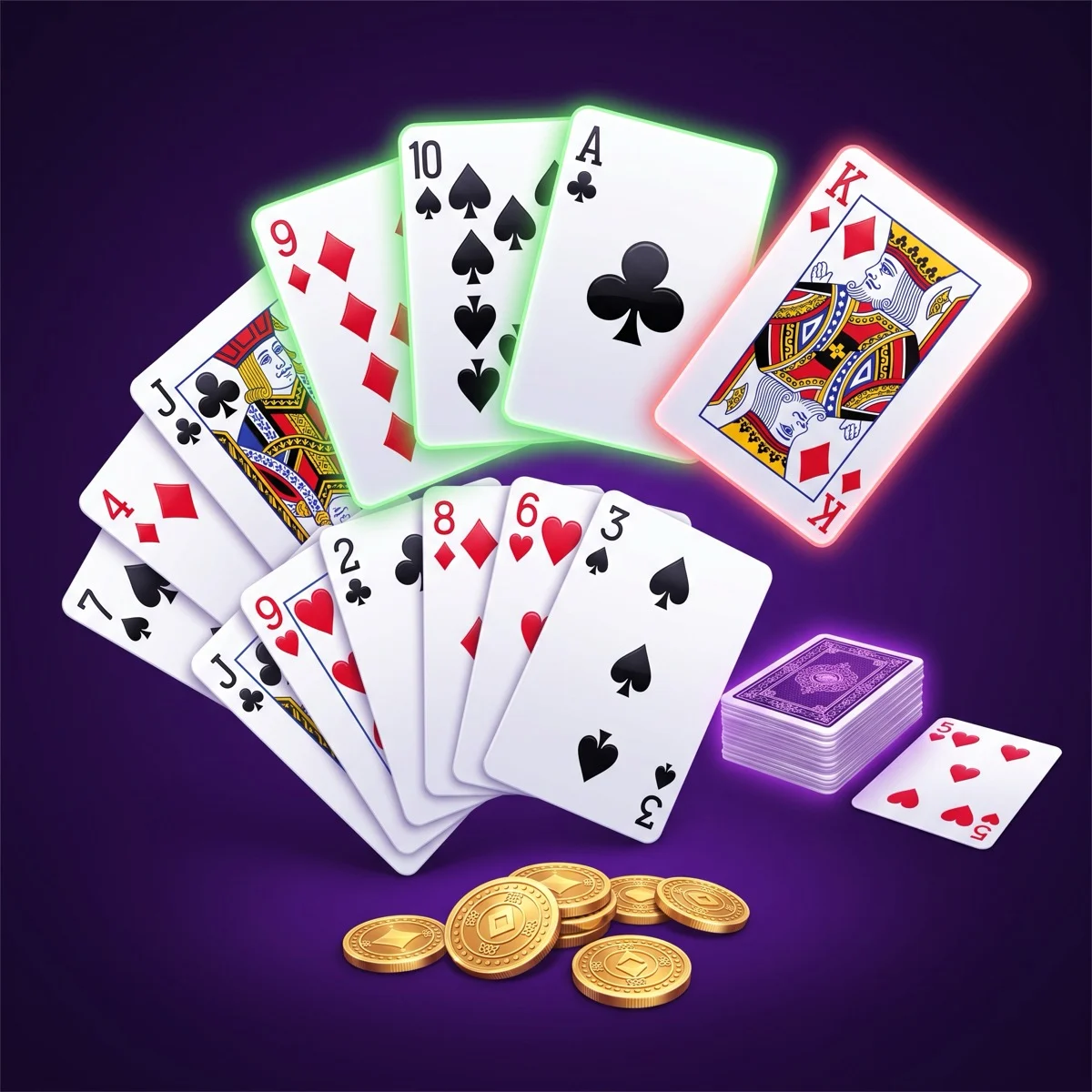
The two hands used on this page. Hand A, the knocker: 4♥ 5♥ 6♥ 7♥, 9♠ 9♦ 9♣, plus A♣ 2♦ 5♣. Hand B, the defender: Q♠ Q♣ Q♦, 2♣ 3♣ 4♣, plus 8♥ 9♥ A♠ 2♥. They're a constructed illustration, not a real deal, and every count below was checked in code.
What Is Deadwood in Gin Rummy?
Deadwood, defined. Deadwood is the cards in a gin rummy hand that don't belong to any meld. Pagat calls them "unmatched cards or deadwood," and their point total is the deadwood count: face cards 10, aces 1, other cards their pip value. You may knock at 10 or less and go gin at zero. The average dealt hand carries 56.5 points of it.
Deadwood
Also called: unmatched cards (Pagat, Bicycle Cards), unmelded cards
Deadwood is the cards in your hand that are not part of any meld. Pagat calls them "unmatched cards or deadwood," and the Gettysburg College rules say "Cards not in melds are referred to as deadwood." Bicycle Cards never uses the word at all; it says "unmatched cards." In Hand A, the A♣, 2♦ and 5♣ are deadwood, and every other card sits in a meld.
Deadwood count
Also called: deadwood points (Gettysburg College rules), count (Pagat), "Points" (MobilityWare)
Your deadwood count is the total point value of your deadwood cards. Hand A counts 1 + 2 + 5 = 8. The count depends on how you group your cards, because a card can sit in only one meld. Pagat: "A card can belong to only one combination at a time." The Gettysburg College rules: "Melds are disjoint, i.e. do not share cards." Your count is whatever the best grouping leaves.
The arrangement trap: one shared card, two possible counts
| Cards held | Where the 9♥ goes | Deadwood left |
|---|---|---|
| 7♥ 8♥ 9♥ 9♠ 9♦ | In the run, 7-8-9♥ | 9♠ + 9♦ = 18 |
| 7♥ 8♥ 9♥ 9♠ 9♦ | In the set of nines | 7♥ + 8♥ = 15 (best) |
| Add the 10♥ | In the run, 7-8-9-10♥ | 9♠ + 9♦ = 18 (best) |
| Add the 10♥ | In the set of nines | 7♥ + 8♥ + 10♥ = 25 |
Constructed illustration by Atay Games, every count checked by an exhaustive meld solver, September 22, 2026. One new card flips which grouping is best.
This is the miscount I see most from new players. They spot a run and a set, count both, and use the 9♥ twice, and then the app's number doesn't match theirs. The home you give a shared card changes the count, and one new card can flip which home is best.
Dead card
A dead card is a card that can no longer become part of any meld, because the cards it would need are gone. It's the gin version of the general meaning in Wikipedia's glossary of card game terms: "One that cannot be used in the play." The K♦ fits only four three-card melds: three sets of Kings and the J♦ Q♦ K♦ run. Once the Q♦ and two of the other Kings are buried in the discard pile, all four are dead ends, and so is the K♦. Stuck in your hand, it still costs 10.
Live card
A live card is a card that can still become part of a meld for someone at the table. Every card starts a hand live, able to join 4 to 6 three-card melds by our count. Late in a hand, a live high card is the discard most likely to be exactly what your opponent needs.
The deadwood scale: where a dealt hand starts
Best possible melds counted for every hand, ace low. First-party simulation by Atay Games, 2,000,000 random ten-card deals, September 2026; the 98-point ceiling is exact. Method in Sources.
What Are Melds, Sets and Runs in Gin Rummy?
Melds, sets and runs. A meld is a set (three or four cards of one rank) or a run (three or more cards of one suit in sequence). Each card can sit in only one meld at a time. By our count, a standard 52-card deck holds 329 possible melds: 65 sets and 264 runs, with the ace low only.
Meld
Also called: combination (Pagat, Bicycle Cards), lay (MobilityWare)
A meld is a set or a run, a group of cards that no longer counts against you. Pagat's page never uses the word. It says "combination," as Bicycle does, and MobilityWare's app help says "lay." How many melds exist? Our code counts 329 in a 52-card deck: 65 sets (five per rank, including the four-card set) and 264 runs (66 per suit, from three to thirteen cards long). In gin, your melds stay hidden in your hand until the hand ends.
Set
Also called: group (Pagat, MobilityWare)
A set is three or four cards of the same rank. Hand A's 9♠ 9♦ 9♣ is one. Bicycle Cards gives it no name and just describes "combinations of three cards of the same rank."
Run
Also called: sequence (Pagat, Wikipedia, MobilityWare)
A run is three or more cards of the same suit in consecutive order. Hand A's 4♥ 5♥ 6♥ 7♥ is one. No authoritative rulebook caps the length, and Pagat notes you can legally go gin with two five-card sequences.
Combination
Also called: meld (the finished sense), two-card combination (the unfinished sense)
A combination is a finished meld in Pagat's and Bicycle's rules, but some strategy guides use the word for cards that could still become a meld. Gin Rummy Palace's lessons count "combinations consisting of several cards that are not yet melds," such as 6♠ 7♠. When you meet the word, ask whether the writer means a meld you have or one you're hoping for.
Card values
Also called: point values, pip values
Card values are the points each card counts as deadwood: kings, queens and jacks 10, aces 1, and number cards their face value. Bicycle Cards: "the figure cards are worth 10 points and the other cards are worth the value indicated by their pips." Melded cards count nothing. Every source we checked agrees, except some round-the-corner rules that charge 15 for a stranded ace.
Ace low
Ace low means the ace ranks below the 2 and never above the king. Pagat: "A-2-3 is a valid sequence but A-K-Q is not." Bicycle: "The ace can be combined with the deuce but not with the king." At 1 point, it's also the cheapest card to get caught holding. For the meld rules in playing order, see sets and runs in the rules walkthrough.
What Are the Stock, Upcard and Discard Pile?
The deal leaves two piles. After ten cards each are dealt, the 21st card is turned face up to start the discard pile and the remaining 31 cards form the face-down stock (Pagat, updated September 1, 2026). Under Pagat's two-card rule, no more than 29 of those 31 can ever be drawn, because the hand stops when two remain.
Stock
Also called: stock pile (Pagat, Wikipedia), stock deck (Bicycle Cards), draw pile (Gettysburg College rules), StockPile (MobilityWare)
The stock is the face-down pile of undealt cards that players draw from. It starts at 31 cards. Pagat ends the hand once two remain and the player who took the third-last card discards without knocking, so no more than 29 are ever drawn. Apps can treat the end of the stock differently.
Upcard
Also called: turned up-card (Pagat), upturned card (Bicycle Cards)
The upcard is the card turned face up after the deal to start the discard pile. The non-dealer gets first refusal. If they pass, meaning they decline it, the dealer may take it. The Gettysburg College rules stretch the word to whatever card tops the discard pile at any moment. Whether to take it is a strategy call: should you take the upcard?
Discard pile
The discard pile is the face-up pile that every turn ends on. Only its top card can be drawn, so buried cards are out of reach. You can't throw back the card you just took from it; Pagat says you "must discard a different card." It's where nearly all of gin's public information lives. Here's when to take from it.
Dealer and non-dealer
The dealer is the player who deals the hand, and the non-dealer is the opponent, who gets the first chance at the upcard. Who deals next depends on the book. Pagat picks the previous hand's winner, Bicycle "the player who wins the previous game," and the Gettysburg rules alternate. With three players, Pagat's dealer sits the hand out; see gin rummy for 3 or 4 players. In an app, the software deals.
Turn
A turn is one draw followed by one discard. You draw the top card of the stock or the discard pile, then discard one face up. A knock is the one turn that ends with the discard face down.
Hand
Also called: round (Wikipedia, MobilityWare), partial game (Bicycle Cards), deal
Hand has two meanings in gin rummy: the ten cards you hold, and one complete deal from shuffle to score. Bicycle Cards calls a deal a "partial game," while Wikipedia and MobilityWare call it a "round."
Void hand
Also called: cancelled hand (Pagat), draw (Wikipedia), replayed hand (Gettysburg College rules)
A void hand is a deal that ends with no score because the stock ran down to two cards without a knock. Pagat: "the hand is cancelled, there is no score, and the same dealer deals again." The Gettysburg rules replay it with the same dealer, and Wikipedia calls it a draw. Check your app, because apps can handle a stock run-out differently.
What Does It Mean to Knock, Go Gin or Get Undercut?
How a hand ends. Knocking ends a gin rummy hand when your deadwood is 10 points or less (Pagat). Going gin means knocking with zero deadwood. After an ordinary knock the defender may lay off cards onto the knocker's melds, and if the defender's count ends equal to or lower, the knocker has been undercut and scores nothing.
Knock
Also called: knocking, going out (Gettysburg College rules), fold (Bicycle Cards)
To knock is to end the hand when your deadwood count is 10 points or less. The player who knocks is the knocker, and Wikipedia calls the other the "defending" player. Pagat says the name comes "presumably because it used to be signalled by the player knocking on the table." Knocking is optional: "A player is never forced to knock if able to" (Pagat). Hand A may knock at 8. Should it? That's covered in when knocking beats waiting.
Knock limit
Also called: knock value (Wikipedia)
The knock limit is the highest deadwood count you may knock with, which is 10 in standard gin. In Oklahoma gin the first upcard sets it, so a turned 7 means 7 or fewer. Across the 13 ranks, our arithmetic puts the average Oklahoma limit at about 6.5. Only four ranks (10, J, Q, K), or 30.8% of deals, leave it at 10.
Going down
Going down is another name for knocking with some deadwood left, as opposed to going gin. Wikipedia: "knocking with deadwood points is known as going down." Table-talk glossaries such as rummytalk's use it too.
Gin
Also called: going gin, gin hand
Gin is a knock with zero deadwood, meaning all ten cards are in melds. It earns a bonus plus the opponent's whole count, and the size depends on where you learned. The Gettysburg College rules page puts it plainly: "North American play tends to award 25 points for gin and undercut bonuses, whereas in the U.K., gin and undercut bonuses are 20 and 10, respectively." No lay-offs are allowed against gin (Pagat). Swap Hand A's A♣ 2♦ 5♣ for J♣ Q♣ K♣ and it's gin. Here's how gin is scored on both scales.
Big Gin
Big Gin is going out with all eleven cards melded, keeping the card you drew instead of discarding. Apps and Wikipedia's gin rummy article commonly list a 31-point bonus for it (MobilityWare is one example), and Wikipedia mentions rule sets that pay 50. The rule sources this glossary leans on don't include it: Pagat, Bicycle Cards and the Gettysburg College rules never mention Big Gin. If the gin version of Hand A draws the 8♥, all eleven cards meld. Check your app's rules screen before counting on it.
Lay off
Also called: layoff, laying off, combine (Bicycle Cards)
To lay off is to add one of your deadwood cards to a meld the knocker has laid down, so it stops counting against you. Only the defender may do it, and never against gin. Pagat: "the knocker is never allowed to lay off cards on the opponent's sets or runs," and "If a player goes gin, the opponent is not allowed to lay off any cards." In our example, B lays the 8♥ and 9♥ on A's heart run and drops from 20 to 3. The undercut guide tracks this in the lay-off ledger.
Undercut
Also called: underknock, underknocking (Wikipedia, rummytalk)
An undercut happens when the defender's deadwood, after lay-offs, is equal to or lower than the knocker's. Ties go to the defender; the Gettysburg College rules say "fewer or the same deadwood points." The defender scores the difference plus a bonus, 10 on the U.K. scale (Pagat) or 25 on the North American one (Gettysburg), and the knocker scores nothing. B's 3 undercuts A's 8, which is worth 5 plus the bonus: 15 or 30. For the defender's side, read how defenders set up an undercut.
The running example: a knock at 8, two lay-offs, an undercut
Constructed illustration by Atay Games, not a real deal. Counts checked by an exhaustive meld solver on September 22, 2026. Bonus scales per Pagat (U.K., undercut 10) and the Gettysburg College rules (North America, undercut 25).
What Do Box Bonus, Game Bonus and Shutout Mean?
Bonuses that land after the game. A box bonus, also called a line bonus, is added at the end of a game for every hand a player won: 20 points in Pagat, 25 in Wikipedia's scoring. Pagat is explicit: "These additional points cannot be counted as part of the 100 needed to win the game." The game bonus is 100, and Pagat makes it 200 on a shutout.
Box bonus
Also called: line bonus (Pagat, Wikipedia), box
A box bonus is a fixed number of points added at the end of a game for each hand a player won. Pagat sets it at 20, Bicycle gives "20 points for each partial game won," and Wikipedia uses 25. The Gettysburg College rules skip it on purpose: their description "omits 'box scores' for tournament play."
Game bonus
The game bonus is the extra 100 points awarded to the first player whose running total reaches 100 or more. Pagat and Bicycle Cards both use 100. Oklahoma games generally play to 150 (Pagat).
Shutout
Also called: schneider (Bridge in the Box), schneid (rummytalk), blitz (The Rummy Rulebook)
A shutout is a game in which the loser never scored a point. Pagat raises the game bonus to 200. Bicycle adds "100 points for winning all the rounds of a game without the opponent having won any." Wikipedia doubles each hand's points before the line bonus. It's the same event with three bookkeeping rules.
Game and match
A game is the race to 100 points across many hands, while a match, in a cash app, is one scored head-to-head contest. Wikipedia's multi-match variant flips the words and calls each race to 100 a "match." For how the bonuses stack up, see the full settlement order.
What Are Hollywood, Oklahoma and the Other Gin Variants?
Variants change the rules, not the words. Hollywood gin scores three games at once, a method Pagat dates to the game's 1941 Hollywood craze. Oklahoma gin lets the first upcard set the knock limit, doubles any deal whose upcard is a spade, and generally plays to 150 (Pagat). Straight gin bans knocking outright, and round-the-corner gin lets runs wrap past the king.
Hollywood gin
Hollywood gin is a way of scoring three games at once on one score sheet. Your first win counts in game one, your second in games one and two, and later wins in all three (Wikipedia). Pagat dates it to 1941, when gin "became a Hollywood craze."
Oklahoma gin
Oklahoma gin is a variant in which the first upcard sets the knock limit for that deal. A spade upcard doubles that deal's score, "including any undercut or gin bonus," and games generally run to 150 (Pagat). Pagat adds: "Some play that if an ace is turned up you may only knock if you can go gin."
Straight gin
Straight gin is a variant in which knocking isn't allowed, so every hand is played until someone goes gin. Wikipedia: "players are required to play until one of them can go Gin." No knocks means no lay-offs and no undercuts.
Round-the-corner gin
Also called: around-the-corner gin
Round-the-corner gin is a variant in which the ace can rank high or low, so runs can wrap past the king. The Rummy Rulebook, a hobby site, lists "A-2-3, A-K-Q and 2-A-K" as valid runs and charges 15 for an unmelded ace. Standard gin forbids the wrap (Pagat).
Not a gin variant: 13-card Indian rummy, which plays by different rules.
What Do Strategy Terms Like Outs and Safety Value Mean?
Strategy words are counts. Outs are the unseen cards that would complete a fragment of your hand. By exact count, a triangle (a pair plus a suited neighbor) has 4 outs, a pair or open-ended connector 2, and an edge connector 1. A card's safety value counts the three-card melds it could still join: 4 for an ace or king, 5 for a 2 or queen, 6 for 3 through jack.
Outs
Outs are the unseen cards that would turn a partial meld in your hand into a finished one. A triangle such as 7♥ 7♠ 6♥ has 4 (the 5♥, 8♥, 7♦ and 7♣), and a plain pair has 2. Outs are how you compare fragments competing for space in a ten-card hand. See counting outs in your opening hand.
Connector
Also called: open-ended connector, edge connector
A connector is two cards of the same suit next to each other in rank, waiting on a third to make a run. Open-ended ones like 6♥ 7♥ have 2 outs. Edge connectors have 1: Q♥ K♥ needs the J♥, and A♥ 2♥ needs the 3♥, because the ace is low only. A one-gap pair like 6♥ 8♥ also has 1.
Safety value
A card's safety value is the number of three-card melds it could still become part of. At the start of a hand an ace or king has 4 (three sets, one run), a 2 or queen has 5, and every card from 3 to jack has 6. We checked each count in code. The number falls as cards are seen, and the dead K♦ above is down to 0. The advanced guide explains the safety-value system.
Safe discard
A safe discard is a card your opponent is unlikely to be able to use. A low safety value makes a card safer, and so does sitting next to cards your opponent already threw. The opposite is a live card they may be waiting on.
What Do Gin Rummy Terms Mean in a Cash App?
Same deck, higher score wins. Gin Rummy Cash's App Store listing says both players "are dealt the same deck and play against the same computer opponent," and "the player who earns the most points wins." Your score is compared with another player's on the identical deal. In 2024 the platform behind it, Skillz, now operated under parent Firy Inc (NYSE: FIRY, formerly SKLZ), hosted an average of over 1.1 million daily tournaments (Skillz FY2024 Form 10-K).
Same-deck match
Also called: identical-board format
A same-deck match is a cash contest in which you and another player each play the identical deal, and the higher score wins. The App Store listing says both players "are dealt the same deck and play against the same computer opponent." So inside each hand you face the app's computer opponent, and your score is compared with the score of another player who got exactly your cards. Neither of you can blame the deal. For tactics, see how the identical-board format changes play.
Shared deals are one reason gin gets argued as a skill game, and we weigh that case in is gin rummy skill or luck. For the knock threshold, bonus values and timing Gin Rummy Cash uses, check the in-app rules.
Practice mode
Also called: free play
Practice mode is free play for virtual currency, with no entry fee and no cash prize. The App Store listing: "Practice for free and sharpen your skills before jumping into competition." It's where to learn how Gin Rummy Cash handles knocks and lay-offs.
Bonus cash
Bonus cash is promotional credit that can pay for cash-match entries but can't be withdrawn. Real cash, meaning deposits plus winnings, can be withdrawn. Our explainer compares bonus cash vs real cash.
Skillz
Skillz is the platform that runs matchmaking, entries and prizes for Gin Rummy Cash and other skill games. Its Form 10-K for 2024 reports "an average of over 1.1 million daily tournaments, including an average of approximately 405 thousand paid entry daily tournaments." Its listed parent company now trades as Firy Inc (NYSE: FIRY). The hub guide explains how real-money gin rummy works.
Ready to use the words at a real table? Start in practice mode, then try a $1 match. Gin Rummy Cash installs from the App Store on iPhone and iPad. On Android it's an APK from the official Atay site, and here's why the Android version installs from our site.
Cash-outs start at $5 (here's how cash-outs work), and real-money play is 18+. Where prize play is available depends on your location. It's skill competition against other players, not gambling.
Why Do Rulebooks Use Different Words for the Same Thing?
Dialects, not errors. Gin rummy has no single governing rulebook, so the same idea goes by different names. Bicycle Cards' gin page never uses the word "deadwood," saying "unmatched cards" instead, and calls a hand a "partial game." Pagat never uses "meld"; its word is "combination." None of these are mistakes. They're dialects of one game.
We read each source's own pages rather than summaries of them, and the pattern is plain. The rules of play differ only at the edges, such as who deals next or what happens when the stock runs low. The words differ everywhere. A player who learned from Bicycle and a player who learned from an app are describing the same hand in two dialects, so a lot of arguments about "the real rules" turn out to be arguments about vocabulary. Where do the numbers genuinely differ? Mostly in the bonus scale.
Who calls it what: gin rummy vocabulary by source
| Idea | Pagat | Bicycle Cards | Gettysburg College (Neller) | Wikipedia | MobilityWare app help |
|---|---|---|---|---|---|
| Cards not in a meld | unmatched cards or deadwood | unmatched cards | deadwood | deadwood | Deadwood |
| Their point total | count | value of the unmatched cards | deadwood points | deadwood count | Points |
| A finished meld | combination | combination | meld | meld | Meld, or "lay" |
| Same-rank meld | set or group | Not named | set | set | Set, or "group" |
| Same-suit sequence | run or sequence | run | run | run or sequence | Run, or "sequence" |
| Face-down pile | stock pile | stock deck | draw pile | stock pile | StockPile |
| First face-up card | turned up-card | upturned card | upcard (any top discard) | upcard | Upcard |
| Ending the hand at 10 or less | knocking | fold, "making a Knock" | knocking, going out | knock; going down | Knock |
| Adding to the knocker's melds | lay off | combine | laying off | lay off | Layoff |
| Defender wins after a knock | undercut | Not named | undercut | undercut or underknocking | Undercut |
| Bonus per hand won | line bonus or box bonus | "20 points for each partial game won" | box scores (omitted) | line bonus or box bonus | Not stated |
| One deal | hand | partial game | hand | round | round |
Each cell uses the source's own wording, checked against its page on September 22, 2026. "Not named" means the source describes the idea without naming it; "Not stated" means it doesn't cover it. MobilityWare stands in for app usage here, and other apps may use other words.
If two sources seem to clash, check the words before you check the rules. The Gettysburg "upcard" is any top discard, not just the first, and Pagat's "combination" is a finished meld, not a hopeful pair.
Frequently Asked Questions
Is deadwood the cards or the points?
Strictly, the cards. Pagat and the Gettysburg College rules use "deadwood" for the unmelded cards themselves, and their point total is the deadwood count. Everyday speech uses the word for both, and apps often show the total as your deadwood. In our 2,000,000-deal simulation, the average dealt hand carried 56.5 points of it.
Can you knock with exactly 10 points of deadwood?
Yes. Pagat says your deadwood "must be 10 points or less," and the Gettysburg College rules say it must not exceed 10. Only about 1 dealt hand in 1,600 starts that low, so you'll usually draw your way there. Oklahoma gin is the exception, because its upcard can set a lower limit.
Is the ace high or low in gin rummy?
Low only. An ace counts 1 point, and A-2-3 of a suit is a run while Q-K-A is not (Pagat; Bicycle Cards). Round-the-corner gin, where runs can wrap from king to ace, is a separate named variant, and some versions of it charge 15 points for an unmelded ace.
What is the difference between deadwood and a dead card?
Deadwood is the unmelded cards in your own hand right now. A dead card is one that can no longer join any meld, for anyone, because the cards it needs are gone. Every card starts a hand able to join 4 to 6 three-card melds. A dead card has none left, but it still counts full points as deadwood.
What is the most deadwood a gin rummy hand can have?
98 points. After the best melding, leftover cards can hold at most two of any rank and no three-card run, so the ceiling is two each of kings, queens, jacks and tens (80) plus two nines (18). K♠ K♥ Q♣ Q♦ J♠ J♥ 10♣ 10♦ 9♠ 9♥ contains no meld at all, and we verified it in code.
Why is it called knocking in gin rummy?
Pagat says it's "presumably because it used to be signalled by the player knocking on the table." Today you discard face down instead, or tap a button in an app. The name stuck, and so did the requirement: in standard gin you need 10 points of deadwood or less to knock.
The Bottom Line
Three things to keep. Deadwood is the number gin rummy is built around, and every draw, discard and knock is about shrinking it. Most rulebook "disagreements" are vocabulary, so translate before you argue. And bonus values are the main place the numbers really differ, usually 25 in North America against 20 and 10 in the U.K., so check the rules screen in whatever app you play.
Bookmark this page, because our other gin guides link their jargon back here. When the words feel natural and you're ready to play for real, the nine cash-match tactics are the next read.
Sources
- John McLeod, "Gin Rummy," Pagat.com, last updated September 1, 2026: deadwood and unmatched cards, combinations, sets and runs, ace low, the deal, the discard rule, knocking and the origin of the name, lay-off rules, undercut and gin scoring, line or box bonus, game bonus and shutout, the two-card stock rule, Hollywood gin, Oklahoma gin and house variations. Retrieved 2026-09-22. pagat.com
- Bicycle Cards (The United States Playing Card Company), "Gin Rummy": unmatched cards, combinations, stock deck, upturned card, fold and Knock, combine, partial game, 20-point gin, 10-point undercut and settlement bonuses. Retrieved 2026-09-22. bicyclecards.com
- Todd W. Neller, "Gin Rummy Rules" (slides, PDF), Gettysburg College, for the EAAI-21 Gin Rummy Undergraduate Research Challenge (2021): deadwood, disjoint melds, draw pile, upcard, 25-point gin and undercut bonuses, replay at two cards, box scores omitted. Retrieved 2026-09-22. cs.gettysburg.edu
- Todd W. Neller, "Gin Rummy EAAI Undergraduate Research Challenge," Gettysburg College: "North American play tends to award 25 points for gin and undercut bonuses, whereas in the U.K., gin and undercut bonuses are 20 and 10, respectively"; stockpile; going out; "fewer or the same deadwood points." Retrieved 2026-09-22. cs.gettysburg.edu
- Wikipedia, "Gin rummy": going down, defending player, undercut or underknocking, Big Gin (31, some rule sets 50; these lines carry no citation in the article), line or box bonus of 25, shutout doubling, straight gin, Hollywood scoring and the multi-match variant. Wikitext read 2026-09-22. wikipedia.org
- Wikipedia, "Glossary of card game terms": dead card ("One that cannot be used in the play") and deadwood. Retrieved 2026-09-22. wikipedia.org
- MobilityWare, "Terminology," Gin Rummy Help Center: StockPile, Upcard, Meld or lay, Set or group, Run or sequence, Points, Big Gin at 31, Layoff, round. Retrieved 2026-09-22. mobilityware.helpshift.com
- Apple App Store, "Gin Rummy Cash: Online Prizes" (Atay Games, id6742690853): same deck and same computer opponent for both players, most points wins, free practice. Retrieved 2026-09-22. apps.apple.com
- Skillz Inc., Annual Report on Form 10-K for the fiscal year ended December 31, 2024: an average of over 1.1 million daily tournaments, including about 405 thousand paid entry daily tournaments. Retrieved 2026-09-22. sec.gov
- The Rummy Rulebook, "Round-the-corner Gin" and "Gin Rummy" (hobby site, tier 3): wrap-around runs, 15-point ace, "Blitz" or "Schneider." Retrieved 2026-09-22. rummyrulebook.com
- RummyTalk, "Glossary of Gin Rummy Terms" (2018, updated May 2022; tier 3): underknock, schneid, going down. Retrieved 2026-09-22. rummytalk.com
- Bridge in the Box, "Guide to Gin Rummy" (tier 3): shutout or schneider. Retrieved 2026-09-22. bridgeinthebox.co.uk
- Gin Rummy Palace, "Good Cards and Combinations" (tier 3): "combination" used for cards that are not yet melds. Retrieved 2026-09-22. ginrummy-palace.com
- First-party simulation (Atay Games, September 2026): 2,000,000 random ten-card deals from a 52-card deck, ace low. For each hand every legal set and run was enumerated and the disjoint combination with the highest melded value chosen; deadwood is the remainder. Results: mean dealt deadwood 56.5, median 58, 0.0625% of hands at 10 or less (about 1 in 1,600), 0.0013% dealt gin (about 1 in 80,000), 39.8% holding at least one meld. A 300,000-deal rerun on September 22, 2026 reproduced these within sampling error.
- First-party computation (Atay Games, September 22, 2026), exhaustive enumeration in Python: 329 possible melds (65 sets, 264 runs); a 98-point maximum deadwood, proved by searching every meld-free combination of up to ten cards; 31 stock cards and at most 29 draws under the two-card rule; an average Oklahoma knock limit of 6.54 (ace counts 1) or 6.46 (ace means gin only); safety values of 4, 5 and 6; outs for triangles, pairs and connectors; and every count in the running example.
A note on rules and results. Gin rummy rules and bonus values vary by book, table and app. Where this glossary gives a number, it names the source, and your app's rules screen is the final word for that app. The running example is a constructed illustration. Skill-based cash games involve real money: knowing the words makes you a clearer player, not a winning one, and even good play loses hands. Real-money play is 18+ and depends on your location.
Know the Words? Now Play the Hand
Play free hands in Gin Rummy Cash until deadwood, lay-offs and undercuts feel automatic, then play a $1 match on the same deal as another player.
Play Gin Rummy Cash