You open a rummy app expecting 13 cards and a joker. Instead you get 10 cards, a deadwood counter and a button that says GIN. Or it happens the other way around. Same family name, two different games: gin rummy and Indian rummy. And the rules you grew up with don't all carry over.
Search results don't help much. Many of the pages that rank for this comparison come from Indian rummy operators. One ranking table even describes 13-card rummy with Western rules like knocking and open melding. That's wrong. Pagat, the long-running card game reference, says 13-card players keep every card concealed until someone declares.
So here's every rule difference in one table and a five-question test that identifies almost any rummy. You'll also see what the deal alone gives you in each game, from 1,000,000 simulated deals, and which one Gin Rummy Cash is.
Gin rummy and Indian rummy are different games. Gin deals 10 cards from one deck with no jokers, and you can knock once your unmatched cards total 10 or less. Indian rummy deals 13 from two decks with wild jokers, and you must declare a full hand with a pure sequence (Pagat). In our 1,000,000-deal simulation, 70% of 13-card hands held a joker.
- 10 vs 13. Gin deals 10 cards from one 52-card deck with no jokers. Pagat's Indian rummy deals 13 from two 53-card packs: 106 cards, printed jokers included.
- 7 in 10 hands get a joker. 70% of 13-card hands are dealt at least one wild card. A standard gin hand: 0% (Atay Games simulation, 1,000,000 deals, September 2026).
- The pure sequence is the bottleneck. 63% of 13-card hands start without one. Among hands that have one, 64% already hold the second sequence too.
- Drop penalties depend on the rulebook. Pagat's home game: 10 and 40, no cap. RummyCircle: 20 and 40, capped at 80. PlayRummy: 10 and 30.
- Only gin has knocking with leftover deadwood, lay-offs and undercuts. Every Indian rummy win is a full-hand declaration, the structural twin of going gin.
- Gin Rummy Cash is American gin. Its listing describes knocking plus gin and undercut bonuses, and our store screenshot shows 10 cards and no jokers.
What's the difference between gin rummy and Indian rummy?
Gin rummy is a two-player game: 10 cards each, one 52-card deck, no jokers. You can knock once your unmatched cards total 10 or less. Indian rummy deals 13 each from two decks, with printed and wild jokers. You win only by declaring a full hand: at least two sequences, at least one of them pure (Pagat, "Indian Rummy").
They're cousins, and it shows. Both are draw-and-discard games: take a card from the stock or the discard pile, then throw one away. Both build sets of one rank and runs in one suit. And unlike basic rummy, both keep melds hidden in your hand until the hand ends. That shared concealment is exactly why people mix them up.
Gin rummy vs Indian rummy, rule by rule
| Rule | Gin rummy | Indian rummy (13-card) | Source |
|---|---|---|---|
| Players | 2 | Up to 6 on two decks; Pagat's home game allows "as many as 10"; RummyCircle seats 2 to 6 | Pagat; RummyCircle |
| Deck | One 52-card deck | Pagat: two 53-card packs (106 cards, 2 printed jokers), three packs for 7+ players. PlayRummy: 104 cards + 4 jokers for 2 to 4 players | Pagat; PlayRummy |
| Cards dealt | 10 | 13 | Pagat |
| Jokers and wild cards | None | Printed jokers, plus every card of the turned-up "cut joker" rank | Pagat |
| Ace | Always low: A-2-3, never Q-K-A | Low or high: A-2-3 or Q-K-A, never K-A-2 | Pagat |
| Card values | K, Q, J = 10; ace = 1; others face value | A, K, Q, J, 10 = 10; others face value; jokers 0 | Pagat |
| Groups | Runs of 3+ in one suit; sets of 3 or 4 of a rank | Sequences of 3+ in one suit; sets of one rank in different suits only | Pagat |
| Required structure | None | At least two sequences, at least one pure (no joker standing in) | Pagat; RummyCircle |
| Melds shown during play? | No, hidden until someone knocks | No, hidden until someone declares | Pagat |
| How a hand ends | Knock (10 or less deadwood) or gin (0) | Declare: discard a 14th card and show all 13 in valid groups | Pagat |
| Winner may keep leftover cards? | Yes, up to 10 points on a knock | No, the declarer's whole hand must be valid | Pagat |
| Lay-offs | Yes: the defender adds cards to the knocker's melds, never against gin | No | Pagat |
| Undercut | Yes: the defender scores on equal or lower deadwood | No | Pagat |
| Bonuses | Gin 20 (Pagat, UK) or 25 (North American); Big Gin in many apps | None; a hand dealt complete ("Hand-Rummy") costs players who already played double | Pagat; Gettysburg College |
| Dropping out | Not in standard rules | Yes: first drop and middle drop, with penalties that vary by rulebook | Pagat; RummyCircle; PlayRummy |
| Who scores | The hand's winner scores the difference; first to 100 wins | Losers take penalty points; points, pool or deals formats | Pagat; RummyCircle |
| Cap per hand | None | 80 on RummyCircle; PlayRummy charges 80 when all 13 cards are unmatched; none stated by Pagat | RummyCircle; PlayRummy; Pagat |
| Stock runs out | Hand cancelled when two cards remain | Hand void, no one wins; players who dropped don't pay | Pagat |
Gin rules: Pagat, "Gin Rummy", updated September 1, 2026. Indian rummy: Pagat, "Indian Rummy: Paplu," updated October 12, 2022, plus the platform rules pages listed in Sources.
Want gin itself? Start with the full gin rummy rules, or look up what it means to knock in gin rummy in our glossary. Gin's bonus values also differ by rulebook, as the scoring section below shows.
Which rummy are you actually playing? A 5-question test
Five questions identify almost any rummy game. How many cards were you dealt? Is there a wild joker? Do melds go on the table during play? How does a hand end, and who scores? Ten cards, no jokers, hidden melds and a knock mean gin. Thirteen cards, a cut joker and a required pure sequence mean Indian rummy (Pagat).
- How many cards did you start with? Ten points to gin. Thirteen points to Indian rummy, but it isn't proof. In some countries Kaluki is "a basic two pack rummy game with 13 or 15 cards dealt per player" (Pagat). Seven usually means basic rummy. A hand that grows by one card each round, from 3 up to 13, is Three Thirteen.
- Is there a printed joker, or a face-up card whose rank turns wild? Yes points to Indian rummy or another joker game. No points to gin or basic rummy.
- Do players lay melds face up during play? Yes means an open-meld game. Two-player Rummy 500, for one, also deals 13 but puts melds face up as you make them. No, everything stays hidden: gin or Indian rummy.
- How does a hand end? Someone stops with 10 or fewer points of unmatched cards: that's a gin knock. Someone shows all 13 cards in valid groups, including a sequence with no joker: that's an Indian rummy declaration.
- Who scores? The winner scores the difference, and the race is to 100: gin. The losers collect penalty points, and either the lowest total survives or points settle each hand: Indian rummy.
Which rummy is this? The five questions as a flowchart
Atay Games decision guide, September 2026, built from Pagat's rules for Gin Rummy, Indian Rummy, 500 Rum, Kaluki and Three Thirteen.
Questions 2 and 4 do most of the work. A wild joker plus the pure-sequence rule is the real fingerprint of Indian rummy. The card count only narrows it down. Western open-meld games will get their own guide soon.
How do jokers work in Indian rummy, and why doesn't gin have them?
Indian rummy has two kinds of wild card. Printed jokers come in the deck. The cut joker is a card turned face up at the start, and every card of its rank becomes wild. In our September 2026 simulation of 1,000,000 deals, 70% of 13-card hands held at least one. Gin's single 52-card deck has no jokers (Pagat).
Pagat spells it out. Once a card is turned up, "all cards of same rank as this turned up card as well as the printed jokers are used as wild cards." If that turned-up card is itself a printed joker, only the other printed joker stays wild. Some tables make every ace wild in that case instead, and PlayRummy's rules page does just that.
Jokers are flexible. Pagat says wild cards "can be used to substitute for any desired card in a set or run." And a joker stuck in a losing hand costs nothing, because jokers count zero.
Now the rule gin players miss. A card of the wild rank still counts as itself when it sits in its natural place. Pagat's own example: with 8s wild, 7♥ 8♥ 9♥ is a pure run, because the 8♥ is used as itself. J♥ Q♥ 8♥ is not pure, since the 8 is standing in for a missing card.
What turns wild when an 8 is cut
Wild-card rules and the 8s example: Pagat, "Indian Rummy: Paplu". Two 53-card packs; the cut card itself is out of play. Card counts computed by Atay Games.
Atay Games simulation, 1,000,000 deals per game, September 2026. Dealt hand, before any draw, from two 53-card packs. Across three deck conventions, 68% to 78% of hands held a joker.
So why doesn't gin need jokers? Our read: the knock does their job. Gin lets you end a hand with up to 10 points of leftover cards, so it never demands a perfect hand. Indian rummy demands all 13 cards in valid groups, and wild cards make that reachable.
What is a pure sequence, and why does Indian rummy need two sequences?
A pure sequence is three or more consecutive cards of one suit with no joker filling a gap. Pagat calls it a "straight run." To declare in Indian rummy, you need at least two sequences, and at least one must be pure. In our September 2026 simulation of 1,000,000 deals, 63% of 13-card hands were dealt without one.
- Pure sequence: 4♠ 5♠ 6♠. No wild card fills a gap.
- Impure sequence: 4♠, a joker, 6♠. The joker stands in for the 5♠.
- Set: 9♣ 9♦ 9♥. Same rank, all different suits, so two 9♣ can't share a set even with two decks.
Players call the pure one the "first life" and the other the "second life." Pagat's version: the first straight run "is sometimes known as the 'original life' and the second run as the 'second life'." Online tables mostly say pure and impure sequence.
Why do lives matter so much? They decide what a losing hand pays. Pagat gives this hand: ♥10 ♥J ♥Q ♥K, ♠7 ♠8, ♦8, ♣4 ♦4 ♠4 ♠4, ♦2 ♦2. The hearts are an original life, but there's no second life, so every other card counts: 43 points.
Swap the ♦8 for a wild card and the bill drops to 8. The spades become a second life, and that makes the trio of 4s valid too. Only one ♠4 and the two ♦2s still count.
Our deal simulation shows where the difficulty sits. Almost two in three 13-card hands are dealt without a pure sequence, even though they hold three more cards than a gin hand. Once a hand has one, jokers make the second sequence easy: 64% of those hands already hold both. Compare gin: only about 1 hand in 134 is dealt two runs, while 23% of 13-card hands are dealt both required sequences.
What the deal alone gives you: gin vs Indian rummy
Atay Games simulation, 1,000,000 deals per game, September 2026. First-party data; every 95% confidence interval is under 0.1 percentage point. Deal math only: it says nothing about skill or who wins.
One result surprised us. A second deck doesn't make pure sequences easier. Duplicate cards crowd the hand, so 36.6% of two-pack hands had a pure sequence, against 42.4% with a single 53-card pack. Across the three deck conventions we tested, the range was 35% to 42%.
How we ran the simulation: method, assumptions and limits
- Scale. 1,000,000 deals per configuration, seed 20260922, standard-library Python, run September 22, 2026. The script isn't published; this box describes the full method.
- Gin. Deal 10 from a 52-card deck. Record any meld (a run or a set of 3+), any run (ace low only) and two disjoint runs.
- Indian rummy. Turn up a cut card from the full pack. Its rank becomes wild, along with the printed jokers, and the cut card leaves play. Then deal 13 from the rest. A pure sequence is Pagat's straight run: a wild-rank card used as itself still counts as natural; ace high or low, no K-A-2.
- Assumptions. One player's hand is a uniform random draw from the cards left after the cut, so player count doesn't matter. An impure sequence needs at least one natural card; joker-only groups are excluded because platforms differ. Testing 3-card windows is enough, since any longer sequence contains one.
- Deck conventions. Primary: two 53-card packs (106 cards), as in Pagat and RummyCircle. Sensitivity: one 53-card pack; and PlayRummy's 104 cards plus 4 jokers, with aces wild when a printed joker is cut.
- Checks. Ten hand-built test cases pass, including a wild card used as itself, Q-K-A legal and K-A-2 illegal. Joker counts match exact combinatorics in all three decks. Our gin "any meld" rate, 39.86%, matches the 39.8% from our separate 2,000,000-deal gin simulation.
- Limits. Dealt hand only, with no draws. It says nothing about skill, win rates or which game is harder.
| Dealt hand holds | Gin (10 of 52) | Indian, 2 packs (106) | Indian, 1 pack (53) | Indian, 104 + 4 jokers |
|---|---|---|---|---|
| At least one wild card | 0% | 69.97% (exact 69.98%) | 68.30% (exact 68.30%) | 77.69% (exact 77.72%) |
| Mean wild cards | 0 | 1.10 | 0.98 | 1.34 |
| Natural run / pure sequence | 20.02% | 36.62% | 42.39% | 35.06% |
| No pure sequence | n/a | 63.38% | 57.61% | 64.94% |
| Two runs / both sequences | 0.74% | 23.36% | 26.98% | 24.93% |
| Any meld | 39.86% | n/a | n/a | n/a |
The two games also use different words for close ideas. Here's how the terms line up, including the nearest thing gin has.
Same idea, three vocabularies
| Pagat's term | Online tables say | Nearest gin idea |
|---|---|---|
| Straight run (original life) | Pure sequence (first life) | Run |
| Ordinary run | Impure sequence | None: gin has no jokers |
| Trail, trio | Set | Set |
| Packing | Drop | None |
| Declare Rummy | Declare, show | Going gin |
Terms from Pagat, "Indian Rummy: Paplu," and RummyCircle's rules pages. Gin terms: our gin rummy glossary.
How does a hand end: knocking in gin or declaring in Indian rummy?
In gin you can end a hand early by knocking once your unmatched cards total 10 points or less. Your opponent can then lay off cards onto your melds. Indian rummy has no knock. A hand ends only when someone discards a 14th card and shows all 13 in valid groups, or when the stock runs out (Pagat).
Here's the idea that makes both games click: every Indian rummy win is a gin. Going gin means melding your whole hand. Declaring in Indian rummy means the same thing, with jokers helping. Gin simply adds a second, earlier exit, the knock, where you can win with some cards left over. That's why knocking feels strange to 13-card players, and why declaring feels strict to gin players.
Three events exist only in gin:
- Lay-offs. After a knock, the defender can add unmatched cards to the knocker's melds. Nobody lays off against gin (Pagat).
- Undercut. If the defender's count after lay-offs is equal to or lower than the knocker's, the defender scores instead. See how an undercut flips a knock.
- Big Gin. Melding all 11 cards after a draw. It's common in apps, usually worth 31 points, but Pagat, Bicycle and the Gettysburg College rules don't use it. More in the Big Gin glossary entry.
And three exist only in Indian rummy:
- Wrong declaration. On RummyCircle's points tables, declaring an invalid hand costs 80 points.
- An early declaration. In Pagat's rules, if someone declares on their first turn, players who haven't had a turn yet pay at half rate.
- Hand-Rummy. A hand dealt already complete makes players who have already played pay double (Pagat).
How rare is a dealt winner in gin? In our 2,000,000-deal gin simulation, about 1 hand in 80,000 is dealt gin. The game is built in the draws.
How is Indian rummy scored, and why do drop penalties vary?
Indian rummy scores the losers, not the winner. Unmatched cards count against you: aces and face cards 10, jokers 0. The drop penalties depend on the rulebook. Pagat's home game charges 10 or 40 points with no cap. RummyCircle charges 20 or 40 and caps a hand at 80. PlayRummy charges 10 or 30.
How much of a losing hand counts? RummyCircle's points-rummy rules page sets it out. Without a pure sequence, all your cards are counted. With a pure sequence but no second one, only the pure sequence is left out. Pagat's rule works the same way in substance, as the 43-point example above shows.
Notice the ace. It costs 10 in Indian rummy and 1 in gin. That's a real trap when you switch games. The card you learned to fear in one game is the cheapest card in the other.
Gin works the other way round. The hand's winner scores the difference in deadwood. Going gin or undercutting adds a bonus: 20 and 10 in Pagat and UK play, or 25 each in North American play. Our guide shows how gin is scored on both bonus scales.
Three rulebooks, three sets of numbers
| Rule | Pagat home game | RummyCircle points rummy | PlayRummy |
|---|---|---|---|
| First drop | 10 | 20 | 10 |
| Later (middle) drop | 40 | 40 | 30 |
| Cap per hand | None stated | 80 | 80, when all 13 cards are unmatched |
| Wrong declaration | Not covered | 80 | Not stated on its rules page |
| Deck | 2 × 53 (2 printed jokers) | 2 packs, 1 printed joker each | 104 cards + 4 jokers (2 to 4 players) |
Pagat, "Indian Rummy: Paplu" (updated October 12, 2022); RummyCircle points-rummy rules page; PlayRummy rules page. All retrieved September 22, 2026. No single body sets 13-card rummy rules, so check your table's rules screen.
Why the spread? No governing body writes 13-card rules. Pagat records a traditional home and club game, and each online platform publishes its own house rules. So when someone says "the drop is 20," the honest reply is: on whose table?
What are points, pool and deals rummy?
They're three ways to run the same 13-card hand. Points rummy settles every hand at a set value per point. Pool rummy keeps a running total and eliminates you at 101 or 201. Deals rummy plays a fixed number of hands with chips, and the most chips wins (RummyCircle's rules pages; Wikipedia).
One hand, three formats
| Format | How it works | Numbers on RummyCircle's tables |
|---|---|---|
| Points | Each hand settles on its own | 80-point maximum; drops 20 and 40 |
| Pool 101 | Running total; you're out at 101 | Drops 20 and 40 |
| Pool 201 | Running total; you're out at 201 | Drops 25 and 50 |
| Deals | Fixed number of deals; chips change hands; most chips wins | Equal chip stacks sized from the 80-point maximum (480 each in its six-deal example); no drop in 2-player games |
RummyCircle's points, pool and deals rules pages, retrieved September 22, 2026. Other platforms set their own numbers.
Wikipedia's Indian Rummy article describes the same three formats. Those lines carry no citations, though, and the article is tagged for needing more, so treat it as a cross-check only.
Gin's nearest equivalent is the standard game to 100, with box bonuses for each hand won. There's also Hollywood gin, which scores three games at once.
Why is Gin Rummy Cash American gin and not 13-card rummy?
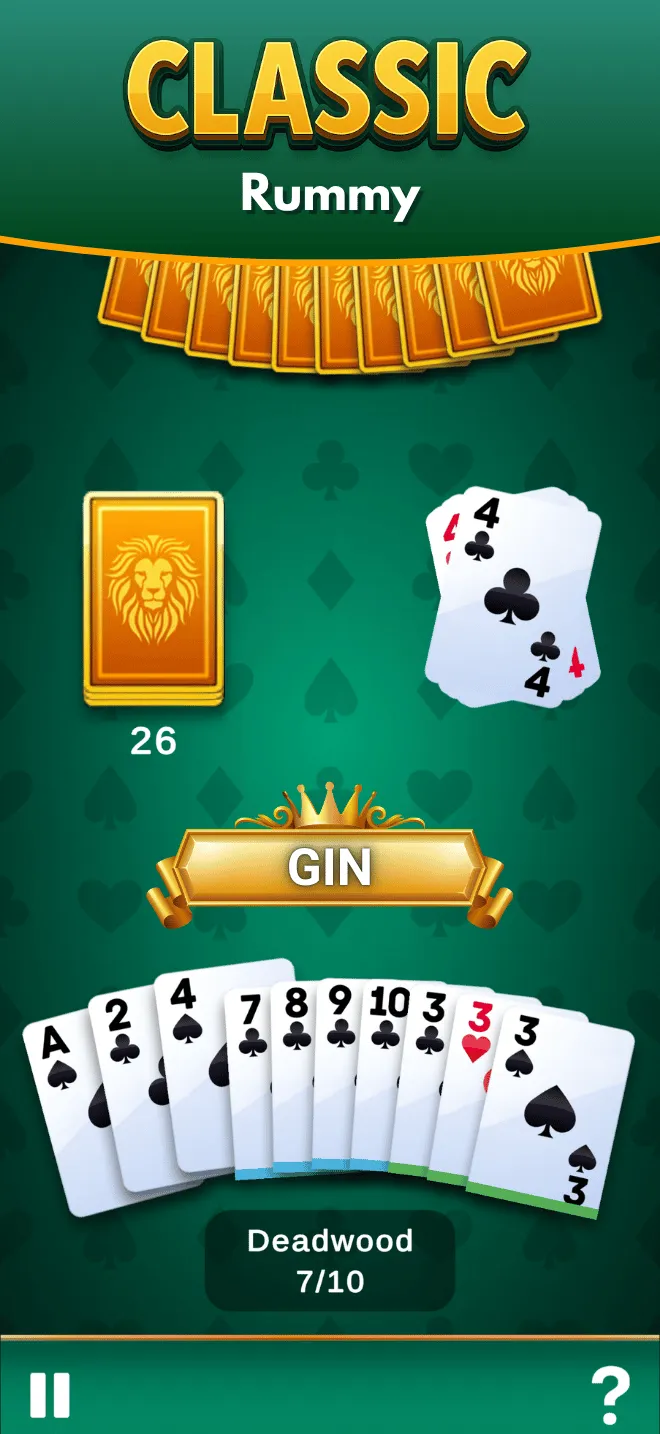
Gin Rummy Cash is American gin. Its App Store listing tells you to "form sets and runs" and to "knock when you're ready." It adds that you earn bonus points "for perfect Gin hands or undercutting your opponent." Our store screenshot shows a 10-card hand with a deadwood counter and no jokers. Atay doesn't offer 13-card rummy.
The format is where it gets specific. The game runs on Skillz, operated by Firy Inc (NYSE: FIRY, formerly SKLZ). The App Store listing says: "Both players are dealt the same deck and play against the same computer opponent. The player who earns the most points wins!"
So your competitor is a real person on the identical deck. Inside the hand, you both play the same computer-controlled opponent, and your point totals are compared. Matchmaking has its own explainer: how opponents are matched.
Why would a same-deck app use gin rather than 13-card rummy? This is our read, not company history. Gin produces a score from each player's own play, and that's what a points comparison needs. A 13-card hand's result depends on who declares first at a shared table of up to six, with losers paying the winner. That doesn't split cleanly into two independent scores.
What we haven't verified in the app: the match clock, any point cap, how many hands a match lasts, the knock limit and the bonus values. The listing mentions "time and point limits" without giving numbers, so check the rules screen in the app.
What about playing 13-card rummy for money?
That's Indian law, not US precedent. India's Promotion and Regulation of Online Gaming Act, 2025 (Act No. 32 of 2025) bans offering online money games. It defines them as games for stakes "irrespective of whether such game is based on skill, chance, or both." On 27 May 2026, India's Supreme Court set aside the Madras and Karnataka High Court rulings. It upheld state bans on online games for stakes, including rummy and poker (State of Tamil Nadu v. Junglee Games India, 2026 INSC 594).
In the US, prize play is 18+ and location-dependent, so check whether prize play is available in your state. This is general information, not legal advice. The full legal and skill evidence is in is gin rummy a game of skill or luck?
What changes if you grew up playing 13-card rummy?
Six 13-card rummy habits work against you in gin. Three are about cards: waiting for jokers, running Q-K-A, pricing aces at 10. Three are about ending a hand: holding out for a full hand, forgetting lay-offs, looking for a drop. One habit carries over: both games hide melds until the hand ends, so watching discards still pays (Pagat).
- Waiting for a joker. Gin's deck has none, so a gap in a run stays open until the exact card arrives.
- Holding Q-K-A as a run. Legal in Indian rummy, illegal in gin, where the ace is always low.
- Treating aces as expensive. An unmatched ace costs 1 point in gin, not 10.
- Holding out for a full hand. In gin you may end the hand at 10 or fewer points of deadwood. You don't need a complete declaration.
- Forgetting lay-offs and undercuts. When you knock, the defender can add cards to your melds and may undercut you.
- Looking for a drop button. Standard gin rules have no drop, so there's no fixed-price exit from a bad hand.
What does carry over? Watching what the other side picks up and throws away, because neither game shows melds until the end. In Gin Rummy Cash, that other side inside the hand is the computer opponent. For the first decisions of a hand, see what to keep from a 10-card deal.
Going the other way?
Gin players trying 13-card rummy should expect to need a pure sequence before anything else counts. And every ace left in your hand costs 10, not 1.
Frequently Asked Questions
Is Indian rummy the same as gin rummy?
No. Gin deals 10 cards from one deck with no jokers and lets you knock with up to 10 points of unmatched cards. Indian rummy deals 13 from two decks with wild jokers and requires a full declaration with a pure sequence. Both hide melds until the hand ends, which is why they get confused (Pagat).
Does gin rummy use jokers?
Not in standard rules. Pagat's gin rules use one standard 52-card deck, and the ace is always low. Indian rummy adds printed jokers plus a cut joker rank. In our 1,000,000-deal simulation, 70% of 13-card hands were dealt at least one wild card, while a gin hand never is.
What is a pure sequence in rummy?
Three or more consecutive cards of one suit with no joker substituting for a card, such as 4♠ 5♠ 6♠. Indian rummy requires at least one to declare, and without it a losing hand counts every card. Gin has no such rule. In our simulation, 63% of 13-card hands were dealt without one.
Can you knock in 13-card rummy?
No. Pagat's Indian rummy has no knock. A hand ends only when a player shows all 13 cards in valid groups, or it's void if the stock runs out. Knocking with up to 10 points of leftover deadwood is a gin rule, and so are lay-offs and undercuts.
Is Gin Rummy Cash 13-card rummy?
No. It's American gin. The App Store listing describes forming sets and runs, knocking, and bonus points for gin hands and undercuts, and both players get the same deck. Our store screenshot shows 10 cards and no jokers. Prize play is 18+ and depends on your location.
Why do rummy apps give different drop penalties?
Because no single body sets 13-card rules. Pagat's home game charges 10 or 40 points with no cap; RummyCircle charges 20 or 40 with an 80-point cap; PlayRummy charges 10 or 30. Each platform publishes its own house rules, so check your table's rules screen before you play.
The bottom line
Gin rummy and Indian rummy share a family and a concealed hand, and not much else. Before you sit down, check these six things:
- 10 cards from one deck vs 13 from two.
- No jokers vs printed and cut jokers.
- A knock or gin vs a full 13-card declaration built on a pure sequence.
- The winner scores in gin; the losers score in Indian rummy.
- 13-card drop and cap numbers depend on the rulebook, so read the rules screen.
- Gin Rummy Cash is American gin.
Ready to try the 10-card game? Learn it free in practice mode, then enter a $1 match if you're 18+ and prize play is available where you live.
Gin Rummy Cash is on iPhone and iPad through the App Store. On Android, it's an APK from the official Atay site, and we explain why Android installs come from our site. Expect a few dollars, not income, and treat entry fees as the cost of a hobby. For formats, prizes and cash-outs, see our guide to playing gin rummy for real money.
Sources
- Atay Games, deal simulation: gin (10 of 52) and 13-card Indian rummy in three deck conventions, 1,000,000 deals per configuration, seed 20260922, run 2026-09-22. First-party data; the script is not published, and the full method is described in this post.
- Atay Games, simulation of 2,000,000 random ten-card gin deals, September 2026. Method in the Sources of our gin rummy rules guide.
- John McLeod, Pagat, "Gin Rummy," last updated 1 September 2026. Retrieved 2026-09-22. pagat.com
- John McLeod, Pagat, "Indian Rummy: Paplu," based mainly on information from Vasant Mali, last updated 12 October 2022. Retrieved 2026-09-22. pagat.com
- Pagat, "500 Rum," last updated 1 June 2026; "Kaluki," last updated 11 February 2011; "Three Thirteen," last updated 1 May 2021. Retrieved 2026-09-22. 500 Rum; Kaluki; Three Thirteen
- Todd Neller, Gettysburg College, "Gin Rummy EAAI Undergraduate Research Challenge" rules, for the bonus scales: 25 and 25 in North American play, 20 and 10 in the UK. Retrieved 2026-09-22. cs.gettysburg.edu
- Bicycle Cards, "Gin Rummy," for the 20 and 10 bonuses and the absence of Big Gin. Retrieved 2026-09-22. bicyclecards.com
- RummyCircle, points rummy, pool rummy and deals rummy rules pages (operator house rules, cited for their own numbers only; not an endorsement). Retrieved 2026-09-22. points; pool; deals
- PlayRummy (Octro), rummy rules page (operator house rules, cited for their own numbers only; not an endorsement). Retrieved 2026-09-22. playrummy.com
- Wikipedia, "Indian Rummy," used as a cross-check only; the format definitions are uncited and the article carries a "needs more citations" tag. Retrieved 2026-09-22. en.wikipedia.org
- Apple App Store, Gin Rummy Cash listing (id6742690853), version 1.23. Retrieved 2026-09-22. apps.apple.com
- Atay Games, Gin Rummy Cash App Store screenshot (ten-card hand, deadwood counter, GIN button), inspected 2026-09-22.
- Verdictum, report on State of Tamil Nadu v. Junglee Games India Pvt Ltd, 2026 INSC 594 (Supreme Court of India, 27 May 2026, Pardiwala and Mahadevan JJ.), published 30 May 2026. Retrieved 2026-09-22. verdictum.in
- Government of India, Promotion and Regulation of Online Gaming Act, 2025 (Act No. 32 of 2025), section 2(1)(g), via the Ministry of Electronics and IT; analysis by Dolce Vita Advisors via Mondaq, 8 May 2026. Retrieved 2026-09-22. meity.gov.in; mondaq.com
Disclaimer. This article is general information, not legal advice. Rules for 13-card rummy vary by rulebook and platform. The numbers here are the ones each named source showed when we checked on September 22, 2026. Skill-based cash games involve real money: better decisions raise your odds over many games but never guarantee a result, and you can lose entry fees. Real-money play is 18+ and is not available in every jurisdiction.
Play the 10-Card Game
Gin Rummy Cash is classic American gin: ten cards, no jokers, knock or go gin. Practice free, then take on a real competitor dealt the same deck.
Play Gin Rummy Cash