Two players sit down and play nine hands of gin rummy. In North America the game is over. In Britain it isn't, and they keep dealing. Nothing about the cards or the play was different. Only the bonus scale was, and that's the part of gin rummy scoring almost nobody explains.
- Card values never vary. Face cards count 10, aces count 1, number cards count their pips.
- A hand scores the deadwood difference, plus a bonus for gin or for an undercut.
- The bonus scale is geographic. North American play uses 25; British rulebooks use 20 for gin and 10 for the undercut.
- Matches are decided after the race to 100, by a box bonus per hand won and a 100-point game bonus.
- Winning more hands doesn't mean winning the match. Six box bonuses are worth less than one game bonus.
What Is Each Card Worth in Gin Rummy?
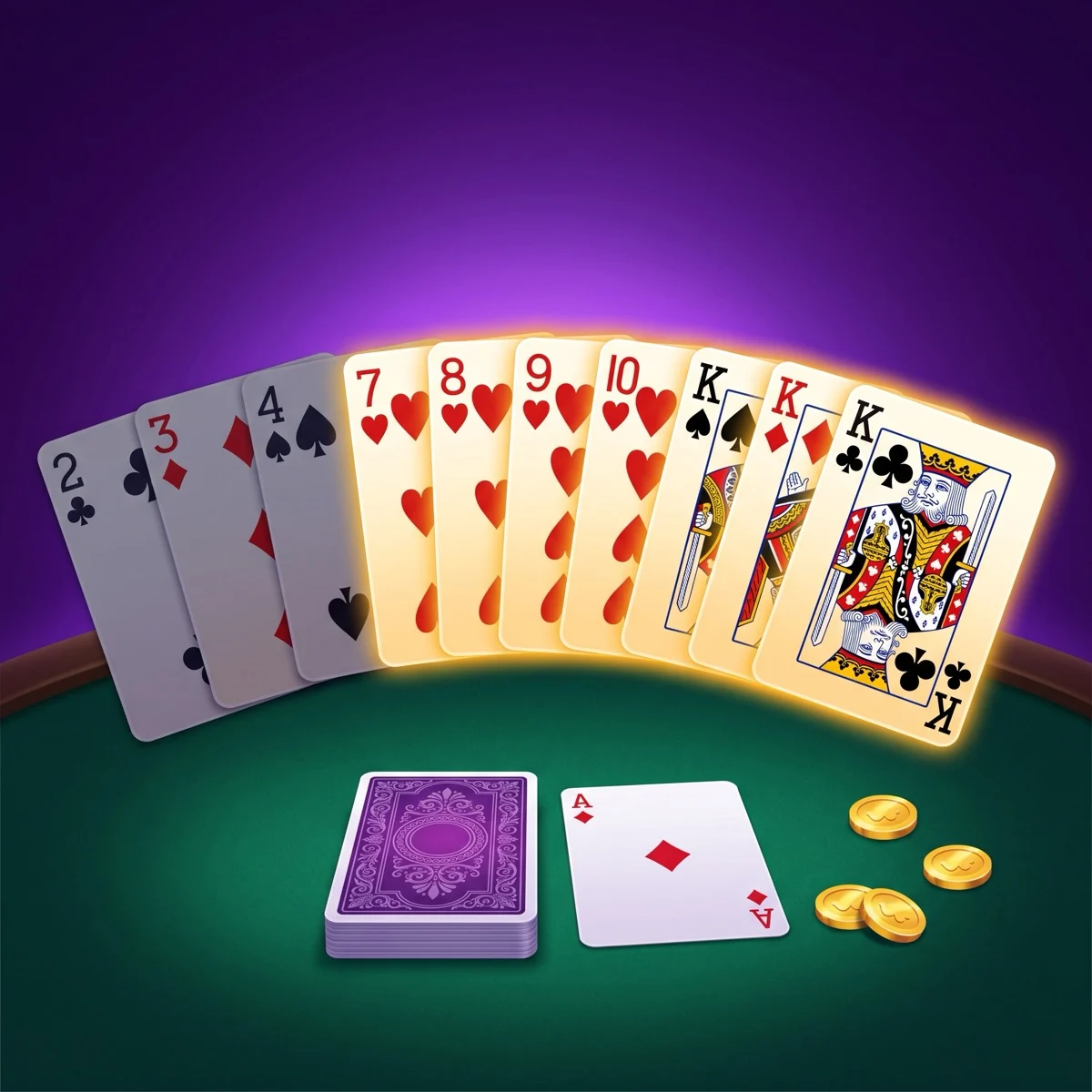
Kings, queens and jacks count 10 points each, aces count 1, and every number card counts its face value (Pagat, "Gin Rummy", updated September 2026). Bicycle Cards puts it the same way: "the figure cards are worth 10 points and the other cards are worth the value indicated by their pips." This is the one part of gin rummy scoring that no rulebook argues about.
The ace is where beginners slip. It's low only, worth a single point, and it never counts 11. That holds for melding too, so A-2-3 of a suit is a legal run and Q-K-A is not.
Gin rummy card values
| Card | Points | Worth knowing |
|---|---|---|
| Ace | 1 | Low only. Never 11, and never above a king in a run. |
| 2 through 10 | Face value | A 7 counts 7 whether it's melded or stranded. |
| Jack, Queen, King | 10 each | Three unmelded face cards are already 30 points of deadwood. |
| Cards in melds | 0 | Only unmatched cards, your deadwood, count against you. |
Card values per Pagat and Bicycle Cards, retrieved September 10, 2026. These values are identical in every published rule set.
How Is a Single Hand Scored?
A hand ends when someone knocks or goes gin, and the score is a difference, not a total. If the knocker's deadwood is lower, "the knocker scores the difference between the two counts" (Pagat). A hand is worth the gap between the two deadwood counts, never the count itself. If it isn't, the opponent takes that difference plus an undercut bonus, and the knocker scores nothing at all.
One asymmetry decides more hands than anything else here. The opponent may lay off deadwood onto the knocker's melds, dropping their own count; the knocker may not lay off in return. So the number that matters is your opponent's count after lay-offs. Gin is the exception, because a gin hand allows no lay-offs and the opponent's full count stands.
The four ways a hand ends
| Outcome | Who scores | How much |
|---|---|---|
| Knock wins | The knocker | The difference between the two deadwood counts. No bonus. |
| Undercut | The opponent | The difference plus the undercut bonus. The knocker scores zero. |
| Gin | The gin player | The gin bonus plus the opponent's whole count. No lay-offs allowed. |
| Big Gin | The gin player | A larger bonus, usually 31, plus the opponent's count. Not a universal rule. |
Outcome mechanics per Pagat and Bicycle Cards. Bonus amounts vary by rule set and are tabulated in the next section.
Big Gin, where you meld all eleven cards without discarding, deserves a caution. Pagat doesn't mention it, and neither does Bicycle Cards or the Gettysburg College rules document. The 31-point figure comes from app implementations and from Wikipedia citing a 1942 Jacoby rulebook. Treat it as common in software and absent from the traditional books.
If any of that machinery is unfamiliar, the full gin rummy rules walkthrough takes one teaching hand and plays it through all four outcomes. The rest of this guide is about what happens after the hand score is written down.
Is the Gin Bonus 20 or 25? Why Both Answers Are Right
Both numbers are correct, and the split is geographic rather than a disagreement. The Gettysburg College rules document, written for an academic gin rummy AI competition, states it directly: "North American play tends to award 25 points for gin and undercut bonuses, whereas in the U.K., gin and undercut bonuses are 20 and 10, respectively" (Neller, Gettysburg College, "Gin Rummy EAAI Undergraduate Research Challenge").
Once you know that, the pattern in the sources snaps into focus. Pagat is John McLeod's British reference and scores gin at 20 with a 10-point undercut. Bicycle Cards, following the same traditional scale, agrees. The Gettysburg rules, Gin Rummy Stars and most mobile apps use 25 across the board. Pagat itself flags the variation rather than dismissing it.
The two gin rummy bonus scales aren't a contradiction. They're a convention that crossed the Atlantic and changed on the way. The Gettysburg College rules note that North American play "tends to award 25 points for gin and undercut bonuses, whereas in the U.K., gin and undercut bonuses are 20 and 10." Neither table is playing it wrong. They're playing two regional standards with identical rules of play and different price tags.
Which rulebook does your game follow?
| Source | Gin | Undercut | Box / line | Game bonus | Game to |
|---|---|---|---|---|---|
| Pagat (McLeod) | 20 | 10 | 20 | 100, or 200 on a shutout | 100 |
| Bicycle Cards | 20 | 10 | 20 | 100, plus 100 for winning every hand | 100 |
| Gettysburg College rules | 25 | 25 | Not used | Not used | 100 |
| Gin Rummy Stars / most apps | 25 | 25 | 25 | 100, plus 100 on a shutout | 100 |
| Oklahoma gin | As above | As above | As above | As above | Generally 150 |
Values as published by each source, retrieved September 10, 2026. "Not used" means the source doesn't define that bonus, not that it forbids it.
The practical takeaway is short. Ask which scale your table uses before the first deal, or open the rules screen in your app. The undercut guide goes deeper on how that one bonus varies and what it does to the defender's decisions.
What Are Line and Box Bonuses?
A box bonus, also called a line bonus, is awarded for each hand you won over the course of the game. Pagat is explicit: "Each player adds a further 20 points for each hand they won. This is called the line bonus or box bonus." Most apps and North American tables use 25 per hand instead.
Here's the rule that trips people up, and it's the reason a box bonus can feel like it appeared from nowhere. Box points are counted at settlement only. They cannot be used to reach the 100 points that ends the game. So a player can be sitting on six box bonuses and still be nowhere near ending anything.
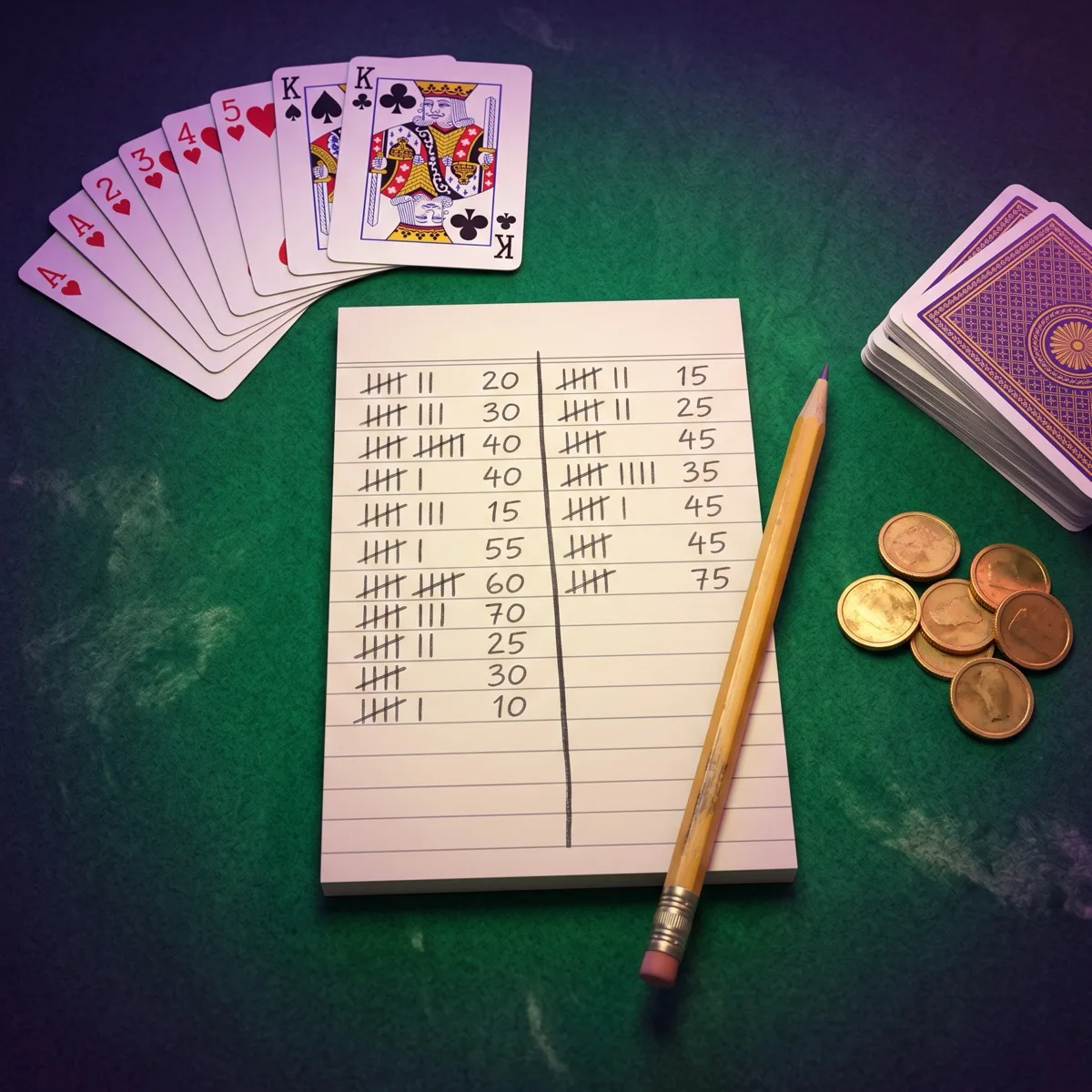
That timing has a real consequence. During the game you're watching one number, the running hand total. At the end you're suddenly handed three more layers of arithmetic. Plenty of tables reach the end of a game and then argue for ten minutes about the final tally, not because anyone miscounted, but because nobody agreed in advance which bonuses were in play.
What Is the Game Bonus, and What Happens on a Shutout?
The first player whose cumulative hand score reaches 100 or more wins the game and adds a 100-point game bonus (Pagat; Bicycle Cards; Gettysburg College rules all set the target at 100). That single bonus is usually the largest number on the scoresheet, and it's the reason the race to 100 matters more than the hand count.
A shutout is a game in which the loser never scored at all. Pagat handles it by upgrading the winner's bonus: "If the loser failed to score anything at all during the game, then the winner's bonus is 200 points rather than 100." Bicycle Cards arrives at the same place by a different route, awarding 100 for the game and another 100 for winning every round. Same total, different bookkeeping. Depending on where you play, you'll hear it called a shutout, a schneider or a blitz.
How a finished game settles: three layers, not one
The nine-hand match from the next section, settled on the North American scale. Hand points decide who reaches 100; the bonuses decide the margin.
A Full Match, Scored Hand by Hand, Twice
One match, scored both ways, settles 279 to 180 on the North American scale and doesn't even finish on the British one. Player A wins three hands with gin. Player B wins six hands on small knock margins. Every card played is identical in both columns; only the bonus scale changes.
The same nine hands, scored on both rulebook scales
| Hand | Result | North American (gin 25) | British (gin 20) |
|---|---|---|---|
| 1 | B knocks, wins by 5 | B +5 | B +5 |
| 2 | A goes gin, opponent holds 14 | A +39 | A +34 |
| 3 | B knocks, wins by 4 | B +4 | B +4 |
| 4 | B knocks, wins by 6 | B +6 | B +6 |
| 5 | A goes gin, opponent holds 10 | A +35 | A +30 |
| 6 | B knocks, wins by 3 | B +3 | B +3 |
| 7 | B knocks, wins by 7 | B +7 | B +7 |
| 8 | B knocks, wins by 5 | B +5 | B +5 |
| 9 | A goes gin, opponent holds 5 | A +30 | A +25 |
| Totals | A wins 3 hands, B wins 6 | A 104, B 30 — game over | A 89, B 30 — keep dealing |
Constructed illustration by Atay Games, September 2026, not a simulation. Knock margins are scale-independent; only the three gin hands change value. Arithmetic verified on both scales.
Two things fall out of that table, and both are counterintuitive.
The first is that the scale changed when the game ended, not just the margin. Player A crosses 100 at hand nine on the North American scale with 104. On the British scale the same three gin hands are worth five points less apiece, leaving A on 89 and eleven short. Same cards, same play, and one table is settling up while the other is shuffling.
The second is the settlement itself. On the North American scale, A takes 104 in hand points, 75 in box bonuses for three hands won, and the 100-point game bonus, for 279. B takes 30 in hand points and 150 in box bonuses for six hands won, for 180. Player B won two hands out of every three and lost by 99 points.
Winning more hands of gin rummy does not mean winning the match. In a nine-hand game scored on the North American scale, a player who won six hands on small knock margins finished on 180 points, while an opponent who won only three hands, all of them gin, finished on 279. Six box bonuses at 25 points each are worth less than a single 100-point game bonus.
What you do about that is a strategy question, not a scoring one, and the knock-versus-gin expected-value math covers it properly. The point here is narrower: the arithmetic rewards ending games, and it rewards ending them big. Keeping score for a bigger table? We have score sheets for three or four players.
How Do Hollywood and Oklahoma Scoring Change the Math?
Both variants keep the hand scoring identical and change the accounting around it. Hollywood gin dates to the game's 1941 boom, when, as Pagat puts it, "gambling bonuses were added and a method of playing three games at once was devised."
The Hollywood method runs three games side by side on one sheet. Your first win is entered in game one. Your second win is entered in games one and two. Your third and every later win is entered in all three. Each column ends independently when someone reaches 100 there, and the player who takes two of the three columns wins overall.
Hollywood gin: how one win lands in three columns
Each player's wins cascade rightward. A column closes at 100 points and stops accepting scores; the overall winner takes two of the three.
Oklahoma gin changes one deal at a time. The upcard sets the knock limit for that hand, and there's a scoring twist attached to it: if the upcard is a spade, "the final score for that deal (including any undercut or gin bonus) is doubled" (Pagat). Games generally run to 150 rather than 100 to absorb the swings.
A doubled spade deal on top of a gin bonus is the single biggest hand in common play. On the North American scale, a gin against 20 points of deadwood is worth 45, and a spade upcard makes it 90.
Why Does Scoring Look Different in a Cash App?
Most people who look up gin rummy scoring are holding a phone, and the number on their screen doesn't match the rulebook they just read. There are two separate reasons, and mixing them up causes most of the confusion.
The first is the scale. Apps overwhelmingly use the North American 25-point bonuses, and Gin Rummy Stars documents exactly that chain of 25s, so an app disagrees with Pagat before a single card is dealt. The second is structural. A rulebook game is a race to 100 spread across many hands, with box bonuses, a game bonus and a possible shutout settled at the very end. A single timed match has no multi-hand game wrapped around it, so those three layers have nothing to attach to and generally don't appear at all.
That's worth stating plainly, because it's the practical answer: a tournament score and a rulebook game score are different quantities. If you learned to keep score at a kitchen table, expect the match total in an app to read differently, and check the rules screen rather than assuming.
In Gin Rummy Cash, both players are dealt the same deck, so the comparison is between two scores built from identical cards. That format is why the app's number is a match score rather than a game score. For how the money side works, the guide to playing gin rummy for real money covers entries, prizes and cash-outs, and the cash-match tactics guide covers playing to the clock.
Practically, read the rules screen once before your first match. It takes thirty seconds and settles every number in the tables above. Gin Rummy Cash runs on iPhone and iPad through the App Store, and on Android through a direct APK from the official Atay site, because real-money skill games aren't listed on Google Play. Practice mode is free, cash matches start from $1, cash-outs start at $5, real-money play is 18+, and prize eligibility depends on where you live. The platform is Skillz, operated by Firy Inc.
Frequently Asked Questions
How many points is gin in gin rummy?
Going gin scores a bonus plus your opponent's entire deadwood count. The bonus is 25 points in North American play and most apps, and 20 points in Pagat and Bicycle Cards. Your opponent cannot lay off against a gin hand, so their full count stands.
What is a box bonus in gin rummy?
A box bonus, also called a line bonus, is awarded for each hand you won during the game. Pagat and Bicycle Cards score it at 20 points per hand; most apps use 25. Box points are added at settlement only and cannot count toward the 100 points needed to end the game.
Does the undercut bonus go to the player who knocked?
No. If the opponent's deadwood is equal to or lower than the knocker's after lay-offs, the opponent scores the difference plus the undercut bonus and the knocker scores nothing. The bonus is 10 points in Pagat and Bicycle Cards and 25 in North American play. Our undercut guide covers the defender's side.
What is a shutout in gin rummy?
A shutout is a game in which the losing player never scored at all. Pagat awards the winner a 200-point game bonus instead of the usual 100. Bicycle Cards reaches the same total by adding 100 for the game and another 100 for winning every hand. It's also called a schneider or a blitz.
Do gin rummy apps use the same scoring as the rulebook?
Often not. Most apps score gin, the undercut and the box bonus at 25 points each, while Pagat and Bicycle Cards use 20, 10 and 20. Timed match formats also tend to drop box bonuses, the game bonus and the shutout, because there's no multi-hand game for them to attach to. Check the rules screen in whatever app you use.
- John McLeod, "Gin Rummy," Pagat.com (updated September 2026) - card values, knocker and undercut scoring, 20-point gin bonus, the 20-point line or box bonus, the 100-point game bonus and the 200-point shutout, the 100-point target, Hollywood gin's 1941 origin, and Oklahoma gin's spade doubling and 150-point target. pagat.com
- Bicycle Cards (The United States Playing Card Company), "Gin Rummy" - figure cards at 10 and pip values, knock and undercut scoring, 20-point gin bonus, 20 points per partial game won, 100 for the game and 100 for winning all rounds. bicyclecards.com
- Todd W. Neller, "Gin Rummy EAAI Undergraduate Research Challenge," Gettysburg College - 25-point gin and undercut bonuses, the 100-point target, and the statement that North American play "tends to award 25 points for gin and undercut bonuses, whereas in the U.K., gin and undercut bonuses are 20 and 10, respectively." cs.gettysburg.edu
- Gin Rummy Stars Support, "Gin Rummy Stars Game Rules" - app-side scoring: 25-point gin and undercut bonuses, 25 points per round won, play to 100 with a 100-point bonus, and an additional 100 points for a shutout. rummystars.freshdesk.com
- Nine-hand scoresheet (Atay Games, September 2026) - a constructed illustration, not a simulation. Three gin hands against deadwood counts of 14, 10 and 5, and six knock wins with margins of 5, 4, 6, 3, 7 and 5. Scored at gin 25 and gin 20, with box bonuses at 25 and a 100-point game bonus applied at settlement. Arithmetic verified on both scales.
- Atay Games, "Gin Rummy Cash" - platform, devices, entry levels and withdrawal terms. ataygames.com
A note on rules and results. Scoring scales vary by book, table and app; where this guide gives a number, it names the source, and your app's rules screen is the final word for that app. Skill-based cash games involve real money. Understanding the scoring makes you a better bookkeeper, not a winning player; that takes practice, and even good play loses hands. Real-money play is 18+ and depends on your location.
Know the Scoring? Put It on the Board
Play free hands in Gin Rummy Cash until knocking, laying off and counting deadwood feel automatic, then take the same deck as a real opponent in a $1 match.
Play Gin Rummy Cash