In 2023, 52 percent of American adults told YouGov they had played gin rummy, more than had played spades or hearts (YouGov, "How Americans feel about 30 card games", 2023). Ask five of them what going gin is worth and you'll hear 20, 25 and 30. They're not confused. The rulebooks really do disagree, and this guide shows you where.
- Two players, 52 cards, 10-card hands. Face cards count 10, aces 1, and the ace is low only.
- Every turn: draw one, discard one. You can't throw back the card you just took from the discard pile.
- Melds are sets (same rank) or runs (same suit, in sequence). Unmatched cards are deadwood.
- Knock at 10 deadwood or less, or go gin at zero. Your opponent can lay off onto your melds; you can't lay off onto theirs.
- Gin is worth 20 in Pagat and Bicycle, 25 in most apps. Check your app's rules screen before you count on a number.
What Is Gin Rummy, and What Do You Need to Play?
Gin rummy is a two-player card game played with one standard 52-card deck and no jokers, where each player holds ten cards. That makes it a different game from 13-card Indian rummy. Kings, queens and jacks count 10 points, aces count 1, and number cards count their face value (Pagat, "Gin Rummy", updated September 2026). That's the whole kit. A table and a pencil finish it.
The object is simple to state. You arrange your ten cards into groups called melds, you shrink the point value of whatever's left over, and you end the hand before your opponent does. Everything else in the rules is machinery for those three jobs. Three- and four-player versions exist, but the game everyone means, and the one in every cash app, is two players.
Where did gin rummy come from?
The usual story credits Elwood T. Baker, a Brooklyn whist teacher, and his son Graham with inventing the game in 1909. The date comes from Baker's son's 1950 obituary and a 1957 Culbertson rulebook, and card-game historian David Parlett notes it was never documented; a 1913 Foster rulebook called the game "Gin Poker" (Parlett, "Gin Rummy").
What's better attested is the boom: gin became a Hollywood craze in 1941, according to Albert Morehead's New Complete Hoyle (1964), and it stayed a fixture of film sets and bridge clubs for decades.
How Is Gin Rummy Dealt, and Who Goes First?
Each player receives ten cards, dealt one at a time. The 21st card is turned face up to start the discard pile, and the remaining 31 cards are placed face down as the stock (Neller, Gettysburg College, "Gin Rummy Rules", 2021). The face-up card is called the upcard, and it drives the first turn.
Who deals first? The rulebooks don't agree, so settle it before you start. Pagat and the Gin Rummy Association have players draw for low card; Bicycle has them draw for high card; some books alternate, and some hand the deal to the loser of the previous hand. After the first hand, most tables let the winner deal. In an app the software deals, and the question never comes up.
The first turn is the one procedure beginners get wrong, because it doesn't start with a draw from the stock. It goes in a fixed order:
- The non-dealer may take the upcard. If they do, they discard a different card and the turn passes.
- If the non-dealer declines, the dealer may take the upcard. Same rule: take it, then discard something else.
- If both decline, the non-dealer draws from the stock, discards, and normal play begins.
Notice that nobody may draw from the stock until both players have passed on the upcard. Whether you should take it is a strategy question, and it's answered in our guide to what to keep and throw in your first three turns. This page only cares that you know the order.
How good is a dealt hand, typically? We simulated two million random ten-card deals and worked out the lowest deadwood each hand could reach with its best possible melds. The average dealt hand carries about 56 points of deadwood, and roughly seven in ten hands start above 50. Only 1 hand in 1,600 is dealt ready to knock, and only 1 in 80,000 is dealt gin. The game happens in the draws. For the full evidence, see is gin rummy a game of skill or luck?
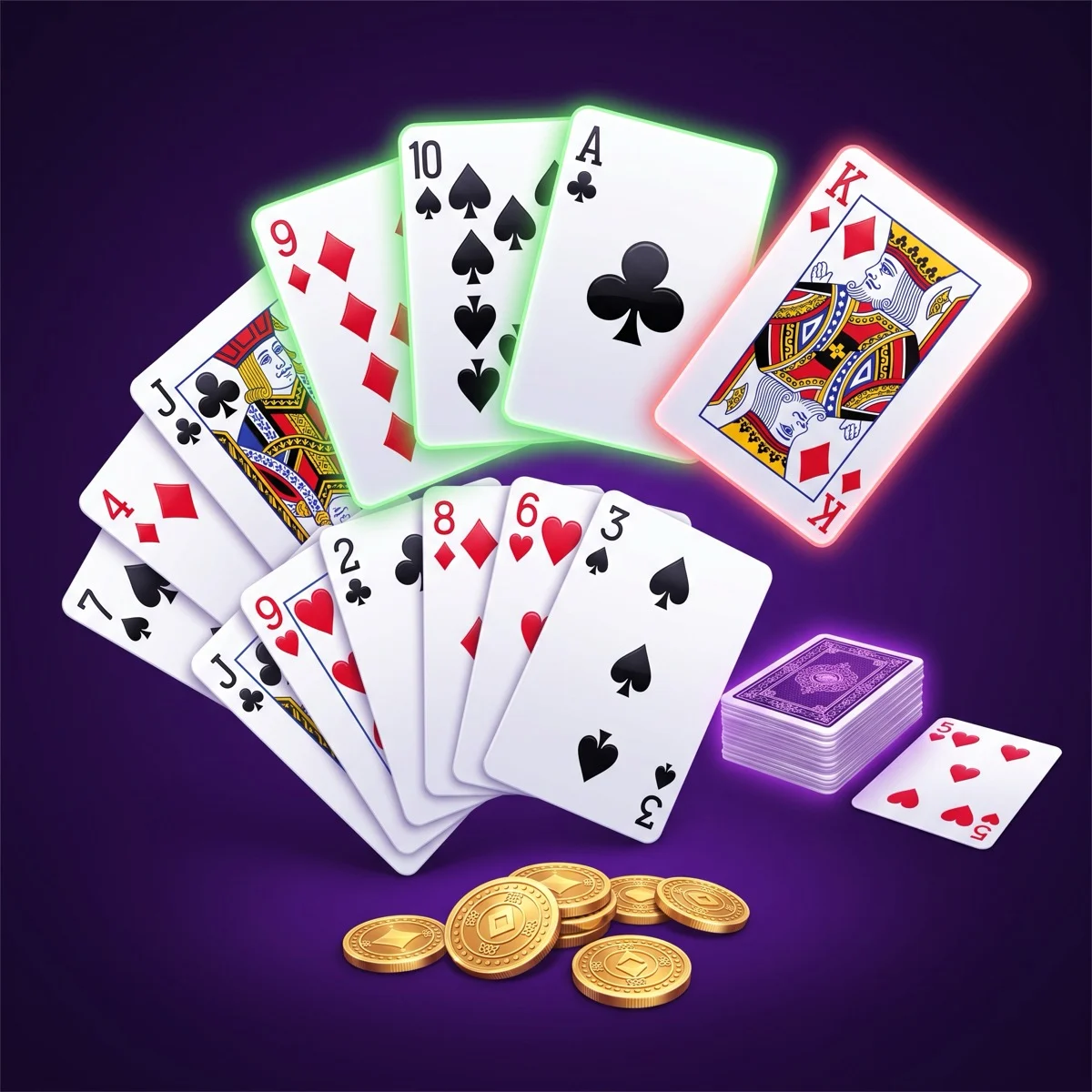
What a dealt gin rummy hand looks like before the first draw
Share of random ten-card hands by best-case deadwood. First-party simulation by Atay Games, 2,000,000 deals, September 2026; method in Sources. A dealt hand is almost never ready to knock.
What Happens on Each Turn? Draw, Then Discard
A turn has two parts and always the same two. First you draw one card, either the top card of the stock or the top card of the discard pile. Then you discard one card face up onto the discard pile, ending with ten cards in hand (Bicycle Cards, "Gin Rummy"). Draw, discard, done.
One restriction trips up nearly every beginner. If you take the top card of the discard pile, you may not discard that same card on the same turn. Pagat puts it plainly: you "must discard a different card." The reason is fair play. Taking a card is information for your opponent, and the rule stops you from fishing for a free look. For the strategy side, see whether to draw from the pile or the stock.
Is that rule universal? Almost. The Gin Rummy Association's tournament rules allow the card to be discarded straight back, but they count it as a completed play, and the original discarder may not take it again unless knocking (Gin Rummy Association, tournament rules). At home, and in every app we've checked, the standard rule applies.
The hand can also end with nobody knocking. If the stock is down to two cards and the player who drew the third-last card discards without knocking, the hand is void: no score, same dealer, redeal (Pagat, 2026). Bicycle's page doesn't mention this rule at all, which is why so many home games invent their own. Apps often differ too; Gin Rummy Stars, for example, plays until the stock is empty.
The three turn mistakes beginners make
- Throwing back the card you just picked up. Illegal in standard rules. Keep it for the turn.
- Drawing without discarding. You never hold eleven cards at the end of a turn, except in the instant you go Big Gin.
- Forgetting the two-card stock rule. Agree on it before the first deal, or let the app decide.
What Counts as a Meld? Sets vs Runs
A meld is either a set or a run. A set is three or four cards of the same rank, like three Kings. A run is three or more cards of the same suit in sequence, like the 7, 8, 9 and 10 of hearts.
Every card belongs to at most one meld: "each card belongs to only one combination," as Pagat states it, so a 7 of hearts can't be both in a run and in a set of sevens.
The ace is low, full stop. Ace-2-3 of a suit is a run; queen-king-ace is not (Pagat; Bicycle). "Round-the-corner" gin, where king-ace-2 wraps, is a named variant with its own scoring, not the default. And there's no ceiling on run length in any authoritative rulebook. Some websites cap runs at five cards; that's a house rule, not gin rummy.
Here's a point that separates gin from the rummy games you may have played as a kid: melds stay in your hand. You don't lay them on the table as you build them. Nobody sees your melds until the hand ends, which is why reading the discard pile matters so much. It's the only window into the other hand.
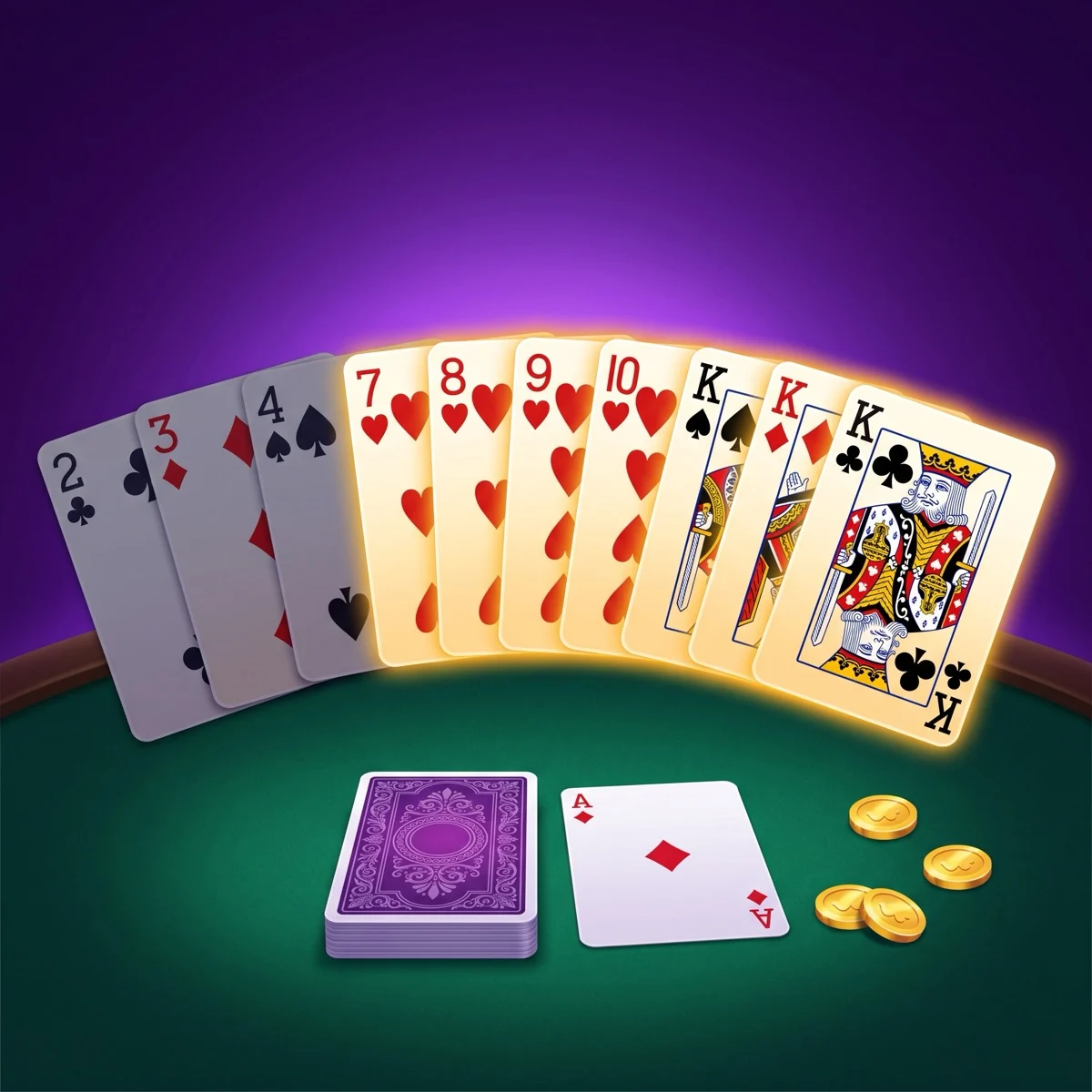
The teaching hand: two melds and nine points of deadwood
How often do you get dealt a meld at all? In the same two-million-deal simulation, 39.8 percent of ten-card hands contained at least one three-card meld off the deal, and a true three-card run showed up in only about 26.5 percent of the eleven cards a non-dealer sees (Atay Games simulation, 2026). So most hands start with nothing made. That's normal. The first few draws build it.
How Do You Knock, and What Is Deadwood?
Deadwood is the point total of the cards in your hand that aren't in a meld. Once your deadwood is 10 points or less, you may knock, which ends the hand. You knock after drawing and before your final discard: you place that discard face down, announce the knock, and lay your melds on the table with the deadwood beside them (Pagat, 2026; Neller, 2021). In the teaching hand, the 2, 3 and 4 total 9, so you may knock.
Then your opponent shows their hand, and something important happens. They lay out their own melds, and they may also lay off: any of their deadwood cards that fit your melds can be added to yours, lowering their count. Hold the 6 of hearts against your 7-8-9-10?
It goes on the end of your run. Hold a King? It joins your Kings. You, the knocker, get no such privilege. "The knocker cannot lay off," as Bicycle puts it, and that asymmetry is the whole risk of knocking.
Going gin, and Big Gin
Going gin means knocking with zero deadwood: all ten cards in melds. Gin earns a bonus, and your opponent may not lay off against it at all (Pagat; Bicycle). Big Gin is a variant found in the 25-point rulebooks: if the card you draw gives you eleven melded cards, you declare without discarding and collect a larger bonus, usually 31. Pagat, Bicycle and the Gettysburg rules don't use it; Wikipedia traces it to a 1942 rulebook by Jacoby and colleagues.

Must you knock as soon as you can? Not in the standard game. Knocking is a choice, and many players hold out for gin or for a lower count.
Tournament play under Gin Rummy Association rules is different: there, knocking is mandatory once your deadwood is at or below the value set by the upcard. When to knock, and why strong players often wait, is the subject of our nine cash-game tactics. The rule itself is just: 10 or less, and it's allowed.
Two things go wrong in almost every first free-mode game I watch. Someone tries to knock at 11 or 12 because "it's close," and the app refuses. And someone knocks, sees the opponent lay off three cards onto their melds, and can't understand why they lost the hand they ended. Both fixes are the same sentence: the number that counts is your opponent's deadwood after lay-offs against your melds, not before.
Ten terms you'll meet in every gin rummy rulebook
| Term | What it means |
|---|---|
| Meld | A set or a run. Cards in melds don't count against you. |
| Set | Three or four cards of the same rank. |
| Run | Three or more cards of one suit in sequence. Ace is low. |
| Deadwood | The point total of your unmatched cards. |
| Knock | Ending the hand with 10 or fewer deadwood points. |
| Gin | Ending the hand with zero deadwood. Earns a bonus; no lay-offs allowed against it. |
| Big Gin | Eleven melded cards declared without a discard. A variant, usually worth 31. |
| Lay off | Adding your deadwood to the knocker's melds to lower your count. Only the non-knocker may do it. |
| Undercut | When the non-knocker's deadwood, after lay-offs, is equal to or less than the knocker's. The knocker scores nothing. |
| Upcard, stock, discard pile | The first face-up card; the face-down draw pile; the face-up pile you throw to. |
Need a term that isn't here? Our gin rummy glossary defines 40 of them, with the other names each one goes by.
How Does Scoring Work? One Hand, Four Outcomes
Scoring starts with the deadwood counts. If you knock and your deadwood is lower than your opponent's after their lay-offs, you score the difference. If their count is equal to or lower than yours, you've been undercut: they score the difference plus a bonus, and you score nothing. Gin earns a bonus plus your opponent's entire deadwood. Hands accumulate until someone reaches 100 points (Pagat; Bicycle; Neller).
A worked example: knock, undercut, gin
Take the teaching hand and knock with it at 9. Your opponent's unmatched cards are the 6 of hearts, the 5 of spades and the 3 of clubs, for 14. Now watch how one detail changes everything.
If they can't lay anything off, you score 14 minus 9, or 5 points. But the 6 of hearts fits your 7-8-9-10 run. Lay it off and their count drops to 8, which is below your 9. You've been undercut on the hand you ended.
The same hand scored four ways
| Outcome | What happened | Pagat / Bicycle scale (gin 20, undercut 10) | App scale (gin 25, undercut 25, Big Gin 31) |
|---|---|---|---|
| Knock wins | You knock at 9; opponent has 14 and nothing to lay off | You score 14 − 9 = 5 | You score 5 |
| Undercut | You knock at 9; opponent lays the 6♥ on your run and finishes at 8 | Opponent scores 1 + 10 = 11; you score 0 | Opponent scores 1 + 25 = 26; you score 0 |
| Gin | You meld all ten (say the 2-3-4 were one suit); no lay-offs allowed | You score 20 + 14 = 34 | You score 25 + 14 = 39 |
| Big Gin | You draw the 6♥ and hold eleven melded cards, no discard | Not used in these rulebooks | You score 31 + 14 = 45 |
Opponent holds 14 deadwood before lay-offs in every row. Bonus values from Pagat, Bicycle Cards, the Gettysburg College rules and the Gin Rummy Stars rules page. The 2-3-4 in the teaching hand are three suits, so the gin row assumes a redrawn hand.
So which scale is right? Both are published by serious sources, and that's the honest answer. Pagat and Bicycle, the two references most rules pages copy from, use gin 20, undercut 10 and a 20-point line bonus per hand won. The Gettysburg College rules used for AI research, Wikipedia and most apps use 25 across the board. Pagat itself notes the 25-point variation. Ask which one your table or your app follows, then play.
Bonus values by rulebook: gin, undercut and line bonus
Points as published by each source, accessed September 10, 2026. Pagat and Bicycle share the traditional 20-10-20 scale; the Gettysburg rules and most apps use 25-25. A blank means the source doesn't use that bonus.
Which rulebook does your game follow?
| Rulebook | Gin | Undercut | Big Gin | Game to | Worth knowing |
|---|---|---|---|---|---|
| Pagat (McLeod) | 20 | 10 | Not used | 100 | Notes the 25/20 variation; two-card stock rule; 100-point game bonus, 200 if the loser scored nothing |
| Bicycle Cards (USPCC) | 20 | 10 | Not used | 100 | Silent on the two-card stock rule; never uses the word "undercut" |
| Gettysburg College rules (Neller, 2021) | 25 | 25 | Not used | 100 | Written for the AAAI gin rummy AI challenge; replay the hand at two stock cards |
| Wikipedia / most apps | 25 | 25 | 31 | 100 | Gin Rummy Stars uses this scale, plays to 50 or 100, and draws until the stock is empty |
| Gin Rummy Association tournaments | Set by event | Set by event | Set by event | 250 | Oklahoma style: the upcard sets the knock limit, an ace means gin only, knocking is mandatory, discarding the taken card back is allowed as a play |
Sources: Pagat; Bicycle Cards; Neller (2021); Wikipedia, "Gin rummy," citing the 1942 Jacoby rulebook for Big Gin; Gin Rummy Stars support; Gin Rummy Association rules. Line bonuses and the 100-point game bonus exist in the traditional rulebooks; many apps score single hands and skip them.
That's the scoring a beginner needs to finish a game. The deeper layer, line and box bonuses, Hollywood scoring, shutouts and how apps compress a whole game into a single scored hand, has its own page: gin rummy scoring explained. So does the defender's side of that undercut row, which our undercut guide covers, including a fuller table of how the bonus varies by rule set.
Gin rummy isn't one rulebook. It's a family of standards, and apps quietly pick one. Pagat and Bicycle score gin at 20 and the undercut at 10; the Gettysburg College rules, Wikipedia and most apps score both at 25, and add a 31-point Big Gin the traditional books don't have. The rules of play are identical. Only the price tags differ, so learn the play once and check the prices wherever you sit down.
How Is Gin Rummy Different in a Cash App Like Gin Rummy Cash?
The rules of play don't change. What changes is the format around them. In Gin Rummy Cash, both players are dealt the same deck and play the same hand against the app's dealer, and the player who earns the more points wins the match (Gin Rummy Cash, App Store listing, 2026). Skillz's developer documentation confirms the mechanism: the random numbers "are in the same sequence for each player in a match" (Skillz, "Randomness").
Why does that matter for a beginner? Because it removes the one thing you can't control. At the kitchen table, a bad deal is just bad luck. In an identical-deck match your opponent got the same cards, so the only difference in the score is what each of you did with them.
The opponent whose score you're chasing is a real person, matched to you by skill rating; the cards across the table are dealt by the app, identically, to you both.
A few tabletop procedures disappear. There's no face-down knock discard; you press a button. Lay-offs and scoring happen automatically. There's a clock and a point target, so matches are short. And the app decides the numbers this guide has been careful about: the knock threshold, the gin and undercut bonuses, and what happens when the stock runs low. Read the rules screen inside the app once. It takes thirty seconds and settles every question in the table above.
Then practice. Gin Rummy Cash runs on iPhone and iPad through the App Store, and on Android through a direct APK from the official Atay site, because real-money skill games aren't listed on Google Play. Practice mode is free.
Cash matches start from $1, real-money play is 18+, and prize eligibility depends on where you live, so check your state before you deposit. The platform, Skillz, is operated by Firy Inc., which reported 117,000 paying monthly users across its games in the second quarter of 2026 (Firy Inc., Q2 2026 results, SEC filing).
Is gin rummy really a game of skill?
The best evidence is structural rather than legal. Identical deals cancel the luck of the cards, and in 2021 the AAAI's educational AI conference ran a research challenge on gin rummy that drew 14 teams and 13 peer-reviewed papers treating knocking and discarding as solvable decision problems (Gettysburg College, EAAI-21 Gin Rummy Challenge).
The often-repeated line that a court ruled gin a game of skill in 1965 traces to one author, Pramod Shankar, describing a Nevada tournament case, and no published citation has surfaced. Treat it as reported history. How skill and law fit together is covered in our guide to playing gin rummy for real money.
Frequently Asked Questions
How many cards do you get in gin rummy?
Ten each, from a standard 52-card deck with no jokers. The 21st card is turned face up to start the discard pile, and the remaining 31 cards form the stock (Gettysburg College rules, 2021). Face cards count 10 points, aces count 1, and number cards count their face value.
What does it mean to knock in gin rummy?
Knocking ends the hand. After drawing, if your unmatched cards (deadwood) total 10 points or less, you discard face down and lay your melds out. Your opponent lays out their melds and may lay off deadwood onto yours; you cannot lay off onto theirs (Bicycle Cards). The player with less deadwood scores the difference.
Is the gin bonus 20 or 25 points?
Both are published. Pagat and Bicycle Cards score gin at 20 points with a 10-point undercut bonus. The Gettysburg College rules document, Wikipedia and most apps, including Gin Rummy Stars, score gin at 25 with a 25-point undercut bonus. Check the rules screen in whatever app you use before you count on a number.
Can you discard the card you just picked up from the discard pile?
Not in the standard rules. Pagat, Bicycle Cards and the Gettysburg College rules all say the card taken from the discard pile must stay in your hand for that turn, so you discard a different card. Gin Rummy Association tournament rules are the exception: discarding it back is allowed but counts as a play.
Can you play gin rummy with 3 or 4 players?
Yes. Pagat documents a three-player version where one player sits out each hand and a four-player partnership version with two games running side by side. Our 3- and 4-player guide covers both, plus a bracket for bigger groups. The standard game, and the version in Gin Rummy Cash, is two players with 10-card hands.
- John McLeod, "Gin Rummy," Pagat.com (updated September 1, 2026) - deal, turn, melds, knocking, the two-card stock rule, 20-10-20 scoring and the 25/20 variation, three- and four-player versions. pagat.com
- Bicycle Cards (The United States Playing Card Company), "Gin Rummy" - card values, ace low, lay-off rule, 20-10-20 scoring and game bonuses. bicyclecards.com
- Todd W. Neller, "Gin Rummy Rules," Gettysburg College, for the EAAI-21 Gin Rummy Undergraduate Research Challenge (February 26, 2021) - 10-card deal, 32 remaining cards, knock at 10 or less, 25-point gin and undercut bonuses, replay at two stock cards. cs.gettysburg.edu
- Gettysburg College, "EAAI-21 Gin Rummy Undergraduate Research Challenge" - 14 teams, 50 participants, 13 peer-reviewed papers. cs.gettysburg.edu
- Gin Rummy Association, "GRA Rules" - tournament rules: upcard-based knock limit, ace means gin only, mandatory knock, discard-back as a play, 250-point games. wsogr.com
- Wikipedia, "Gin rummy" - Big Gin (31 points), citing Richard, Jacoby and Hazen, Gin-Rummy: How to Play It and Authorized Official Laws (1942); 1941 Hollywood popularity, citing Morehead, New Complete Hoyle (1964). wikipedia.org
- David Parlett, "Gin Rummy" (Historic Card Games) - the disputed 1909 Baker attribution and the 1913 "Gin Poker" reference. parlettgames.uk
- Gin Rummy Stars support, "Gin Rummy Stars Game Rules" - app scoring (gin 25, undercut 25), games to 50 or 100, play until the stock is empty. rummystars.freshdesk.com
- YouGov, "How Americans feel about 30 card games" (June 7, 2023; 1,000 U.S. adult citizens surveyed May 10-12, 2023) - 52 percent have played gin rummy. today.yougov.com
- GameColony, "Gin Rummy: A Game of Skill," quoting Pramod Shankar, How to Win at Gin Rummy (1997) - the reported 1965 Nevada tournament ruling; no published case citation located. gamecolony.com
- Skillz Developer Documentation, "Randomness" - identical random sequence for each player in a match. docs.skillz.com
- Apple App Store, "Gin Rummy Cash: Online Prizes" (Atay Games Ltd) - same deck for both players, time and point limits, highest score wins. apps.apple.com
- Firy Inc. (formerly Skillz), "Firy Reports Second Quarter 2026 Results," Form 8-K exhibit (August 13, 2026) - 117,000 paying monthly active users. sec.gov
- First-party simulation (Atay Games, September 2026) - 2,000,000 random ten-card deals from a standard 52-card deck, ace-low runs. For each hand, every legal set and run was enumerated and the disjoint combination of melds with the highest point value was chosen; deadwood is the remainder. Results: 0.0625% of hands at 10 deadwood or less, 0.0013% at zero, mean deadwood 56.5, median 58. Dealt-meld frequencies (39.8% of ten-card hands; 26.5% true runs in eleven cards) are from the same method as published in our opening-hand guide.
- Atay Games, "Gin Rummy Cash" - platform, devices, entry levels and withdrawal terms. ataygames.com
A note on rules and results. Rule sets vary by book, table and app; where this guide gives a number, it names the source, and your app's rules screen is the final word for that app. Skill-based cash games involve real money. Knowing the rules makes you a competent player, not a winning one; that takes practice, and even good play loses hands. Real-money play is 18+ and depends on your location.
Learned the Rules? Now Practice Them
Play free hands in Gin Rummy Cash until knocking, laying off and counting deadwood feel automatic, then read the opening-hand guide before your first $1 match.
Play Gin Rummy Cash