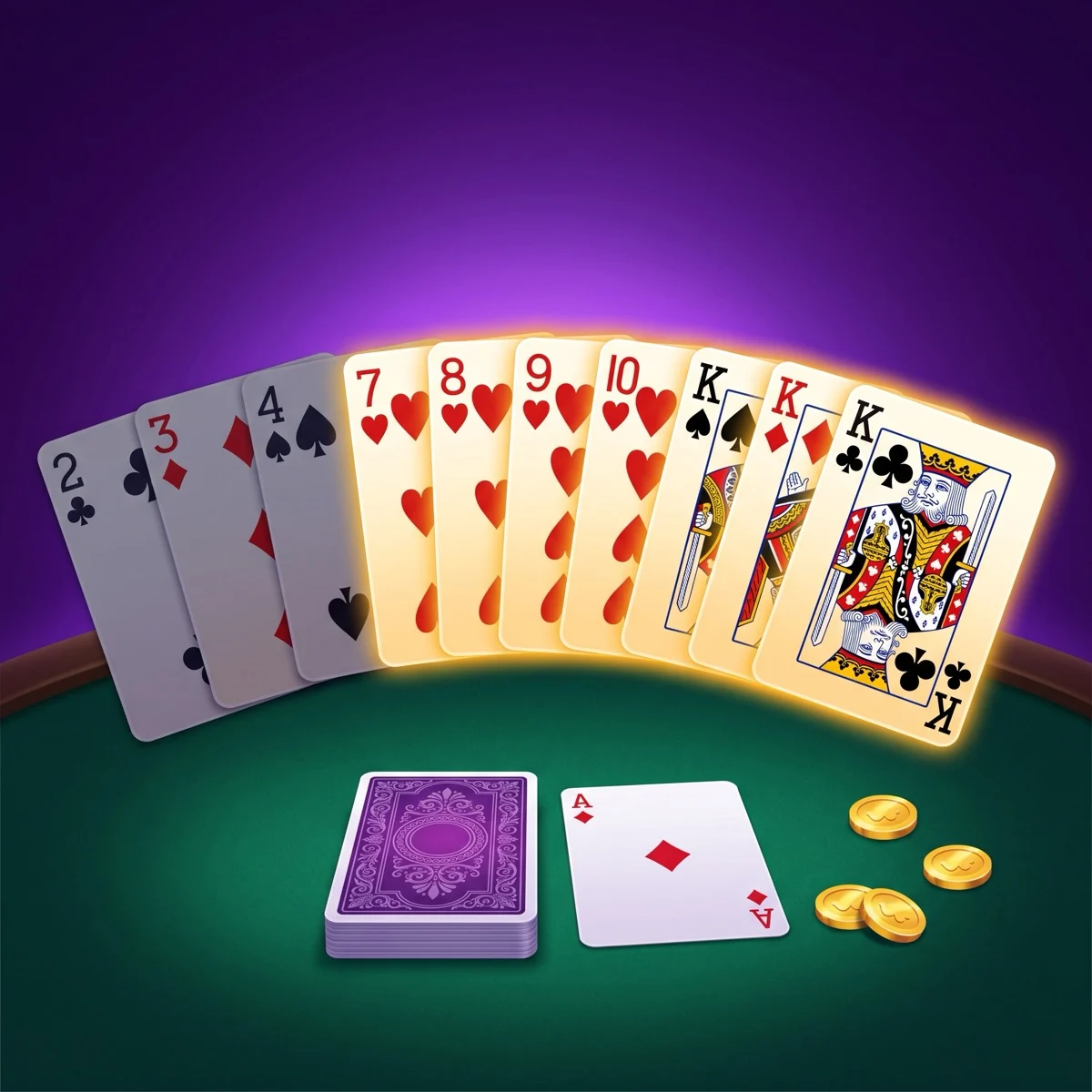

Thanksgiving falls on Thursday, November 26 this year, and National Card Playing Day is December 28 (National Day Calendar). That's two crowded family tables, and gin rummy is the classic that seats exactly two. Bicycle Cards lists it as "Players 2," ages 8 and up. So how do you play gin rummy with 3 players, or 4, or with a cousin who has never played?
The rules pages that rank for this disagree about who sits out and who deals, and none says what to do with six people. Below: a format for every headcount, the three- and four-player rules with disputed parts flagged as house rules, a fair rotation we tested, a knockout for big tables, a teaching script and score sheets. Keep our gin rummy terms handy, or start with the full two-player rules.
Gin stays a two-player hand. With three, two play while the dealer sits out; with four, two partnerships play side by side to 125 (Pagat); with five or more, split into tables of two or three and advance the winners. In our 200,000-hand simulation, dealing three players into one hand left 17% of hands with no winner.
Atay Games simulation, September 2026. Bots under research rules; method below.
- 31, 21, 11 cards: the stock left after dealing 10 cards each to 2, 3 or 4 players plus the upcard. Deal three into one hand and 17.4% of hands run out of stock with no winner (0.18% heads-up). Deal four in and 75.8% do.
- Plan in hands: a cutthroat race to 100 took a median of 12 hands (80% of games: 7 to 18). Partnership to 125 took a median of 9 rounds, two boards at a time. A heads-up race to 50 took a median of 5 hands.
- Sitting out first costs you: under the traditional winner-stays rotation, the player who sat out hand one won 30.2% of 50,000 games (fair is 33.3%), and 28.3% in a race to 50.
- A fix that tested fair: pass the deal left every hand and, once someone reaches the target, finish the round so all three have sat out equally. The first sitter-out then won 33.3%, for about two extra hands (median 15 instead of 12).
- Who deals barely matters: first option on the upcard won 50.2% of decided hands in 400,000 deals, and Pagat's three dealer rules gave the same game results (49.9% to 50.0%).
All figures: Atay Games bot simulations under research rules, September 2026, not Gin Rummy Cash's settings.
Can you play gin rummy with 3 or 4 players?
Yes, but every hand is still one player against one. In Pagat's rules, three players rotate with the dealer sitting out. Four players split into two partnerships whose members play separate games against alternating opponents, and the first team to 125 wins. Bicycle Cards lists standard gin for two players, ages 8 and up.
Every format below works the same trick. The hand itself never changes: ten cards each, one stock, one discard pile, two people. What changes is who plays it, or how the scores get added together. Three players take turns sitting out. Four players run two games at once and pool the results. Bigger groups split into tables and play down to a final.
If your group already knows the full two-player rules, you're most of the way there. Find your headcount, settle the house rules for that format, and deal. Rows marked "house format" are ours, built from the sourced formats. The rest come straight from Pagat's three- and four-player section and Rummy Rulebook.
Which gin format fits your table?
| Players | Format | Game to | Decks | Typical length | Source |
|---|---|---|---|---|---|
| 2 | Standard gin | 100 | 1 | 10 hands | Pagat |
| 3 | Cutthroat: two play, the dealer sits out | 100 | 1 | 12 hands (15 with our fair rotation) | Pagat |
| 4 | Partnership: two boards, teams pool scores | 125 | 2 | 9 rounds | Pagat |
| 5 | One cutthroat table and one heads-up table race to 50; the two winners play a final to 100 | 50, then 100 | 2 | See the bracket section | House format (Atay Games) |
| 6 | Three heads-up races to 50; the three winners play a cutthroat final to 100 | 50, then 100 | 3 | See the bracket section | House format; or Rummy Rulebook's team game to 150 |
| 7 | Two heads-up tables and one cutthroat table race to 50; the three winners play a cutthroat final | 50, then 100 | 3 | See the bracket section | House format |
| 8 | Four heads-up races to 50, two semifinals to 50, a final to 100 | 50, then 100 | 4 | See the bracket section | House format; or Rummy Rulebook's team game to 175 |
| 9+ | Tables of 2 or 3; winners advance until 2 or 3 remain | 50, then 100 | 1 per table | See the bracket section | House format |
Why does every gin hand stay two-player?
Because the stock runs out. Ten cards each plus the upcard leaves 31 cards to draw with two players, 21 with three and 11 with four. In 200,000 simulated hands per table size, dealing three players in left 17.4% of hands with no winner, against 0.18% heads-up (Atay Games simulation, September 2026).
The rule that kills the hand is in the standard rules. Pagat puts it this way: "The play also ends if the stock pile is reduced to two cards, and the player who took the third last card discards without knocking. In this case the hand is cancelled, there is no score, and the same dealer deals again."
Hands that end with no winner, by players dealt into one hand
Atay Games simulation, September 2026: 200,000 hands per table size, identical baseline bots under research rules (knock at 10, hand void at two stock cards). 95% confidence intervals: 0.16% to 0.19%, 17.2% to 17.5%, 75.6% to 76.0%.
What happens when you deal everyone into one hand
| Players dealt in | Stock after deal and upcard | Hands with no winner | Hands ending in gin | Draws per player |
|---|---|---|---|---|
| 2 | 31 | 0.18% | 2.1% | 6.3 |
| 3 | 21 | 17.4% | 1.7% | 4.9 |
| 4 | 11 | 75.8% | 0.4% | 2.5 |
Atay Games simulation, September 2026. Bots, not people.
In plain terms: with three people dealt in, each player gets about five draws instead of six, and roughly one hand in six ends with nobody scoring. With four, three hands in four die. That's why the traditional formats rotate players or pair them up instead of crowding one hand.
Some families still deal all three in to keep everyone busy. That's fine as a house rule if you can live with dead hands, but don't try it with four. And our bots knock the moment they can. People who hold out for gin would run the stock dry even more often.
How we ran the numbers
- Bots, not people. Every player is the same baseline bot. It takes the face-up card only when it fits a meld, discards to cut deadwood and knocks as soon as it legally can. The engine is the one behind our published bot test, a Python port of Todd Neller's EAAI gin engine, re-checked hand for hand on 20,000 decks with zero mismatches.
- Research rules. Knock at 10 or less, 25-point gin and undercut bonuses (one run used 20 and 10), the upcard offered around the table, hand void when the stock falls to two. Box and game bonuses weren't modeled, because they don't count toward the target.
- Three parts. Part A dealt 200,000 hands at each table size. Part B played 400,000 heads-up hands to measure first option on the upcard. Part C played 50,000 games for each of 11 formats and rotations.
- House assumptions. In cutthroat, the player coming back in has first option, and a void hand is re-dealt to the same pair. A void partnership board scores 0. Fixed seeds 202609231 to 202609233; 95% confidence intervals. The script isn't published; the method is described here.
What can't this simulation tell you?
These are bots, not people, and they all play identically, so the results say nothing about skill. The rules are research rules, not any app's settings. And every length is counted in hands, not minutes, because we didn't time real players at a real table. Your pace depends on who's sitting there.
How do you play 3-player gin rummy (cutthroat)?
Two play and one sits out. In Pagat's rules the dealer deals to the other two and doesn't play, and the loser of each hand deals the next. So the winner stays on against the player who sat out. Everyone keeps their own score, and Rummy Rulebook's cutthroat game runs to 100.
- Everyone draws a card to decide who deals first. Settle the method with the house-rule table below.
- The dealer deals 10 cards each to the other two, turns up the next card and sits out the hand.
- The two active players play a normal hand under the full two-player rules.
- Write the points in the winner's column only.
- Pagat's rotation: the loser deals the next hand and sits out, and the winner plays the person who just sat out.
- A dead hand (stock down to two cards) is re-dealt by the same dealer to the same two players.
- The first player to 100 wins. Add end-of-game bonuses if your table uses them.
Two sources disagree on the opening. Rummy Rulebook's cutthroat page says the lowest card sits out, and the second-lowest deals and plays the highest. It adds that the idle player "may only observe, and not offer advice." Pagat has the dealer sit out instead. Neither is wrong, so pick one before the first deal.
Cutthroat house rules to settle before the first deal
| Question | Option A | Option B | Our suggestion |
|---|---|---|---|
| Who deals? | The player sitting out (Pagat) | An active player deals; the idle one watches (Rummy Rulebook) | Dealer sits out: it gives the idle person a job |
| Who has first option on the upcard? | Sources are silent | Sources are silent | The player coming back in |
| Can the sitter-out give advice? | "may only observe, and not offer advice" (Rummy Rulebook) | Pagat doesn't say | No advice during a hand |
| Gin and undercut bonus | 25 and 25, usual in North America | 20 and 10, the UK values (Gettysburg College rules) | Pick one; here's why gin is worth 25 in some rulebooks and 20 in others |
| Line (box) bonus per hand won | 20 (Pagat) | 25 (Rummy Rulebook) | Optional for casual tables |
| Rotation | Winner stays on (Pagat, Rummy Rulebook) | Deal passes left every hand, and you finish the round (tested below) | Finish the round |
Is the classic rotation fair?
Not quite. In 50,000 simulated cutthroat games to 100 under winner-stays, the player who sat out the first hand won 30.2% (95% CI 29.8% to 30.6%). Fair is 33.3%. In a race to 50 it fell to 28.3%. Passing the deal left every hand, whatever the result, didn't fix it: 30.5%.
Our reading: the player who sits out first starts a hand behind. When the game stops the moment someone crosses 100, they may never get that hand back. Stopping only on complete rounds closes the gap, and in our simulation that's exactly what fixed it.
Our recommended fix: finish the round
Pass the deal, and the seat out, to the left every hand, whatever the result. When someone reaches 100, keep playing until the round of three hands is complete, so everyone has sat out the same number of times. Highest score wins. In 50,000 simulated games, the first sitter-out won 33.3% (95% CI 32.9% to 33.8%), right on fair.
The cost is about two extra hands: a median of 15 instead of 12 (mean 14.4 against 12.6). A void hand doesn't count toward the round; the same dealer just deals again. Agree on a tiebreak for the top spot before you start. Our simulation counted every tie against the first sitter-out, the strictest case, and the result still came out fair.
Pagat's winner-stays rotation is still the common rule, and it's fine for a relaxed game. If you'd rather not change it, play three games and let each person sit out the first hand once. That spreads the handicap around over an evening, though we didn't simulate it.
How often the first player to sit out wins a cutthroat game
Atay Games simulation, September 2026: 50,000 cutthroat games per rotation, identical bots under research rules. 95% confidence intervals: 29.8% to 30.6%, 27.9% to 28.7%, 30.1% to 30.9%, 32.9% to 33.8%, 32.6% to 33.5%. Ties for the lead counted against the first sitter-out.
Two ways to rotate three players
Top: Pagat's three-player rule. Bottom: the Atay Games house rotation tested in our September 2026 simulation.
From the old rulebooks
The name is at least as old as Oswald Jacoby's 1947 book Oswald Jacoby on Gin Rummy, whose "Cutthroat Gin" chapter opens: "Gin rummy for three players can be played in several different ways." Hoyle's Rules of Games, by Albert Morehead and Geoffrey Mott-Smith, calls chouette "The usual method of three-hand Gin Rummy play," and its glossary entry begins "A method whereby three or more may participate in the scoring of a two-hand..."
We read these books only through Open Library's full-text search, so we quote the fragments and leave the scoring details to the originals.
How do you play 4-player partnership gin?
Two teams of two. Each player plays a separate two-handed game against one opponent, and opponents switch every hand. Teams pool their results: if both partners win, the team scores the total; if the hands split, the higher side scores the difference. The first team to 125 wins (Pagat).
- Everyone draws a card. Rummy Rulebook's partnership page teams the two highest against the two lowest.
- Sit partners opposite each other at a square table.
- Use two decks, one per board. Each pair plays a normal hand at the same time.
- Score the round with the pooled rule: both partners won, add their scores; boards split, subtract the smaller win from the larger.
- Switch opponents for the next hand.
- The first team to 125 wins.
A few details vary by source, so agree on them first:
- When opponents switch: every hand in Pagat. Rummy Rulebook's standard version switches at the end of each game; its "Alternating" variation switches every hand.
- Table talk: Rummy Rulebook lets you advise your partner once your own hand is over, as long as you haven't seen the cards of your partner's opponent. In its Alternating variation, "there may be no communications between partners."
- Bonuses: Rummy Rulebook applies gin and undercut bonuses to each board and the box bonus to the team.
- A dead board: the sources are silent. Our house rule: it scores nothing, and the other board still counts.
Two rounds of partnership gin, scored
| Round | Board 1 | Board 2 | Round result | Running totals |
|---|---|---|---|---|
| 1 | Ana beats Ben by 18 (Team 1 +18) | Dee beats Cal by 7 (Team 2 +7) | Team 1 scores 18 − 7 = 11 | Team 1: 11, Team 2: 0 |
| 2 | Dee goes gin against Ana's 12 deadwood: 25 + 12 = 37 (Team 2 +37) | Cal beats Ben by 9 (Team 1 +9) | Team 2 scores 37 − 9 = 28 | Team 1: 11, Team 2: 28 |
Constructed example by Atay Games, arithmetic checked. Under the 20-point UK gin bonus, Dee's hand is worth 32 and Team 2 scores 23 in round 2.
How long does it take? In 50,000 simulated games, a partnership game to 125 took a median of 9 rounds (80% of games: 5 to 13). That's about 18 boards in all, played two at a time (Atay Games simulation, September 2026). The format isn't new, either: Jacoby's 1947 book lists "Partnership Gin," "Alternating Partnership Gin" and "Team Style Partnership Gin" as separate chapters.
Partnership seating: partners opposite, opponents alternate
Partners-opposite seating from Rummy Rulebook; opponents alternate every hand as in Pagat. Names are illustrative.
Who deals next in gin rummy, and does it matter?
Barely. Pagat has the winner of each hand deal the next and lists "loser deals" and "the turn to deal alternates" as variations. In 400,000 simulated hands, the player with first option on the upcard won 50.2% of decided hands, and all three dealer rules gave the same game results (Atay Games simulation, September 2026).
Who deals next?
| Format | Rule | Source |
|---|---|---|
| 2 players | Winner of the last hand deals | Pagat: "the dealer is the winner of the previous hand" |
| 2 players | Loser deals | Pagat: "Some books give the rule that the loser of each hand deals the next" |
| 2 players | Deal alternates | Pagat variation; Gettysburg College rules: "The deal alternates between players with each hand during a game" |
| Any | Dead hand: the same dealer deals again | Pagat |
| 3 players | Loser deals and sits out | Pagat |
| 3 players | Deal passes left every hand; finish the round | House rule, tested above |
| 4 players | Alternate the deal on each board | House rule; the sources are silent |
The game results back that up. Across 50,000 two-player games under each rule, the player who had first option in hand one went on to win 49.9% (winner deals), 50.0% (loser deals) and 49.9% (deal alternates). First option was worth about 0.2 points a hand: 8.2 points per hand dealt against 8.0.
So pick the rule that's easiest to remember. In cutthroat, let the dealer be the person sitting out. In partnership, alternate the deal on each board. The Gettysburg College research rules alternate too, and they replay a void hand "with the same dealer."
How do you run gin rummy for 5, 6 or the whole family?
Split into tables of two or three. Play short races to 50, and send the table winners on until two or three players are left for a final to 100. In our simulation a heads-up race to 50 took a median of 5 hands and a three-player race to 50 a median of 6, about half a full game.
Here's our house format. It's built from the sourced two- and three-player games, and nothing in a rulebook says you must play it this way.
- Draw cards to seed the tables.
- Make tables of two (heads-up) or three (cutthroat, finishing the round). Use one deck per table.
- The first player to 50 wins the table.
- Winners re-seat until two or three remain. The final runs to 100, heads-up or cutthroat.
- Knocked-out players start a consolation cutthroat or partnership table, so nobody sits idle.
- Keep one bracket card for the whole room. There's a blank one in the score sheets below.
Six players make three heads-up tables, and the three winners play a cutthroat final, so the three-player rules get used twice. Eight players make four tables, then two semifinals to 50, then a final. Five and seven mix one cutthroat table with heads-up tables, as in the format table.
Brackets for 6 and 8 players
Atay Games house format, not a rulebook rule. Three-player tables use the finish-the-round rotation.
Use the fair rotation at three-player bracket tables. Racing to 50 under winner-stays, the first sitter-out won only 28.3%. With the finish-the-round rotation it was 33.0% (95% CI 32.6% to 33.5%).
Short races also produce more upsets, which suits a mixed-age table. Here's why short matches produce more upsets. Expect some spread: 80% of heads-up races to 50 took 2 to 8 hands, and three-player races with the fair rotation took 3 to 12. Prefer teams? Rummy Rulebook runs partnership gin for six players to 150 and for eight to 175.
How many hands each format took
| Format | Median | 80% of games | Mean | First sitter-out won (fair 33.3%) |
|---|---|---|---|---|
| 2 players to 100 | 10 hands | 6 to 14 | 10.2 | n/a |
| 2 players to 100, UK 20/10 bonuses | 11 hands | 7 to 15 | 10.8 | n/a |
| 2 players to 50 | 5 hands | 2 to 8 | 5.1 | n/a |
| Cutthroat to 100, winner stays | 12 hands | 7 to 18 | 12.6 | 30.2% |
| Cutthroat to 100, deal passes left | 13 hands | 8 to 19 | 13.4 | 30.5% |
| Cutthroat to 100, finish the round | 15 hands | 9 to 21 | 14.4 | 33.3% |
| Cutthroat to 50, winner stays | 6 hands | 2 to 9 | 5.8 | 28.3% |
| Cutthroat to 50, finish the round | 6 hands | 3 to 12 | 7.2 | 33.0% |
| Partnership to 125 | 9 rounds | 5 to 13 | 9.0 | n/a |
Atay Games simulation, September 2026: identical bots under research rules, 25-point gin and undercut unless noted. Lengths in hands, not minutes.
None of this is new. Jacoby's 1947 book already had a chapter called "Six or More Players," and the book talks about how to "run a moderate-sized party for gin players."
How do you teach gin rummy in five minutes?
Teach four things, then play one hand face up: what a meld is, what a turn is, when you can knock and how a hand scores. Short-term memory holds only about four chunks at once (Cowan, 2001), so leave lay-off details, box bonuses and variants for the second hand.
Five minutes is what we designed the script for. We haven't timed it at a real table, so treat it as a target. Read the SAY lines out loud and do the SHOW lines with real cards. Every SAY line is plain enough for a newcomer, and nothing in it depends on which rulebook you follow.
The five-minute gin rummy script
Minute 1: the goal
SAY "Make sets, three or four of the same rank, and runs, three or more in a row in one suit. Cards that don't fit are deadwood. Lower deadwood wins. Face cards count 10, aces 1, everything else its number."
SHOW A set, a run and one leftover card.
Minute 2: a turn
SAY "Take one card, either the top of the face-down pile or the top face-up card, then throw one face up. You always end your turn with ten. One rule people break: if you took the face-up card, you can't throw that same card straight back."
SHOW One draw and one discard. Our rules guide lists the three turn mistakes beginners make.
Minute 3: ending a hand
SAY "When your leftover cards add up to 10 or less, you can knock: throw your last card face down and show your hand. No leftovers at all is gin."
SHOW The teaching hand from our rules guide: two melds and nine points of deadwood.
Minute 4: scoring, short version
SAY "The knocker scores the difference between the two leftover counts. If the other player's count is equal or lower, after adding cards to the knocker's melds, that's an undercut, and they score instead, plus a bonus. Gin always scores a bonus. First to 100 wins, or 50 for a quick game."
SHOW Agree the bonus out loud: 25 is the usual North American choice; UK rules use 20 for gin and 10 for an undercut.
Minute 5: one open hand
SAY "Let's play one hand face up. I'll say every choice out loud."
SHOW Everyone plays with cards face up. Then deal for real.
The rules guide has the three turn mistakes and the teaching hand if you want to rehearse. Leave these for later: the edge cases of laying off, line and box bonuses, the game bonus and shutouts, and variants like Oklahoma. Our scoring guide has them when your newcomer asks.
Two tips. Give the newcomer one rule for the draw: take the face-up card only if it goes straight into a meld. It's the one-question test for the draw, and it heads off a lot of early mistakes. For kids, Bicycle Cards lists gin rummy for ages 8 and up. A younger child can partner an adult in four-player partnership gin; that's our suggestion, not a rulebook rule.
How do you keep score with 3 or 4 players?
One column per player or team. Write each hand's points only in the winner's column. Keep line (box) points on a separate row, because Pagat says they "cannot be counted as part of the 100 needed to win the game." Agree before the first deal whether gin and undercut are worth 25 each or 20 and 10.
Below are three sheets: cutthroat, partnership and a bracket card. Print them, or copy the columns onto any paper. The cutthroat sheet has a "round done?" box for the finish-the-round rotation. The partnership sheet has room for both boards and the net result. Add end-of-game bonuses after the last hand.
Sheet A: cutthroat (3 players)
Player 1: ____________ Player 2: ____________ Player 3: ____________ Game to: ______ Gin and undercut: 25/25 or 20/10 (circle one)
| Hand | Sits out and deals | Playing | Winner | Points | Player 1 total | Player 2 total | Player 3 total | Round done? |
|---|---|---|---|---|---|---|---|---|
| 1 | ☐ | |||||||
| 2 | ☐ | |||||||
| 3 | ☐ | |||||||
| 4 | ☐ | |||||||
| 5 | ☐ | |||||||
| 6 | ☐ | |||||||
| 7 | ☐ | |||||||
| 8 | ☐ | |||||||
| 9 | ☐ | |||||||
| 10 | ☐ | |||||||
| 11 | ☐ | |||||||
| 12 | ☐ | |||||||
| 13 | ☐ | |||||||
| 14 | ☐ | |||||||
| 15 | ☐ | |||||||
| 16 | ☐ | |||||||
| 17 | ☐ | |||||||
| 18 | ☐ | |||||||
| 19 | ☐ | |||||||
| 20 | ☐ | |||||||
| Line (box) points, kept separate: hands won × 20 or 25 | ||||||||
Sheet B: partnership (4 players)
Team 1: ____________ + ____________ Team 2: ____________ + ____________ Game to: 125 Gin and undercut: 25/25 or 20/10 (circle one)
| Round | Board 1: who vs who | Board 1: winner, points | Board 2: who vs who | Board 2: winner, points | Net: team, points | Team 1 total | Team 2 total |
|---|---|---|---|---|---|---|---|
| 1 | |||||||
| 2 | |||||||
| 3 | |||||||
| 4 | |||||||
| 5 | |||||||
| 6 | |||||||
| 7 | |||||||
| 8 | |||||||
| 9 | |||||||
| 10 | |||||||
| 11 | |||||||
| 12 | |||||||
| 13 | |||||||
| 14 | |||||||
| 15 | |||||||
| Box points to the team, kept separate | |||||||
Sheet C: bracket card (6 or 8 players)
Races to 50; final to 100. Decks needed: 3 for six players, 4 for eight (one per table). Consolation table: ______________________
| Stage | Players | Race to | Winner |
|---|---|---|---|
| 6 players: Table 1 | ____ vs ____ | 50 | |
| 6 players: Table 2 | ____ vs ____ | 50 | |
| 6 players: Table 3 | ____ vs ____ | 50 | |
| 6 players: Final (cutthroat) | ____, ____, ____ | 100 | |
| 8 players: Table 1 | ____ vs ____ | 50 | |
| 8 players: Table 2 | ____ vs ____ | 50 | |
| 8 players: Table 3 | ____ vs ____ | 50 | |
| 8 players: Table 4 | ____ vs ____ | 50 | |
| 8 players: Semifinal 1 (Tables 1 and 2) | ____ vs ____ | 50 | |
| 8 players: Semifinal 2 (Tables 3 and 4) | ____ vs ____ | 50 | |
| 8 players: Final | ____ vs ____ | 100 |
Playing Hollywood gin, three games scored at once? That needs its own sheet, so it isn't here. A full gin score calculator with printable sheets for standard, Hollywood and Oklahoma scoring is planned for later.
What can you play between family games?
Solo practice on a phone. Gin Rummy Cash's App Store listing says both players "are dealt the same deck and play against the same computer opponent," and the higher score wins, so you can drill the rules alone between hands. Keep cash matches away from the table: the platform treats a backgrounded or long-paused match as aborted, and the opponent wins.
Start in free practice. In the app, you play each hand against a computer opponent. The player you're ranked against is a real person playing the same deck, as the App Store listing describes. Skillz, operated by Firy Inc (NYSE: FIRY, formerly SKLZ), runs the matchmaking and prizes. The listing describes head-to-head matches and tournaments, not cutthroat or partnership play, so treat it as solo practice, not a way to run your family game.
Play for cash only when you can finish uninterrupted. Skillz's help center lists what turns a match into an aborted one: the game "put in the background in the middle of the gameplay while you answer a call/message," a game "paused for a long period of time," or a lost connection. Then "The opposing player is automatically awarded with winning the match and any corresponding prizes." A holiday table is full of interruptions.
Real-money play is 18+ and depends on where you live, so check whether prize play is available where you live. Gin Rummy Cash is on iPhone and iPad through the App Store, and on Android as an APK from the official Atay site. Here's why Android installs from our site. For formats and prizes, see how real-money gin rummy works.
Frequently Asked Questions
Can you play gin rummy with 3 players?
Yes. Two play and the third sits out and deals, and the loser of each hand deals the next (Pagat). Each player keeps a separate score, first to 100. In our simulation, a three-player game to 100 took a median of 12 hands, or 15 if you finish the round so everyone sits out equally.
How many cards do you deal in 3-player gin rummy?
Ten each to the two players in the hand, then one card face up; the dealer gets no cards. Dealing all three in leaves only 21 stock cards, and in our 200,000-hand simulation 17% of those hands ended with no winner, against 0.18% with two players.
What is cutthroat gin rummy?
Three-player gin where everyone plays for themselves and two people play each hand while one sits out, usually to 100 points. Rummy Rulebook says it's also called round robin gin, and Oswald Jacoby's 1947 gin book already had a chapter called "Cutthroat Gin."
How do you play gin rummy with 4 people?
As two partnerships. Each player plays a separate hand against one opponent, opponents switch every hand, and teams pool results. If both partners win, add the scores; if the boards split, the higher side scores the difference. The first team to 125 wins (Pagat).
Can 5 or 6 people play gin rummy?
Yes, at more than one table. Play heads-up or three-player races to 50 and advance the winners; six players make three tables and a three-player final. Rummy Rulebook also runs team games to 150 for six. Families raised on 13-card rummy already have a game built for bigger tables.
Does it matter who deals in gin rummy?
Very little. In our 400,000-hand simulation, the player with first option on the upcard won 50.2% of decided hands. Pagat's standard rule has the winner deal next, with "loser deals" and alternating as accepted variations. Pick whichever rule your table remembers.
What age can kids learn gin rummy?
Bicycle Cards lists gin rummy for ages 8 and up. Teach four things (melds, a turn, knocking and scoring), play one hand face up, and let a younger child partner an adult in four-player partnership gin. That pairing is our suggestion, not a rulebook rule.
What's the bottom line for gin with three or more players?
- Every hand stays heads-up. Change who plays, or add the scores together.
- Three players: cutthroat. Pagat's winner-stays rotation is the common rule; our finish-the-round rotation gave the first sitter-out a fair 33.3%, against 30.2%.
- Four players: partnership to 125, two boards at once, net scores to the team.
- Five or more: tables of two or three racing to 50, winners advance to a final.
- Who deals barely matters. Teach four things and play one hand face up.
Print the sheets, settle your house rules before the first deal, and let the newcomer play the first hand face up. Next, brush up on the full two-player rules, how gin scoring works and the draw decision.
Sources
- Atay Games, multi-player gin simulation, run 2026-09-23. Part A: 200,000 hands each with 2, 3 and 4 players dealt into one hand. Part B: 400,000 heads-up hands. Part C: 50,000 games for each of 11 formats and rotations. Identical baseline bots under research rules, fixed seeds, 95% confidence intervals. First-party data; method described in this post, script not published.
- John McLeod, "Gin Rummy," Pagat.com (last updated 1 September 2026): playing with 3 or 4 players, the dealer rule and its variations, the two-card stock rule, and line or box points. Retrieved 2026-09-23. pagat.com
- The Rummy Rulebook, "Cutthroat Gin" (undated). Retrieved 2026-09-23. rummyrulebook.com
- The Rummy Rulebook, "Partnership Gin" (undated), including the Alternating variation and games for 6 and 8 players. Retrieved 2026-09-23. rummyrulebook.com
- Todd Neller, Gettysburg College, "EAAI Gin Rummy Undergraduate Research Challenge" rules: alternating deal, void-hand replay, and North American vs U.K. bonus values. Retrieved 2026-09-23. cs.gettysburg.edu
- Todd Neller, EAAI Gin Rummy engine (the basis of our Python port). Retrieved 2026-09-23. github.com
- Bicycle Cards, "Gin Rummy": Age 8+, Players 2. Retrieved 2026-09-23. bicyclecards.com
- Oswald Jacoby, Oswald Jacoby on Gin Rummy (Henry Holt, 1947), Internet Archive record; chapter titles and short fragments read via Open Library full-text search. Retrieved 2026-09-23. archive.org
- Albert H. Morehead and Geoffrey Mott-Smith, Hoyle's Rules of Games (New American Library, 1963 printing), Internet Archive record; fragments read via Open Library full-text search. Retrieved 2026-09-23. archive.org
- Nelson Cowan, "The magical number 4 in short-term memory: A reconsideration of mental storage capacity," Behavioral and Brain Sciences 24(1), 87 to 114, 2001. Retrieved 2026-09-23. doi.org
- Federal Reserve Financial Services, "Holiday Schedules": Thanksgiving Day, November 26, 2026. Retrieved 2026-09-23. frbservices.org
- National Day Calendar, "National Card Playing Day, December 28." Retrieved 2026-09-23. nationaldaycalendar.com
- Apple App Store, Gin Rummy Cash listing (id6742690853). Retrieved 2026-09-23. apps.apple.com
- Skillz, "What is an Aborted match?" (updated 2026-07-05). Retrieved 2026-09-23. support.skillz.com
A note on results. The simulation figures in this post come from identical bots under research rules. They describe the formats, not how you or your family will play. Skill-based cash games involve real money, and you can lose entry fees. Set a daily limit, never wager what you cannot afford to lose, and use the responsible play tools available in-app. Real-money play is 18+ and is not available in every jurisdiction.
Practice Between Hands
Drill the rules free on your phone, then save cash matches for when you can play one start to finish.
Play Gin Rummy Cash