On December 21, 1913, a Liverpool-born journalist named Arthur Wynne published a diamond-shaped grid he called a Word-Cross in the New York World's Sunday "Fun" section. It was the first known published crossword, and it's why December 21 is now marked as Crossword Puzzle Day.
More than a century later, "crossword" covers a lot more than Wynne's puzzle. Search an app store for it and you'll find letter-wheel games, and even word searches, wearing the name. They aren't the same puzzle, and they don't ask the same thing of you.
We build cash versions of three of these formats, so we put crossword vs word search vs word connect side by side properly. We looked at what each puzzle hands you, what it makes you supply, and what 2,000 random boards of each actually hide. Below: the one-table answer, each format, our counts, which is hardest, the brain evidence, and where each one came from.
- Three puzzles, three different jobs. A crossword tests recall from meaning, a word connect game tests unscrambling a fixed set of letters, and a word search tests scanning for a word you already know.
- "Crossword" on an app doesn't always mean clues. Among the first 30 "crossword" results from Apple's search API, 3 were letter-wheel games and 4 were word searches (Atay Games check, September 2026).
- A six-letter wheel hides about 21 everyday words among 1,920 possible swipes. A random 4x4 letter grid hides about 56 (medians of 2,000 random boards each, Atay Games count).
- Crosswords have the only head-to-head trial we found. In 107 adults with mild cognitive impairment, web-based crosswords beat computerized brain games over 78 weeks, with no placebo group (NEJM Evidence, 2022). We found no trial of word searches or letter-wheel games.
- December 21 marks Arthur Wynne's 1913 "Word-Cross." The word search came 55 years later, in 1968.
What's the real difference between a crossword, a word search and a word connect game?
It comes down to what the puzzle hands you. A crossword gives you a clue and asks for the word. A 2014 study in Frontiers in Psychology describes solvers working from the clue's meaning plus the letters already in the grid. A word connect game gives you the letters instead. A word search gives you the word itself.
One naming note first. In this post, "word connect" means letter-wheel games like Wordscapes. It doesn't mean Connections-style games, such as the New York Times' Connections, where you sort 16 words into four groups. Search engines mix the two up, so we won't.
Here's the whole comparison on one screen. We've added a fourth column for Boggle-style grids, the family our Word Money game belongs to, because it completes the picture.
| Crossword | Word connect (letter wheel) | Word search | Boggle-style grid | |
|---|---|---|---|---|
| You're given | Clues, plus a grid of blank squares showing lengths and crossings | A wheel of letters and a crossword-shaped grid of blanks, with no clues | A letter grid and a list of words to find | A small letter grid, with no list and no blanks |
| You supply | The word, from memory | The order of the letters | Where each word is | The words, and a path through touching letters |
| Main skill | Recall from meaning, helped by crossing letters | Unscrambling (anagramming) | Visual scanning for a known word | Finding words along paths |
| Can you always finish? | No. A clue you don't know can stop you | In principle, yes: every answer uses only the wheel's letters (a median of 21 everyday words on a six-letter wheel*) | Yes. Each word is listed and sits in one of a fixed set of spots (300 for a six-letter word on a 10x10 grid*) | No. A random 4x4 grid holds a median of 56 everyday words*, and nobody finds them all |
| Clock in casual play | None, unless you time yourself | Often none: Wordscapes promises "your own pace with unlimited tries" | None | Classic Boggle: 3 minutes (Hasbro rules) |
| Atay cash version | None. We don't make a clue crossword | Crossword Cash (timed) | Word Search Cash (timed, identical boards) | Word Money (timed, tile point values, same board for everyone) |
* Atay Games count, 2,000 random boards per format, September 26, 2026. Random boards, not any app's boards or dictionary. Method in the counts section below.
If you'd rather browse the three cash formats side by side, here are all three Atay word games.
The short answer. A crossword hands you a clue and asks you to recall the word. A word connect game like Wordscapes hands you the letters and asks you to rearrange them, with no clues. A word search hands you the word and asks where it is. Pick by the skill you enjoy: recalling, unscrambling or scanning.
Why does a crossword test recall instead of unscrambling?
Because a crossword gives you meaning and makes you produce the word. In 2014, Thanasuan and Mueller described crossword solving as using "semantic information in the form of clues that indicate the meaning of the answer, and orthographic patterns that constrain the possibilities" (Frontiers in Psychology). Nothing else comes free.
In plain terms, you work two routes at once. The clue points you toward a meaning. The letters already sitting in the crossing answers tell you what shape the word must take. That's why a crossword speeds up as it fills: every answer you place hands its neighbors a letter or two.
It's also why a crossword can stop you cold. If a clue asks for a capital city you've never heard of, no amount of staring at the grid produces it. Knowledge gates the finish. A word connect game or a word search can't do that to you, because the letters, or the word itself, are already on the screen.
The answer space is big, too. Our everyday word list holds 2,401 five-letter words, and Webster's Second holds 8,506 (Atay Games count, 2026). The clue and the crossings are what narrow a slot to one. For how fast a single placed letter shrinks it, see our guide on how to play a letter wheel against the clock, which walks through the math.
Recall from meaning. Crossword solving leans on two kinds of information at once, according to a 2014 study in Frontiers in Psychology: the clue, which points to the answer's meaning, and the letters already in the grid, which narrow what can fit. That's why a crossword speeds up as it fills, and why one unknown clue can stop you.
What is a word connect game, and is it a crossword?
A word connect game hands you a wheel of letters to swipe into words, and each word drops into a crossword-shaped grid. It looks like a crossword but works from letters, not clues. In our 2026 count of 2,000 random six-letter wheels, only about 1 swipe in 90 spelled an everyday word.
So it's really an anagram puzzle in a crossword's clothes. The skill is unscrambling a small, closed set of letters, and good players rely on words that "pop out" at them rather than trying orders one by one. Our two-pass strategy guide covers how to use that under a clock.
Why do so many letter-wheel apps call themselves crosswords?
Because the grid looks like one, and "crossword" is a name people search for. Wordscapes' own App Store listing says "Get your word hunt on with over 6,000 crossword puzzles!" It also calls itself "a great fit for fans of crossword, word connect, spelling games, and word anagram games" (App Store, checked September 2026).
We checked how common that is. On September 26, 2026, we read the first 30 results Apple's public search API returns for "crossword" in the US and sorted each by what its own description says you do. Seven had no clues at all: three letter-wheel games and four word searches. Two of the letter-wheel apps have "Crossword" in their names.
What 30 "crossword" apps actually ask you to do
Atay Games check of Apple's iTunes Search API (term "crossword", US storefront, first 30 of 50 results), September 26, 2026 (first-party data). Sorted by each listing's own description; we didn't play the apps. The API's order may not match the App Store app's ranking.
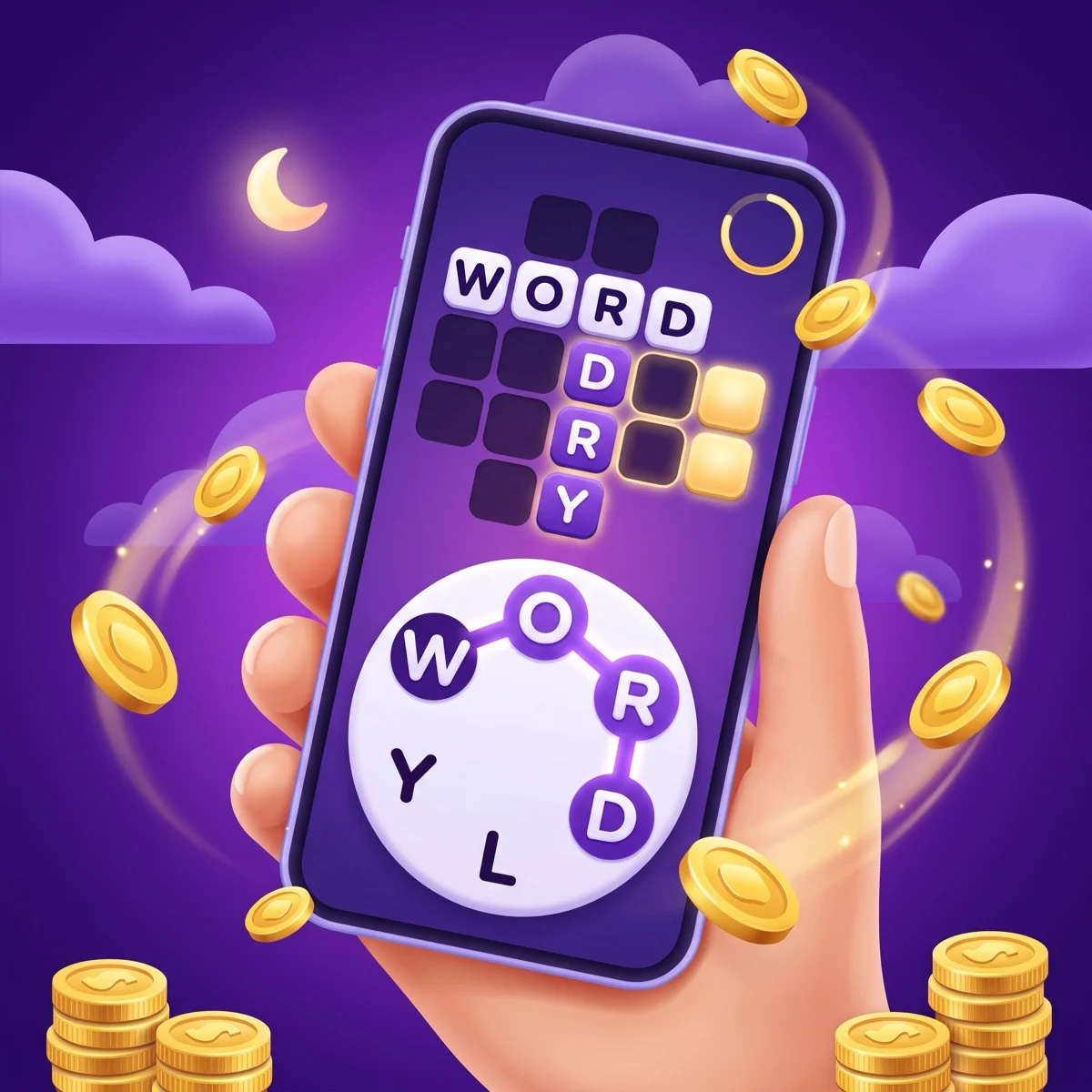
So does ours. Crossword Cash belongs to this family. Its App Store screenshots show a small wheel of letters whose answers fill a crossword-shaped grid, with no clue list anywhere on screen. Its store description borrows crossword language, though, so if you're unsure, the app's own screen is the final word: play a free round and look.
Crossword Cash is timed and played head-to-head. We don't list its clock length, scoring or hint rules here, because those can change between versions. Check them in free practice. Here's the Crossword Cash game page if you want to see the screenshots yourself.
What are some games like Wordscapes?
The swipe-to-spell letter wheel is a phone-era format, and several free apps arrived within about a year and a half of each other. By first App Store release date, per Apple's own listing data:
- Word Cookies! (BitMango): December 2016.
- Word Trip (PlaySimple Games): May 2017.
- Wordscapes (PeopleFun): June 2017.
- Crossword Jam (PlaySimple Games): September 2017.
- Words of Wonders: Crossword (Fugo Games): April 2018.
All five are free to download. Word Cookies reached the App Store six months before Wordscapes, so we couldn't pin down who made the first letter wheel, and we won't guess. If you want the same format with a clock and a matched opponent, that's what Crossword Cash is for.
A crossword in name only. A word connect game gives you a wheel of letters to swipe into words that fill a crossword-shaped grid, with no clues. Many app listings still call these games crosswords. In Atay Games' September 2026 check of Apple's top 30 "crossword" results, three were letter-wheel games and four were word searches.
What does a word search actually test?
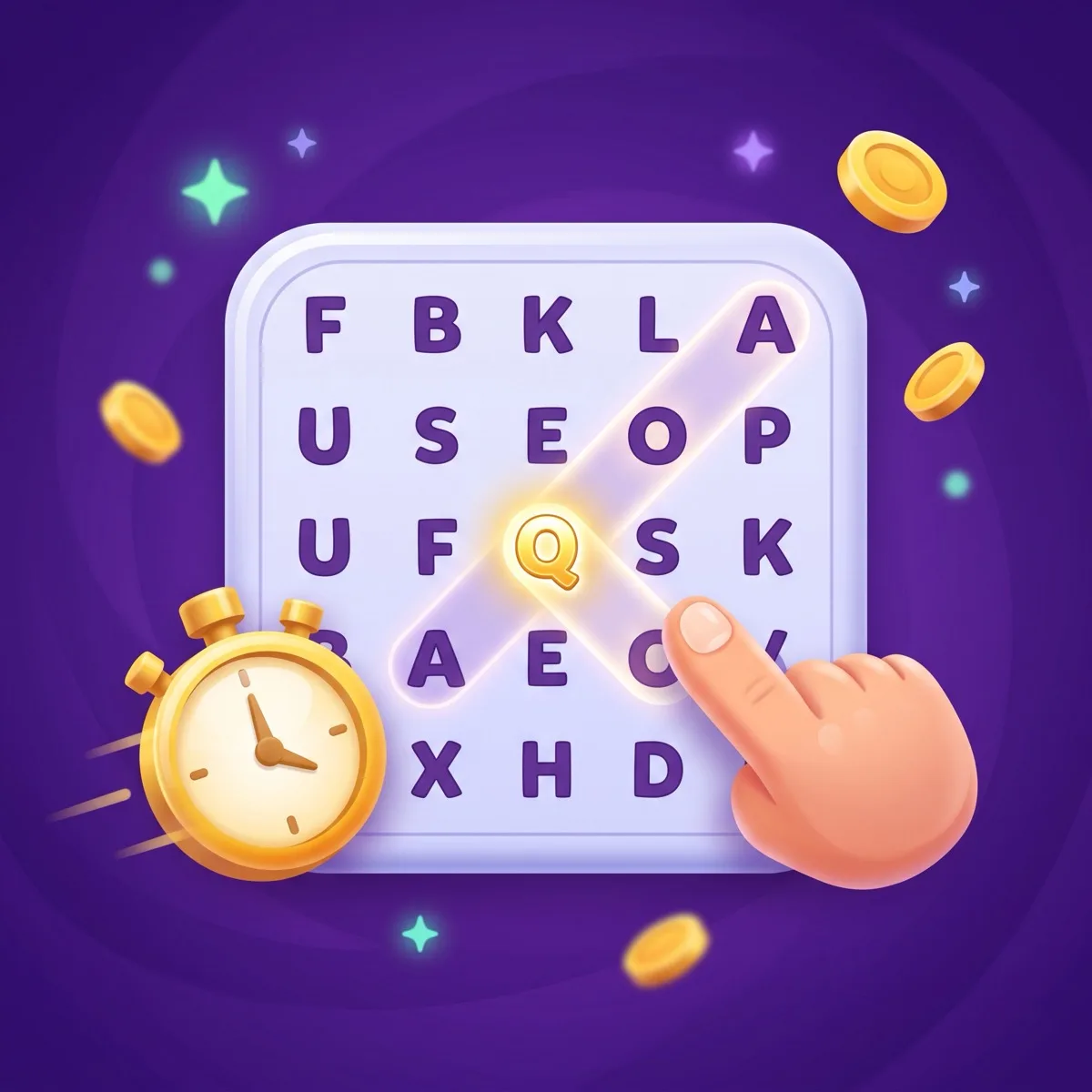
Visual search. You already know every answer, because it's printed in the list; the puzzle only asks where it is. In Atay Games' 2026 count, a six-letter word on a 10x10 grid can sit in exactly 300 positions across eight directions. That's why a word search is the one puzzle here you can always finish.
That 300 is simple arithmetic. Across and down, running either way, a six-letter word fits in 200 spots. The four diagonal directions add another 100. A three-letter word has 576 possible homes, and a ten-letter word only 44. So speed, not knowledge, separates players: the answer is guaranteed to be there, and the race is how fast your eyes find it.
For technique, see how to find words faster. The format itself is usually credited to Norman E. Gibat in 1968; more on that in the history section.
Does a word search hide words nobody listed?
Yes, by accident. In our 2,000 random 10x10 grids, filled at English letter frequencies, a median of 8 everyday words of four or more letters appeared that nobody asked you to find. Some cash games turn that idea into a feature.
Word Search Cash is one. Its cash matches run on Skillz (now Firy Inc, NYSE: FIRY), which described the scoring in an August 2025 how-to-play post. There, "regular words earn 100 points, hidden bonus words are worth 200, and each second left on the clock adds 10 bonus points." Those hidden words "appear twice on the board" (Skillz blog). Scoring can change between versions, so check your own screen.
Search, not recall. A word search tests visual search, because you already know every answer. On a 10x10 grid, a six-letter word can sit in exactly 300 positions across eight directions. Random filler letters also hide words nobody listed: a median of eight everyday four-letter-plus words per random grid, in Atay Games' 2,000-grid count.
Where does a Boggle-style grid like Word Money fit?
It's the open-ended cousin: a small letter grid with no list and no blank squares. In Atay Games' September 2026 count, a random 4x4 grid offered 283,300 ways to trace three to eight touching tiles and hid a median of 56 everyday words. You don't finish one. You score as many words as you can.
That makes it the hardest of the four to "complete" and, for competitive word-hunters, the most open. Classic Boggle gives you three minutes and crosses off any word two players both find, under Hasbro's published rules (Hasbro).
Our Word Money is Boggle-style, not Boggle. Its App Store listing says to "Connect letters in any direction" and that "The longer the word, the bigger the points." It also says "Everyone plays on the same board," and the top score takes the win (App Store). Every tile also shows its own point value. Round length and the shortest word allowed are best checked in the in-app tutorial.
Boggle is a trademark of Hasbro, and Word Money isn't affiliated with Hasbro. Here's how Word Money differs from classic Boggle, rule by rule.
The open-ended grid. A Boggle-style grid is the open-ended word puzzle: no clues, no list and no blank squares. On a random 4x4 grid there are 283,300 ways to trace three to eight touching tiles, and a median of 56 everyday words to find, in Atay Games' September 2026 count of 2,000 boards. Nobody finds them all.
How many answers does each puzzle hide?
On 2,000 random boards of each, a six-letter wheel hid a median of 21 everyday words, a seven-letter wheel 35 and a 4x4 letter grid 56, in Atay Games' September 2026 count. A word search works differently: each listed word has one home, among 300 possible spots for a six-letter word on a 10x10 grid.
| Format (random boards) | What a player could try | Everyday words hidden, median (middle half) | Webster's Second words, median |
|---|---|---|---|
| Six-letter wheel | 1,920 swipes | 21 (14 to 30) | 35 |
| Seven-letter wheel | 13,650 swipes | 35 (24 to 50) | 65 |
| 4x4 Boggle-style grid | 283,300 traces of 3 to 8 tiles | 56 (40 to 76); 26 with 4+ letters | 114 (70 with 4+ letters) |
| 10x10 word search | 300 positions per listed six-letter word | The listed words, plus 8 unlisted words of 4+ letters (7 to 11) | 21 unlisted |
How many real words hide in a random board
Atay Games board count, September 26, 2026 (first-party data). Random boards, not any app's boards or dictionary. Method in the box below.
How we counted
- Letter wheels. 2,000 six-letter and 2,000 seven-letter wheels, each built from the letters of a random everyday word of that length, the way letter-wheel games build a wheel around one longest answer. We counted every word of three or more letters a wheel can spell using each letter once, and every ordered swipe of three or more letters.
- Word search. The 300 positions are exact arithmetic for a 10x10 grid in eight directions. For the unlisted words, we filled 2,000 random grids at English letter frequencies and counted every word of four or more letters readable in any direction.
- Boggle-style grid. 2,000 random 4x4 grids at the same letter frequencies. We traced every path through touching tiles (eight neighbors, no tile reused). As a check, our path counter finds 12,029,640 paths of every length on a 4x4 grid.
- Two dictionaries. "Everyday" is the 30,000 most frequent words in Peter Norvig's counts from the Google Web Trillion Word Corpus, kept only if the word or its stem is in the Hunspell en_US dictionary (SCOWL, 2026 release): 18,833 words. "Webster's Second" is the macOS word list: 210,626 lowercase words of three or more letters.
- Run. Seed 20260925, standard-library Python 3.14.4, about 5 seconds. First run September 25, 2026, re-run September 26 with identical output. A second run with a different seed and 5,000 boards moved no everyday-word median by more than one word. The script itself isn't published.
What do the counts tell you?
Four things. First, a word search is the only one of the four you can always finish, because every answer is listed and has a limited number of places to be. Second, a letter wheel is a small, closed hunt. Guessing is slow, since about 1 swipe in 90 spells an everyday word, but the answer set is finite. That's why these games reward extra words: the grid shows only some of the roughly 21 a six-letter wheel can make.
Third, a Boggle-style grid is open-ended, with a median of 56 everyday words and no list to tell you when you're done. Fourth, a clue crossword sits at the other extreme. Its answer space is every word of the right length you know, and only the clue and the crossings narrow it down.
Now the limits. These are random boards, not any app's boards, and real games choose friendlier letters and check words against their own dictionaries. "Everyday" is a word-frequency stand-in, not a test of anyone's vocabulary. And our letter frequencies come from English text, not from any game's board generator. The pattern holds; the exact numbers won't match your screen.
Atay Games board count, September 2026. Atay Games counted the words hidden in 2,000 random boards of each format. A six-letter letter wheel held a median of 21 everyday words among 1,920 possible swipes. A seven-letter wheel held 35, and a 4x4 letter grid held 56. These were random boards, not any app's.
Which is hardest, and which one suits you?
To finish, a crossword is the hardest and a word search the easiest. That's our reading of the 2026 counts above, not a study. A word search promises its answers are on the board, a six-letter wheel leaves a closed set of about 21 everyday words, and a crossword gives you only the clue.
A Boggle-style grid can't be finished at all, only scored. So "hardest" depends on what you want from a puzzle. Here's a quick way to choose:
- You love trivia and wordplay: a clue crossword. It rewards what you know and how you think about meaning.
- You're the one who unscrambles Scrabble racks for fun: a word connect game. It rewards spotting words hidden in a handful of letters.
- You want a calm puzzle you can always finish: a word search. It rewards patient, steady scanning.
- You like open-ended hunts and beating a score: a Boggle-style grid. It rewards finding more, and longer, words than the next person.
Does a clock change which puzzle you're good at?
Yes. Casual letter-wheel apps often let you take your time. Wordscapes' listing says "Take each level at your own pace with unlimited tries." A cash version is a timed race against an opponent. So the order you play words in, and your speed, start to matter as much as your vocabulary.
Skillz says most of its matching is asynchronous. In those games, "both players play the same match with the same conditions, but they do not have to play at the same time" (Skillz help center). And because you're matched with players at your level, the gaps you face tend to be small. A player who's brilliant with all the time in the world can struggle against a clock, and the reverse happens too.
Finishable vs open-ended. A word search is the easiest puzzle to finish, because every answer is listed somewhere in the grid. A crossword is the hardest, because a clue you don't know can stop you. Timed cash versions change the skill again: against a matched opponent playing under the same conditions, order and speed matter as much as vocabulary.
Why is National Crossword Puzzle Day on December 21?
Because Arthur Wynne's "Word-Cross," the first known published crossword, ran in the New York World on Sunday, December 21, 1913, according to the American Crossword Puzzle Tournament's history of the puzzle. In 2026, the day falls on a Monday and marks the 113th anniversary. It's an informal observance, not an official holiday.
Wynne's puzzle looked different from today's. The tournament's history notes that it "was diamond shaped and contained no internal black squares." Smithsonian Magazine adds that Wynne "inserted 'fun' at the top as the first 'across' entry and called it 'Word-Cross.'" The name flipped soon after: "An illustrator later accidentally changed 'Word-Cross' to 'Cross-Word,'" and it stuck (Smithsonian, 2019).
The craze took about a decade. In the early 1920s other papers picked it up, and "within a decade crossword puzzles were featured in almost all American newspapers," the tournament's history says. In 1924, Richard Simon and M. Lincoln Schuster published The Cross Word Puzzle Book, the first collection of crosswords, according to Guinness World Records. It came with a free pencil and sold more than 100,000 copies, per Smithsonian. The New York Times ran its first crossword on February 15, 1942.
And the word search?
It's much younger. The word search is usually credited to Norman E. Gibat, who published one in his Selenby Digest, a free want-ad paper in Norman, Oklahoma, on March 1, 1968 (Wikipedia; Grandmaster Puzzles). Treat "first" with care, though. Spanish puzzles called sopas de letras may be older, and even Gibat's Wikipedia entry says "It is not entirely certain whether Gibat's puzzle was the very first word search."
The swipe-to-spell letter wheel is the baby of the family. It arrived with phone apps: Word Cookies! reached the App Store in December 2016 and Wordscapes in June 2017, per Apple's listing data. Our own cash versions followed in 2023 and 2025.
From Word-Cross to letter wheel: when each format arrived
Sources: American Crossword Puzzle Tournament (1913); Guinness World Records and Smithsonian Magazine, 2019 (1924); Smithsonian (1942); Wikipedia and Grandmaster Puzzles (1968, usually credited); Apple App Store listing data, retrieved September 26, 2026 (app dates).
Why December 21. National Crossword Puzzle Day falls on December 21 because Arthur Wynne's "Word-Cross," the first known published crossword, ran in the New York World on that Sunday in 1913. It was diamond-shaped with no black squares inside. The word search came later, usually credited to Norman E. Gibat of Oklahoma in 1968.
Is a crossword better for your brain than a word search?
Crosswords have the only head-to-head trial we found, and it's narrow. In 2022, a study in NEJM Evidence followed 107 adults with mild cognitive impairment for 78 weeks. Those trained on web-based crosswords did better on a memory-and-thinking score than those trained on computerized brain games (Devanand and colleagues). There was no placebo-style group.
The details matter. Participants averaged 71 years old, trained at home for 12 weeks, then had booster sessions. On the main score, the games group worsened slightly (9.53 to 9.93) while the crosswords group improved (9.59 to 8.61). The difference just cleared the usual bar for statistical significance (P=0.04). The authors note the trial "did not include a control group that would be equivalent to placebo," so it can't say crosswords beat doing nothing.
What about word puzzles in general?
Word puzzles in general go along with better test scores. In a 2019 study of 19,078 adults aged 50 to 93, how often people did word puzzles was linked to their scores on all 14 cognitive measures, and those who never did them scored worst (Brooker and colleagues, International Journal of Geriatric Psychiatry). That's a correlation. The authors themselves say future work needs to find out whether puzzles actually change how thinking holds up with age.
And for the other two formats, we came up empty. We found no controlled trial of word searches or letter-wheel games. So our honest advice is simple: play the puzzle you enjoy, because that's the one you'll keep doing. We don't claim any of these games, ours included, protects your memory. For the wider research, here's the full evidence on brain games.
What the research can say. Crosswords have the only head-to-head trial we found among these puzzles. In a 2022 NEJM Evidence study of 107 adults with mild cognitive impairment, web-based crossword training beat computerized brain games on a memory-and-thinking score over 78 weeks. The study had no placebo-style group, and we found no trial of word searches or letter-wheel games.
Frequently Asked Questions
What is the difference between a crossword and a word search?
A crossword gives you clues and blank squares, and you recall each answer from memory. A word search gives you the answers in a list, and you find where they're hidden in a letter grid. Crosswords test knowledge and recall; word searches test scanning. You can always finish a word search, but a crossword can stump you.
Is Wordscapes a crossword?
Not in the classic sense. Wordscapes is a word connect game: you swipe a wheel of letters into words that fill a crossword-shaped grid, working from the letters rather than from clues. Its own App Store listing calls its levels crossword puzzles, which is why the names get mixed up. It's closer to an anagram puzzle.
Is Crossword Cash a real crossword?
Not the newspaper kind, going by its App Store screenshots. They show a small wheel of letters whose answers fill a crossword-shaped grid, with no clue list on screen, so it plays like a letter-wheel game with a clock and an opponent. The store text uses crossword language, so the app's own screen is the final word.
Are crosswords better for your brain than word searches?
Crosswords have the stronger evidence, but it's limited. In a 2022 trial of 107 adults with mild cognitive impairment, web-based crosswords beat computerized brain games over 78 weeks, though there was no placebo group. We found no trial of word searches or letter-wheel games. Enjoy them as puzzles, not treatments.
When is National Crossword Puzzle Day?
December 21 each year. It marks the day in 1913 when Arthur Wynne's "Word-Cross" puzzle, the first known published crossword, ran in the Sunday New York World. In 2026 it falls on a Monday, the puzzle's 113th anniversary. It's an informal observance, not an official holiday.
Who invented the word search?
The word search is usually credited to Norman E. Gibat, who published one in his Selenby Digest in Norman, Oklahoma, on March 1, 1968. Similar Spanish puzzles called sopas de letras may be older, so historians treat "first" with some caution.
The bottom line
Recall, rearrange or scan: pick the puzzle that matches the skill you enjoy. A crossword asks what you know, a word connect game asks what you can unscramble, and a word search asks how fast you can look. Don't trust the name on the app to tell you which one you're getting. Look at the screen.
This December 21, the crossword turns 113. If you want to mark it, try all three formats back to back and notice how differently they feel.
One honest note on money. The cash versions are timed races against matched players under the same conditions. A skill edge is worth a few dollars, not an income, and entry fees can be lost. Treat paid play as a hobby with a budget.
Curious? Practice free first, then decide whether Crossword Cash, Word Search Cash or Word Money is for you. They're on iPhone and iPad through the App Store, and on Android as an APK from the official Atay site. Here's why real-money games aren't on Google Play. Real-money play is 18+ and depends on where you live, so check whether prize play is available in your state.
Sources
- Atay Games, word-format board count: 2,000 random boards per format, seed 20260925, standard-library Python 3.14.4, run 2026-09-25 and re-run 2026-09-26 with identical output. First-party data from random boards, not any app's boards or dictionary; method described in this post.
- Atay Games, App Store naming check: first 30 of 50 results from Apple's iTunes Search API for "crossword" (US storefront), sorted by each listing's own description, retrieved 2026-09-26. itunes.apple.com
- American Crossword Puzzle Tournament, "Brief History of Crossword Puzzles," retrieved 2026-09-26. crosswordtournament.com
- Smithsonian Magazine (Deb Amlen), "How the Crossword Became an American Pastime," December 2019, retrieved 2026-09-26. smithsonianmag.com
- Guinness World Records, "First crossword puzzle book," retrieved 2026-09-26. guinnessworldrecords.com
- Wikipedia, "Norman Gibat" (citing The Oklahoman and other sources), retrieved 2026-09-26. en.wikipedia.org
- Grandmaster Puzzles (Thomas Snyder), "Word Search Rules and Info," 2013-04-01, retrieved 2026-09-26. gmpuzzles.com
- Frontiers in Psychology (Thanasuan, K. and Mueller, S. T.), "Crossword expertise as recognitional decision making: an artificial intelligence approach," volume 5, article 1018, 2014, retrieved 2026-09-26. doi.org
- NEJM Evidence (Devanand, D. P. and colleagues), "Computerized Games versus Crosswords Training in Mild Cognitive Impairment," volume 1, issue 12, published 2022-10-27, retrieved 2026-09-26. doi.org; full text at pmc.ncbi.nlm.nih.gov
- International Journal of Geriatric Psychiatry (Brooker, H. and colleagues), "An online investigation of the relationship between the frequency of word puzzle use and cognitive function in a large sample of older adults," 2019, retrieved 2026-09-26. doi.org
- Skillz, "How to Play Word Search Real Cash Games by ATAY Games: Race to Spot Words and Win Real Prizes," 2025-08-12, retrieved 2026-09-26. skillz.com
- Skillz help center, "How does Skillz player matching work?", article 211525983 (page updated 2026-07-02), retrieved 2026-09-26. support.skillz.com
- Apple App Store, Wordscapes listing (PeopleFun, Inc., first released 2017-06-14), retrieved 2026-09-26. apps.apple.com
- Apple App Store, first-release dates and descriptions for Word Cookies! (BitMango, id1153883316), Word Trip (PlaySimple Games, id1214223596), Crossword Jam (PlaySimple Games, id1269540854) and Words of Wonders: Crossword (Fugo, id1369521645), via Apple's lookup API, retrieved 2026-09-26. itunes.apple.com
- Apple App Store, Word Money listing (id6744853139), Crossword Cash listing (id6471887989) and Word Search Real Cash Games listing (id6470329450), retrieved 2026-09-26. Word Money; Crossword Cash; Word Search Cash
- Apple App Store, NYT Games listing (The New York Times Company, id307569751; lists Connections), retrieved 2026-09-26. apps.apple.com
- Hasbro, Boggle instructions, retrieved 2026-09-26. instructions.hasbro.com
- Peter Norvig, "count_1w.txt" word counts from the Google Web Trillion Word Corpus; SCOWL, Hunspell en_US dictionary, release 2026.02.25; used for the board count, retrieved 2026-09-25. norvig.com; github.com/en-wl
- Trademarks: Wordscapes is a trademark of PeopleFun, Inc. Boggle is a trademark of Hasbro. Word Cookies!, Word Trip, Crossword Jam, Words of Wonders and Connections belong to their respective owners. Atay Games isn't affiliated with any of them.
A note on this article. This is general information about puzzle formats as of September 2026. Our board counts use random boards and public word lists, not any app's boards or real players. App listings, scoring and rules change between versions, so check the game's own screen. Nothing here is medical advice, and no game in this article is a treatment for memory problems. In cash play, better skills raise your odds over many matches but never guarantee a single result, and you can lose entry fees. Real-money play is 18+ and isn't available everywhere.
Try All Three Formats Free
Crossword Cash, Word Search Cash and Word Money all have free practice. If you ever enter a cash match, pick an entry fee you're comfortable losing. Cash play is optional, skill-based and 18+.
See the Word Games