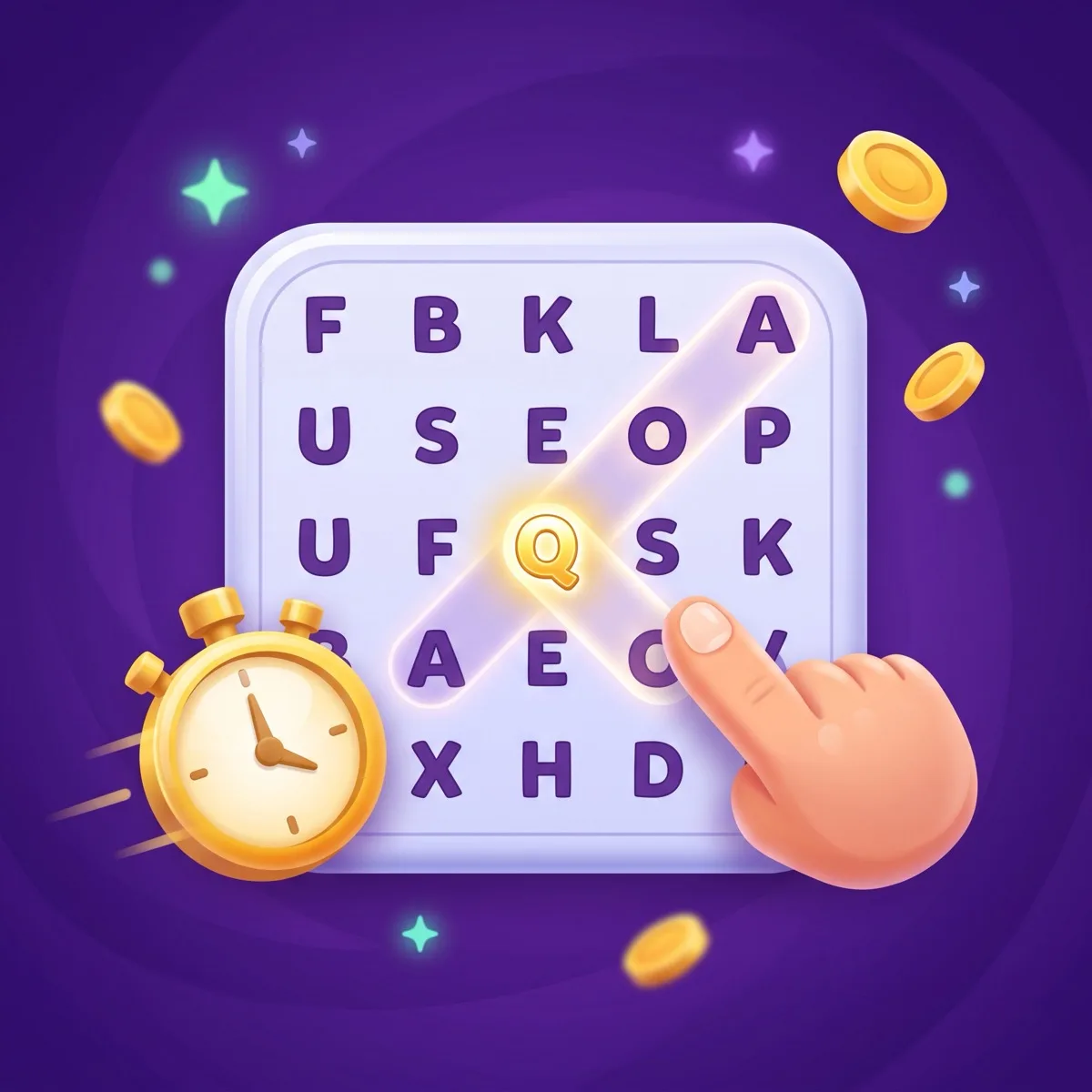
The difference between finding a word in ten seconds and finding it in three isn't luck, and it isn't a bigger vocabulary. It's how your eyes move across the grid. Most people search a word search the way they read a book, left to right, top to bottom, and then wonder why one puzzle eats ten minutes. There's a faster way, and it's a trainable skill. Below are nine techniques, ordered from highest impact down, plus a 15-minute drill to lock them in. And if you play a timed word search, where every second you save is worth points, speed stops being a party trick and becomes the whole game.
- Scan, don't read. Reading is linear. Scanning jumps to high-signal anchor points and traces outward. Reading a word takes 8 to 12 seconds; trained scanning takes 2 to 4.
- Rarest letters first. Q, Z, X, and J are under 0.5% of English text combined, so they jump off a grid full of vowels. (Wikipedia, Letter frequency)
- Read shapes, not letters. Endings like -ING and -TION, double letters like LL and SS, and the first two letters are pre-chunked patterns your brain reads as one unit.
- It's your eyes, not your effort. During visual search you make about 2 to 5 eye movements per second, and speed comes from aiming them well, not staring longer. (Nature, Scientific Reports, 2016)
- Speed pays in timed play. When a per-second time bonus is scoring you, finishing faster, not just finding more, decides the match.
Why Do Some People Find Words So Much Faster?
Fast solvers scan; slow solvers read. That's the whole difference. Reading a word means checking it letter by letter, a linear process that runs about 8 to 12 seconds per word. Scanning is pattern-driven: your eye snaps to an anchor, then traces outward in eight directions, and the same word turns up in 2 to 4 seconds. Speed here is a skill you build, not a talent you're born with.
How big is the gap? Casual solvers report taking 5 to 10 minutes on a small 10-word grid, while experienced solvers finish the same puzzle in under 2 minutes. Those figures come from puzzle-site solvers rather than a controlled study, so treat them as illustrative. Still, the direction is clear, and the reason is simple: practiced scanning covers the board once instead of three times.
The Speed Gap Is Real (and Trainable)
Source: reported solver times via itWordSearches and WordSearchPuzzle (2026). Illustrative ranges, not a peer-reviewed measurement.
In a paper puzzle, slow just means slow. In a timed match, slow means you lose, because the clock is part of the score. That's the frame worth holding onto as you read the rest of this: every technique below is really a way to spend fewer seconds per word. Want to see where that speed literally converts into money? Hold that thought until the section on timed cash play.
How Do Your Eyes Actually Search a Grid?
Your eyes don't glide across a puzzle. They jump. In 2016, researchers tracking visual search found that people make roughly 2 to 5 of these jumps, called saccades, every second, and that skilled readers average about 4.5 per second (Nature, Scientific Reports). Between jumps your eye holds still for a fraction of a second to actually see. So getting faster isn't about moving your eyes more. It's about landing each jump somewhere useful.
Here's the part that changes how you practice. A 2008 study of visual scanning found that performance depends more on the efficiency of your saccades than on how long you fixate (Vision Research). In plain terms: where you look beats how hard you look. Staring longer at a cluster of letters won't rescue a bad search pattern. Aiming your next jump at a rare letter or a familiar word-ending will.
So why does this matter for a word search? Because every trick in the rest of this guide is a rule for aiming your saccades. Rare-letter anchoring tells your eye where to jump. Shape recognition tells it what to jump to. A systematic sweep stops it from jumping back to the same spot twice. You're not training your eyes to move faster. You're training them to waste fewer moves.
During visual search, the human eye does not glide smoothly across the page. It moves in short jumps called saccades, holding still for only a fraction of a second between them. In 2016, researchers found people make roughly 2 to 5 of these jumps per second, and that skilled readers average around 4.5 (Nature, Scientific Reports). A separate 2008 study showed that search speed depends more on how efficiently the eye moves than on how long it fixates on any one spot (Vision Research). The practical lesson for a word search is direct: getting faster means aiming each eye movement at a high-value target, such as a rare letter or a familiar word-ending, rather than staring harder or longer at the grid.
Which Letters Should You Look For First?
Look for the rarest letters first. Q, Z, X, and J together make up under 0.5% of all letters in English text, so on a grid crowded with vowels they're the fastest anchors your eye can find (Wikipedia, Letter frequency). Scarcity is exactly what makes them useful: there are so few of them on the board that when a target word contains one, it barely has to compete for your attention.
Consider the spread. The letter E shows up about 12.7% of the time in English, while Z sits near 0.074%. That makes E roughly 170 times more common than Z. On a filled grid, the E's are everywhere and effectively invisible as anchors, while a lone Z is a beacon. If your target word is QUARTZ or JAZZ or XYLOPHONE, don't hunt the whole word. Find the rare letter, then trace its neighbors in all eight directions.
Why Rare Letters Are the Fastest Anchors
Source: Wikipedia, Letter frequency (standard English corpora); cross-checked against Norvig, English Letter Frequency Counts (Mayzner Revisited), 2013.
One more level up: rare pairs are even faster than rare single letters. A Q in English is almost always followed by a U, so QU is a two-cell signature you can spot as a single shape. The same goes for uncommon starts. Once your eye learns these signatures, you stop reading letters and start recognizing fingerprints.
In a word search, look for the rarest letters first. In typical English text, Q, Z, X, and J together make up under 0.5% of all letters, while E alone appears about 12.7% of the time, roughly 170 times more often than Z (Wikipedia, Letter frequency; cross-checked against Norvig's Mayzner corpus). Because rare letters barely appear on the grid, they do not compete for your attention the way common vowels do, which makes them the fastest anchor points available. The method: if a target word contains a rare letter, find that single letter first, then trace its neighbors in all eight directions to complete the word. Rare pairs like QU are faster still, since they read as one two-cell signature.
Should You Read Word Shapes or Single Letters?
Read shapes, not letters. Common endings like -ING, -TION, -LY, and -NESS, plus double letters like LL, SS, EE, and OO, are patterns your brain already reads as a single unit. Spotting one of those chunks surfaces a word far faster than checking one character at a time. Your reading brain has spent years learning these shapes, so a word search is really a chance to reuse a skill you already own.
That leads to the question every beginner asks: do you hunt the first letter or the whole word? Neither. Hunt the first two letters. A single starting letter throws off too many false hits on a busy grid, so you burn time checking neighbors that lead nowhere. The whole word is too much to match at once. The first pair is the sweet spot: it narrows the field fast, then you extend in one direction to confirm.
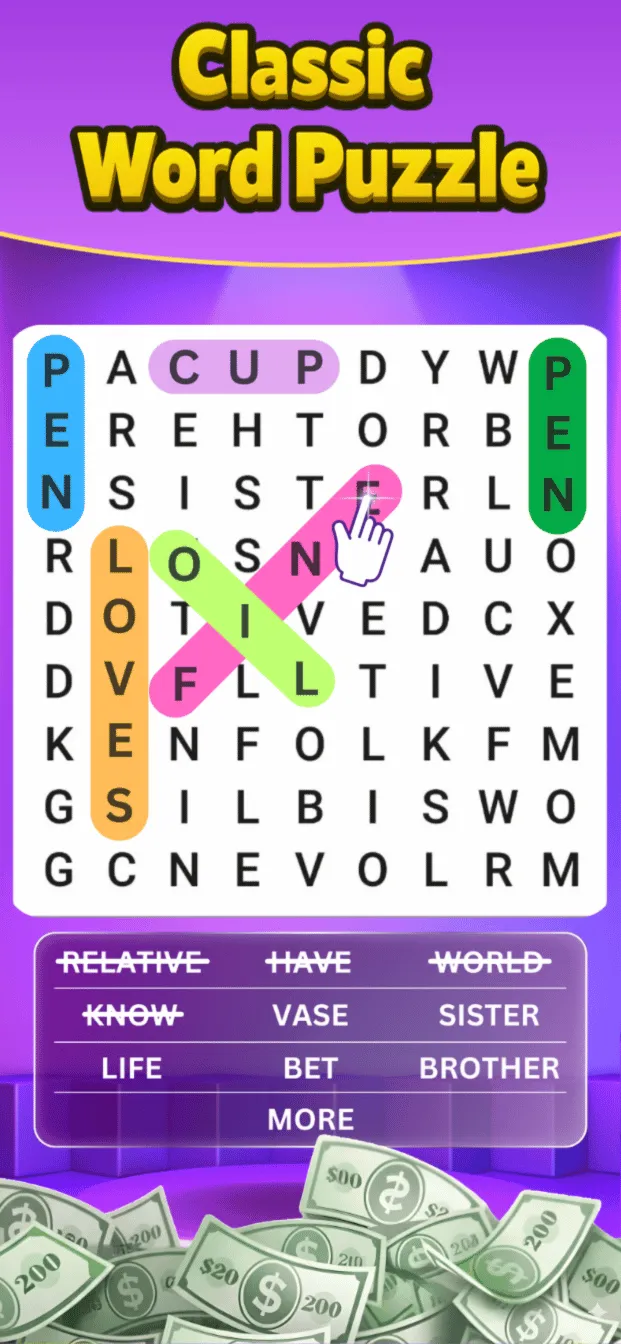
Double letters deserve a special mention. Two identical letters sitting side by side are unusually easy to spot, and they often sit in the middle of a word, giving you a foothold to expand both ways. If a target word has an obvious double, like BALLOON or COFFEE, start there instead of at the front. It's a shortcut hiding in plain sight.
To find words faster, read word shapes rather than single letters. Common endings such as -ING and -TION and double letters such as LL and SS are pre-chunked patterns the brain reads as one unit, so they surface a word faster than a letter-by-letter check. When choosing where to start, look for the first two letters of a target word: a single letter gives too many false hits, and the whole word is too slow to match at once.
How Do You Scan a Grid Systematically?
Random scanning re-covers the same letters two or three times. A systematic sweep covers every cell exactly once, and that alone can save 5 to 10 seconds a round. The goal is simple: never search the same square twice, and never leave a corner unsearched. A consistent pattern is what makes that possible. Here's the method, step by step.
- Pick one pass pattern and commit. Row by row, column by column, or four quadrants. Any consistent pattern beats darting around the board on instinct. On Boggle-style grids, where words bend in any direction, start from the center tiles instead.
- Scan one direction at a time. Do a full pass looking only for horizontal words, then a pass for vertical, then diagonals. Switching directions mid-scan is a hidden tax on your attention.
- Sweep the perimeter first. Generators often seat words along the edges. A quick lap around the border banks easy finds before you tackle the crowded middle.
- Use a finger or stylus as a guide. It pins your fixation point and stops you skipping lines. On a phone you're already dragging, so make that drag deliberate.
- Clear found words immediately. Crossing off, or letting the app highlight, removes visual noise so the remaining targets stand out. This compounds fast under a clock.
- Take the longest words first. Long words span more cells and form a longer visual line, so they pop before the board fills with crossed-out clutter.
Don't forget the direction most people miss. Words run horizontally, vertically, and diagonally, and plenty read backward. Diagonal and reversed words are the number-one time sink, because solvers scan for them last, if at all. Build them into your directional passes from the start. For the version of this system tuned specifically to Word Search Cash boards, we break it down further in our 5-step scanning system for Word Search Cash.
To scan a word search grid systematically, pick one pass pattern and commit to it: row by row, column by column, or quadrants. Search one direction at a time, sweep the perimeter first, use a finger to guide your eye, and cross off each word as you find it to cut visual noise. Covering every cell exactly once, instead of re-searching the same area two or three times, can save five to ten seconds a round.
Slow Habit vs Faster Technique: A Cheat Sheet
Here's the whole method on one screen. Each slow habit below has a faster replacement, and the reason it wins.
| Slow habit | Faster technique | Why it wins |
|---|---|---|
| Reading the grid line by line | Scan to rare-letter anchors (Q, Z, X, J) | Fewer, better-aimed eye jumps |
| Searching for the whole word | Lock the first two letters, then extend | Narrows the field without false hits |
| Scanning every direction at once | One direction per pass | Removes the direction-switching tax |
| Wandering the board randomly | Systematic sweep, cross off as you go | Covers each cell once, not three times |
| Chasing every word in order | Skip a stubborn word after 10 to 15 seconds | Banks easy finds and the clock bonus in timed play |
The five habits above map to the techniques in this guide, from rare-letter anchoring to knowing when to abandon a word under a clock.
When Does Finding Words Faster Pay Real Money?
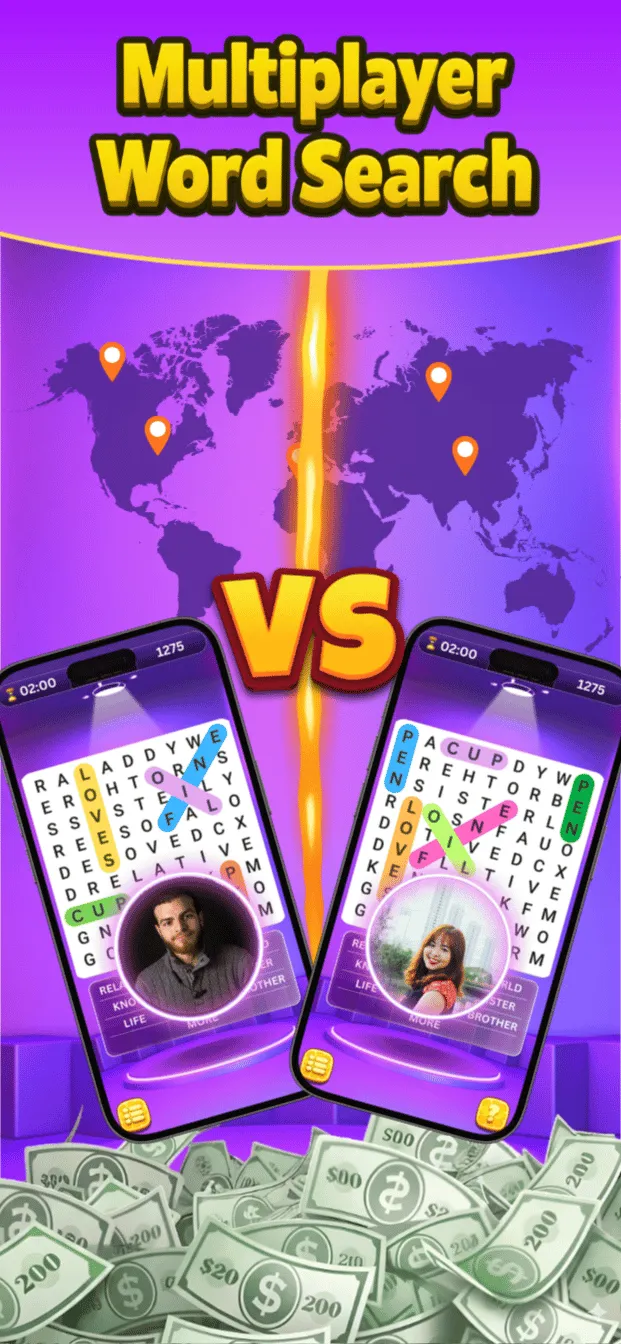
In a casual puzzle, slow just costs you time. In a timed word search, speed is the win condition, because you earn points for every second left on the clock when you finish. Word Search Cash by Atay Games, for example, awards a 10-point time bonus for each remaining second, so finishing faster, not just finding more, often decides the match (Skillz scoring, via our full guide). Suddenly every technique above has a dollar value attached.
That flips one piece of common advice on its head. Every casual guide tells you to find every word. Under a per-second time bonus, that can be the wrong move. Grinding one stubborn word for 25 seconds can cost you three easy ones plus the clock bonus you'd have banked by finishing. Learn the opportunity cost of a word: if a target isn't falling in about 10 to 15 seconds, skip it, grab the easy finds, and circle back only if time allows. No casual guide teaches this, because it only makes sense when the clock is scoring you. The same skip rule carries over to its sibling word game, where you build words from a letter wheel instead of finding them, and the Crossword Cash two-pass method shows why the slot you abandon gets easier while you're away.
Our finding. When we timed our own players, casual solvers averaged one find every 8 to 12 seconds. After two weeks of practicing single-direction passes and rare-letter anchoring, the same players were finding words in 2 to 4 seconds. The technique did the work, not raw effort.
Mobile changes the mechanic, too. On paper you circle a word; on a phone you drag across it. A clean, confident drag that doesn't overshoot the last letter is its own speed skill, and a sloppy drag that misfires costs you a second every time. Practice the drag itself, not just the spotting.
Two honest notes before you chase this. First, earnings are modest: casual players typically make around $5 to $50 a month, and speed is the lever that moves you up that range. Second, these are skill-based games, not gambling, and cash play isn't legal in every state, so check our state-by-state legality guide first. For a realistic picture of the numbers, see how much you can actually earn playing skill games, and if you're weighing whether the whole category is trustworthy, start with whether real cash skill games are legit.
In a timed word search, speed is the win condition because remaining seconds convert to points. Word Search Cash awards a 10-point bonus for every second left on the clock, so finishing faster can matter more than finding more words. That creates an opportunity cost per word: grinding one stubborn word can cost several easy finds plus the clock bonus, so skilled players skip a word that isn't falling within 10 to 15 seconds and return to it only if time allows.
What's the Fastest Way to Practice and Improve?
Speed comes from reps, but random reps plateau. This 15-minute routine trains the three sub-skills separately, then together, so each one actually improves instead of blurring into "just do more puzzles." Run it a few times a week and time the final step so you have a number to beat.
- Rare-letter sprints (5 min). Grab any puzzle and ignore the word list. Just find and circle every Q, Z, X, J, and K on the grid as fast as you can. This trains your eye to lock onto high-signal anchors on reflex.
- Single-direction passes (5 min). Solve one puzzle finding only horizontal words first, then a second pass for vertical, then diagonals. This builds the directional discipline that kills the diagonal-word time sink.
- Timed full run (5 min). Solve a fresh puzzle normally, but time it. Write the number down.
- Track it weekly. Same grid size, same word count, and watch the number drop. A measurable target beats a vague plan to "practice more."
This is where the eye-movement science pays off. You're not teaching yourself to stare harder. You're teaching your eyes to land on better targets, so each of those 2-to-5-per-second jumps does more work. Curious how a word search differs from a crossword or a letter-wheel game? Here's what each puzzle actually tests. If you want puzzles that also stretch memory and reasoning while you train, our roundup of games that challenge your brain is a good next stop. And once your scanning reflex is sharp, put it where it counts: word games that pay real money reward exactly this skill.
A 15-minute word-search speed drill trains three sub-skills in sequence. Spend five minutes on rare-letter sprints (circle every Q, Z, X, J, and K, ignoring the word list), five minutes on single-direction passes (find only horizontal words, then vertical, then diagonal), and five minutes on a timed full solve. Record the final time each session and repeat weekly on the same grid size to watch your solve time drop measurably.
Frequently Asked Questions
What letters should you look for first in a word search?
Look for the rarest letters first: Q, Z, X, and J. Combined they make up under 0.5% of the letters in English text, so on a grid crowded with common vowels they stand out immediately (Wikipedia, Letter frequency). If a target word contains one, find that letter first, then trace its neighbors in all eight directions.
How do you solve a word search fast?
Scan the grid instead of reading it. Anchor on rare letters, look for word shapes like the -ING ending or double letters rather than single characters, sweep the board one direction at a time so no cell gets searched twice, and cross off each word as you find it. Trained scanning drops a find from roughly 8 to 12 seconds down to 2 to 4.
Why am I so slow at word searches?
Usually because you read the grid line by line, the way you read a book. During visual search the human eye makes only about 2 to 5 movements per second (Nature, Scientific Reports, 2016), so speed comes from aiming those movements at high-value targets like rare letters, not from staring harder or longer at the board.
Should you look for the first letter or the whole word?
Look for the first two letters, not one and not the whole word. A single starting letter produces too many false hits on a busy grid, while matching the entire word at once is slow. Locking the first pair narrows the search fast, then you extend outward in one direction to confirm the rest.
Can practicing word search actually make you faster?
Yes. Finding words is a trainable visual-search skill, and structured drills such as rare-letter sprints and single-direction passes improve your solve time week over week. Regular word puzzling is also linked to sharper reasoning and memory in older adults, though that research is correlational (PROTECT study, 2019), not proof puzzles cause the benefit.
The Bottom Line on Finding Words Faster
Finding words fast isn't a gift. It's a set of habits that aim your eyes better. Scan instead of read, start with the rarest letters, recognize shapes instead of single characters, and sweep the grid so you never search a square twice. Run the 15-minute drill a few times a week, and your solve time will drop on its own.
Five things to carry into your next puzzle:
- Scan, don't read. Jump to anchors and trace outward, rather than crawling line by line.
- Rarest letters first. Q, Z, X, and J are under 0.5% of English text, so they're your fastest anchors.
- Read shapes. Endings, double letters, and the first two letters are chunks your brain already knows.
- Sweep in one direction at a time. Cover every cell once, and build in diagonals and reversals from the start.
- Under a clock, know when to quit a word. Bank the easy finds; the time bonus rewards a fast finish.
Sources
- Wikipedia, Letter frequency (standard English corpora), retrieved 2026-07-23, en.wikipedia.org/wiki/Letter_frequency
- Peter Norvig, English Letter Frequency Counts: Mayzner Revisited (Google Books corpus, ~3.5 trillion letters), 2013, retrieved 2026-07-23, norvig.com/mayzner.html
- Nature, Scientific Reports, "Persistence in eye movement during visual search," 2016, retrieved 2026-07-23, nature.com/articles/srep20815
- Vision Research, "The dependence of visual scanning performance on saccade, fixation, and perceptual metrics," 2008, retrieved 2026-07-23, pubmed.ncbi.nlm.nih.gov/18295297
- Brooker et al., International Journal of Geriatric Psychiatry (PROTECT study, 19,078 adults aged 50 to 93; correlational), 2019, retrieved 2026-07-23, onlinelibrary.wiley.com
- Atay Games internal player-timing research, 2026 (first-party operational data, illustrative).
Legal and financial disclaimer. This article is for general informational purposes only and does not constitute legal or financial advice. Skill gaming laws vary by state and change over time. Earnings figures are illustrative ranges drawn from documented player reports and platform data, not income guarantees. Solve-time figures cited here are reported by puzzle solvers and are illustrative, not results of a controlled study. Never deposit money into a gaming platform that you cannot afford to lose. Responsible play resources: National Council on Problem Gambling at ncpgambling.org or 1-800-522-4700.
Put Your New Speed to the Test
Word Search Cash turns fast finding into real points. Free practice tournaments, real-cash matches from $0.60, withdrawals in 1 to 3 business days, and real human opponents, never bots.
Play Word Search Cash