You can see three words on the wheel. You go for the long one, because it looks like the most points. Twenty seconds later it still hasn't come, two short words are still sitting there unplayed, and the board dies with one slot empty. That's the most common way to lose a Crossword Cash match, and it has nothing to do with vocabulary. It's an order-of-operations problem. This post gives you the order, a word connect game strategy built for the clock: a two-pass routine, a rule for which word to play first, and one number that changes how you look at a blank slot.
- Crossword Cash is a letter-wheel game, not a clue crossword. You swipe letters to spell words, and the words drop into a slot grid with no clues. The clock is the limit, not your dictionary.
- Pass one is the words you see instantly. Pass two is the slots they constrain. A five-letter slot has 8,506 possible dictionary words. Once it must start with a placed T and use only your six wheel letters, three remain.
- Play the word that touches the most empty slots first. Every letter it places is a clue for two or three other answers.
- Try wheel letters in frequency order. E, T, A, O, I, N, S, R lead English text (Norvig, 2013). Peel off S, ED, ER and ING endings first.
- Skip a stuck slot after 10 to 15 seconds. Play something else and come back with new letters on the board.
What Kind of Game Is Crossword Cash, Really?
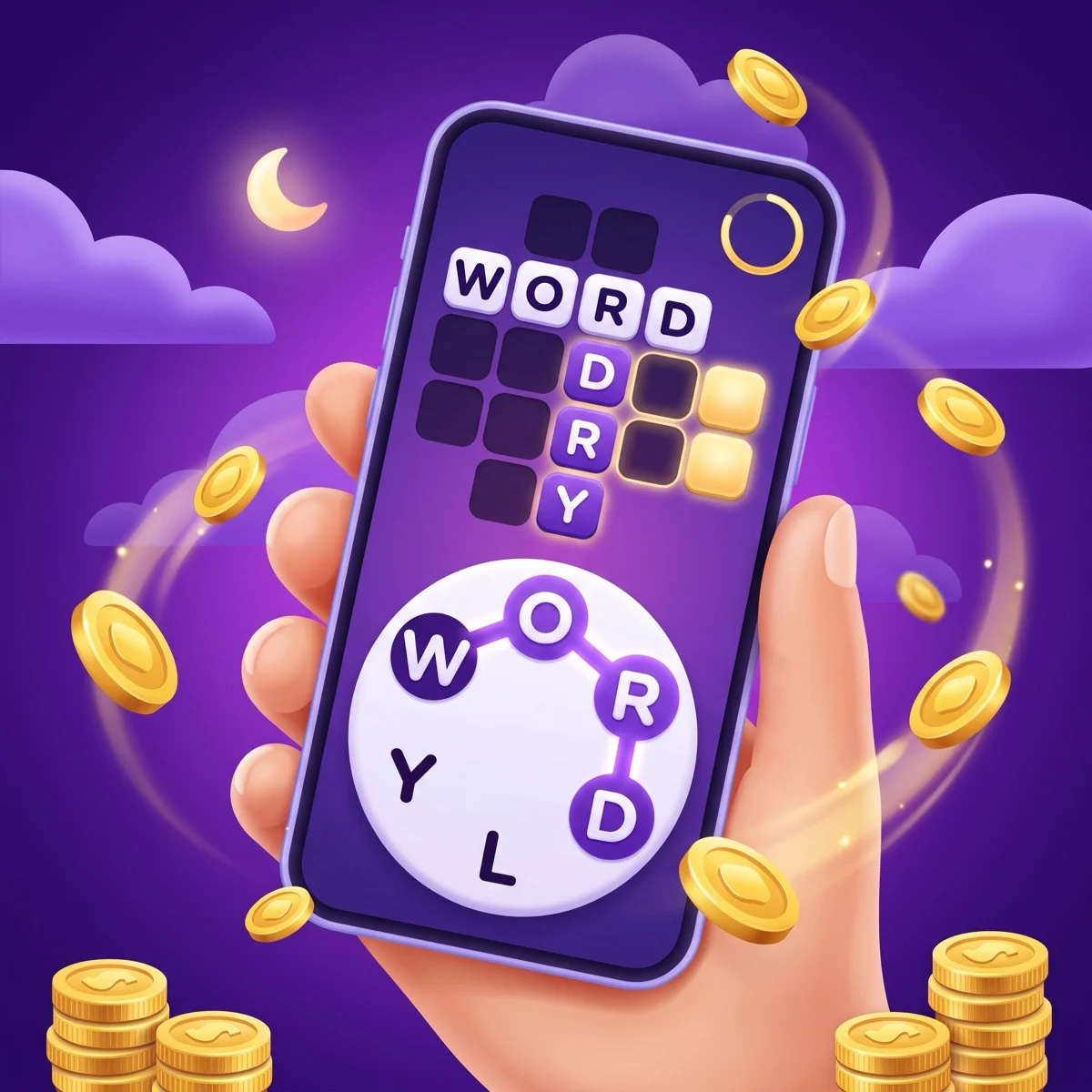
It's a timed word connect game built on a letter wheel, the format that Wordscapes made mainstream, and Wordscapes has passed 50 million downloads (Google Cloud, PeopleFun case study). A wheel of letters sits at the bottom of the screen. You swipe through them in sequence to spell a word, and every valid word drops into a crossword-shaped grid of blank tiles above. The grid shows slot lengths and where they cross. It doesn't show clues, because there aren't any.
Three more things matter for strategy. Extra valid words that don't fit the grid earn bonus points. Hints exist, and the game's own advice is to use them wisely. And both players receive the identical wheel, grid, and clock, so the higher score wins on speed and accuracy alone, against an opponent matched to your skill level (Atay Games, Crossword Cash).
Your screen shows a countdown, a running score, and a row of dots marking the boards in the match. The exact numbers change with app versions, so read them off your own screen in free mode before you rely on them.
That makes it a different skill from its sibling, Word Search Cash, as our crossword vs word search vs word connect comparison shows. There you're finding words hidden in a fixed grid, which is a visual scanning job, and the scanning system for word search covers it. Here you're building words from six or seven letters and fitting them into slots. Scanning won't help you. Ordering will.
Is this a big competitive format or a novelty? In 2025 the Skillz platform, now called Firy, reported $541.9 million in gross marketplace volume, which it defines as the total entry fees users paid for contests, across its whole catalog of skill games (Skillz, Fourth Quarter and Full Year 2025 Results, March 2026). Crossword Cash runs on that platform. The people you're matched against are paying to play, and they're practicing too.
Why Does Order Beat Vocabulary on a Timer?
Because on a clock, your score is words per second, and the fastest words are the ones you never had to search for. In 2003, Novick and Sherman found that anagram solutions that "pop out" arrive in about two seconds, and they happen mostly for skilled solvers, while solutions that require deliberate search take much longer (Novick and Sherman, Quarterly Journal of Experimental Psychology, 2003). A board is won by harvesting every pop-out first and saving the searching for last.
Short words pop out more often, and English is built from them. In 2013, Peter Norvig analyzed the Google Books corpus and found that three-letter words make up 20.5 percent of running text, four-letter words 14.8 percent, and five-letter words 10.7 percent, with the average word running 4.79 letters (Norvig, English Letter Frequency Counts: Mayzner Revisited, 2013). Nearly half of everything you've ever read is three to five letters long. Your eye has been trained on those shapes for your whole life, which is exactly why they pop.
Share of English text by word length
Percent of word tokens by letter count in the Google Books corpus, 743 billion words (Norvig, 2013). Gold bars mark the three-to-five-letter range that dominates pass one.
There's a second reason vocabulary alone doesn't win. In 2014, a study of elite crossword and Scrabble competitors found they outscored high-SAT students on working-memory tasks, not just on word knowledge (Toma, Halpern and Berger, Applied Cognitive Psychology, 2014). Holding several partial candidates in mind while the board changes is a memory job. The routine below is designed to keep that load small.
What Is the Two-Pass Method in a Word Connect Game?
The two-pass method splits every board into a harvest and a hunt. In pass one you swipe every word you can see without thinking, which is nearly always the short common words. In pass two you stop looking at the wheel in the abstract and start solving the grid's remaining slots, each of which now has a known length and one or more placed letters. The switch happens the moment nothing pops for about three seconds.
- Pass one: harvest. Read the wheel once. Swipe every three-, four- and five-letter word that arrives on its own. Don't judge them. A word you see is worth more than a word you're hunting, because it costs almost no time and it puts letters on the board.
- The trigger. When you catch yourself staring at the wheel with nothing arriving, that's the signal. Three seconds of silence, and you switch. Staying on the wheel past that point is where boards die.
- Pass two: hunt. Look at the grid instead. Pick the empty slot with the most placed letters in it. You now know its length and some of its letters, and you know it uses only wheel letters. Solve that pattern, not the wheel.
- Repeat. Each word you place in pass two reveals letters in other slots. Go back to the best-constrained slot and do it again.
Why does this work when "just find words" doesn't? Because the two passes use two different mental tools. Pass one runs on recognition, the pop-out effect from the last section. Pass two runs on constraint, which is what the next section quantifies. Mixing them, which is what most players do, means searching the wheel for a word that recognition already failed to give you. That's the slowest possible use of the clock.
Clue-crossword solvers have used a "two-pass" idea for years: fill the easy clues, then use the crossing letters to attack the hard ones. In a letter-wheel game there are no clues, so the second pass is driven entirely by the grid. It's the same name with a different engine, and the engine is what makes it fast. Both passes also depend on real opponents, not scripts: the routine wins because you're racing a person who is stalling on the same wheel you are.
How Much Does One Placed Letter Actually Help?
Far more than it feels like. Take a five-letter slot. The macOS system dictionary, which is Webster's Second with about 211,000 lowercase entries, contains 8,506 five-letter words. Say your wheel is T, A, B, L, E, S and you've already placed TABLE across the top. A down slot hangs off that T. Restrict the 8,506 to words that use only your six wheel letters and 18 remain. Require the placed T as the first letter and three remain: TABLE, TALES and TABES. Two of those are words you'd actually play.
How a five-letter slot collapses: from every word to three
Counts computed on September 9, 2026 from the macOS system word list (Webster's Second, web2, lowercase entries only). Wheel T-A-B-L-E-S, five-letter slot, first letter fixed to a placed T. Bars are drawn on a logarithmic scale so the smallest values stay visible. Game dictionaries differ from Webster's, which leaves out regular plurals, so in-game counts will differ slightly. The collapse is the point, not the exact number.
| Constraint on the five-letter slot | Candidates | Examples |
|---|---|---|
| Any five-letter word in the list | 8,506 | Everything from ABACK to ZYMIC |
| First letter is the placed T | 584 | TABLE, TIGER, TRUCK, TWIRL |
| Built only from T A B L E S | 18 | BEAST, BLAST, LEAST, SLATE, STEAL, TABLE |
| Both at once | 3 | TABLE, TALES, TABES |
Notice which constraint does the heavy lifting. The placed letter alone cuts the list by about 93 percent. The wheel alone cuts it by more than 99 percent. Together they leave you a choice between two or three words, and a choice takes a second.
That's the cascade: each word you place hands the next slot a constraint, and the next slot solves faster than the one before it.
Which Word Should You Play First? Cascade Value
Among the words you can see, play the one that touches the most unfilled slots. Call that its cascade value. A word that sits alone on the grid gives you points and nothing else. A word that crosses three empty slots gives you points plus one known letter in each of three future answers. Same time to swipe, three times the information.
Cascade value on a T-A-B-L-E-S board
| Word | Slot | Empty slots it touches | Play it when |
|---|---|---|---|
| TABLE | 5 across, top row | 3 (TALES, BEAST, EAST hang off it) | The instant it pops. Highest cascade on the board. |
| SET | 3 across, bottom row | 2 (ends TALES and BEAST) | Pass one. It costs a second and pins two long slots. |
| BEAST | 5 down from the B | 2 (TABLE, SET) | Pass two, once B and T are on the board. |
| TALES | 5 down from the T | 2 (TABLE, SET) | Pass two. With T and S placed it's a three-way choice. |
| EAST | 4 down from the E | 1 (TABLE) | Pass one if it pops, otherwise last. Lowest cascade. |
Sample board built for this post: TABLE across the top, TALES and BEAST down from its T and B, EAST down from its E, SET across the bottom joining TALES and BEAST. Slot layouts in the game vary; the counting rule does not.
This is also the honest answer to the "long word first" question. The longest slot usually uses every wheel letter or all but one, and it tends to cross the most other slots, so its cascade value is the highest on the board. Play it the moment it pops.
But never hunt it early. A long word that hasn't arrived by itself is the slowest thing you can search for, and while you're searching, three short words with cascade value of their own are sitting there unplayed. Pop-outs first, cascade value to break ties, long slots when the grid hands them to you.
Which Letters Do You Try First on the Wheel?
Start with the ones English uses most. In 2013, Peter Norvig counted 3.56 trillion letters in the Google Books corpus and found E at 12.49 percent, T at 9.28, A at 8.04, O at 7.64, I at 7.57, N at 7.23, S at 6.51 and R at 6.28 (Norvig, English Letter Frequency Counts, 2013). Those eight letters are almost two thirds of everything written. When you're stuck, a word built from them is far more likely to exist than a word built around the wheel's odd letter.
Three practical moves follow from that:
- Peel the endings off first. If the wheel holds an S, every four-letter word you found is also a five-letter word. ED, ER, ING and LY behave the same way. Find the stem, then bolt the ending on.
- Pair the common letters. Norvig's most frequent two-letter sequences are TH, HE and IN. If the wheel has a T and an H, start your search with TH and let the rest follow. In 1976, Mendelsohn showed that solvers naturally test letter orders in decreasing order of how often those pairs occur in English, and that anagrams built from rare pairs take longer to crack (Mendelsohn, Memory and Cognition, 1976). Do it on purpose and it's faster still.
- Park the rare letters. Q sits at 0.12 percent of English text, Z at 0.09, J at 0.16 and X at 0.23. If the wheel has one, the slot that needs it is a pass-two slot. Don't burn pass-one time on it.
Which wheel letters to try first: frequency in English text
Percent of all letters in the Google Books corpus, 3.56 trillion letters (Norvig, 2013). Top eight letters shown against the five rarest.
Crossword Cash Tips: When Do You Skip, Hint, or Chase Bonus Words?
Skip a stuck slot after 10 to 15 seconds, spend a hint only on the slot that opens up the most crossings, and chase bonus words only when the grid is done or truly stuck. Those three rules cover almost every clock decision in the game. Clue-crossword solvers often move on after a short stall on one clue and circle back later. A letter-wheel board is far smaller, so the window has to be tighter.
The skip rule
If a constrained slot doesn't resolve in 10 to 15 seconds, leave it. Play any other word you can see, even a low-value one, because it might drop a letter into the slot you abandoned. Then return. The slot you come back to is a different, easier puzzle than the one you left, because the constraint got tighter while you were away. That's the cascade working for you in reverse.
The hint rule
A hint buys you a letter, and a letter is a constraint. So spend it where the constraint pays off most: the empty slot with the highest cascade value, not the slot that annoys you. Hints aren't free, whatever form the cost takes in the version you're playing, so check what a hint costs in free mode before you lean on one in a cash match. A hint that reveals a letter in an isolated three-letter slot is the worst purchase on the board.
The bonus-word rule
The game pays for extra valid words that don't fit the grid. That's real score, and on a board you've finished with time left, farming them is the only thing to do. During the board, though, a bonus word gives you points and no letters. A grid word gives you points and constraints. Until the grid is complete, grid words win. Confirm the exact bonus-word value on your own score pop-up, because it changes with versions.
It's the loss I see most often when I run free-mode boards myself, and the failure has a shape. A player plays TABLE, sees SET and EAST on the wheel, and goes hunting for a mystery five-letter down slot instead. Fifteen seconds pass. Then twenty. Eventually they play SET, and the slot reads B-E-A-S-T at once, because the B was already there and SET just handed it the T. The board ends one slot short, and the slot it ends short on is the one they spent the most time on.
The routine exists to stop that specific loss. It's also why the skip rule is 10 to 15 seconds and not 30: in my own boards, anything I couldn't place inside that window almost always fell in under three seconds once one more word was down.
How Do You Practice, Budget, and Enter Your First Cash Match?
Run the routine in free mode until you're finishing boards with time to spare, then enter a $1 match as a test of the word connect game strategy rather than a bet on your vocabulary. Free practice is the honest starting point for every skill game, and it's where the two-pass switch becomes automatic instead of something you have to remember under a clock.
A practice loop that works: play one board, then ask where the clock went. Did you stall on the wheel after pass one should have ended? Did you hunt a long word early? Did you skip and come back? One question per board is enough.
Crosswords have a long research record on the cognitive side, including a 78-week trial in which crossword training beat computerized brain games in adults with mild cognitive impairment (Devanand and colleagues, NEJM Evidence, 2022), and our brain-games guide covers that evidence properly. This post is about winning boards, so the loop stays about the clock.
Then the money side, stated plainly. Crossword Cash runs on iPhone and iPad through the App Store. On Android it installs from a direct APK on the official Atay site, which is why real-money games aren't on Google Play. Cash matches start at $1, the minimum withdrawal is $5, and there are no withdrawal fees. Before you size up, read how much you can realistically earn from skill games.
You're matched with players of similar skill, so improvement pays off but everyone is improving, and the platform takes a commission on entries. Real-money play is 18+ and depends on where you live, so check whether prize play is available in your state first.
One honest close. A better routine raises your average score across many boards. It never guarantees a single match, and you'll lose some to a player who saw the long word half a second before you did. Treat it as a skill hobby with a budget you don't chase, know what you can realistically earn before you size up, and borrow the bankroll and focus habits that apply to every cash game. For where Crossword Cash sits among other word games that pay, that roundup has the comparison.
Frequently Asked Questions
Is Crossword Cash a real crossword?
Not the newspaper kind. There are no clues. A wheel of letters sits at the bottom of the screen, you swipe them in sequence to spell words, and each valid word drops into a crossword-shaped grid of blank tiles. Both players get the same wheel, grid, and clock, and the higher score wins.
What is the two-pass method in word games?
Pass one is swiping every word you see instantly, usually short common words. Pass two is solving the slots those words now constrain, because a slot with a known length and one placed letter has far fewer candidates. On a six-letter wheel, a five-letter slot starting with a placed T drops from 8,506 dictionary words to three.
Which letters should you try first when unscrambling?
Start with the letters that appear most in English. In Peter Norvig's count of 3.56 trillion letters from Google Books, E leads at 12.49 percent, then T, A, O, I, N, S and R. Peel off common endings like S, ED, ER and ING first, then unscramble what remains. Save Q, Z, J and X for the second pass.
Do bonus words count for points in Crossword Cash?
The game rewards extra valid words that aren't in the grid with bonus points, on top of the grid words themselves. How much they pay relative to a grid word depends on the current version, so check the score pop-up in free mode. In a timed match, chase them only when the grid is complete or truly stuck.
Is Crossword Cash a game of skill or luck?
Skill. Both players receive the identical wheel, grid, and clock, so the only variable is how fast and accurately each person finds words. Matchmaking pairs you with opponents of similar ability based on match history. A better routine raises your average score over many matches, but it never guarantees a single result.
- Peter Norvig, "English Letter Frequency Counts: Mayzner Revisited" (2013) - letter frequencies, two-letter sequence frequencies, and word-length distribution from the Google Books corpus. norvig.com
- Novick and Sherman, "On the nature of insight solutions: evidence from skill differences in anagram solution," Quarterly Journal of Experimental Psychology A (2003) - the two-second pop-out finding. pubmed.ncbi.nlm.nih.gov
- Mendelsohn, "An hypothesis approach to the solution of anagrams," Memory and Cognition (1976) - solvers test letter orders in decreasing bigram-frequency order. pubmed.ncbi.nlm.nih.gov
- Toma, Halpern and Berger, "Cognitive Abilities of Elite Nationally Ranked SCRABBLE and Crossword Experts," Applied Cognitive Psychology (2014). onlinelibrary.wiley.com
- Devanand and colleagues, "Computerized Games versus Crosswords Training in Mild Cognitive Impairment," NEJM Evidence (2022), via PubMed Central. pmc.ncbi.nlm.nih.gov
- Skillz Inc. (now Firy Inc.), "Skillz Reports 2025 Fourth Quarter and Full Year 2025 Results" (March 2026) - gross marketplace volume defined as total entry fees paid for contests. investors.skillz.com
- Google Cloud, "PeopleFun" customer case study - Wordscapes passing 50 million downloads. cloud.google.com
- Candidate-word counts in this post were computed by Atay Games on September 9, 2026 from the macOS system word list (Webster's Second, web2, lowercase entries only). Game dictionaries differ from Webster's, which omits regular plurals, so in-game counts will differ slightly.
- Atay Games, "Crossword Cash" - gameplay, bonus words, hints, entry levels, and withdrawal terms. ataygames.com
A note on results. Skill-based cash games involve real money. A better routine raises your average score over many boards, but it never guarantees a single outcome, and you can lose entry fees. Outcomes vary by player, region, and game. Set a daily limit, never wager what you cannot afford to lose, and use the responsible play tools available in-app. Real-money play is 18+ and is not available in every jurisdiction.
Ready to Run the Two Passes?
Practice the routine in free mode until the switch is automatic, then enter a $1 cash match against real human opponents on the identical board.
Play Crossword Cash