Your name could be called any second. You've got one hand free, a clipboard or a coffee in the other, and ten minutes of dead time you didn't ask for. So what do you actually play? Most "games to play while waiting" lists get this exactly wrong: they hand you two-handed shooters and timed challenges that punish you the moment you look up. The right waiting-room game passes one simple test, plays with a single thumb, and lets you walk away mid-round without losing a thing. Here's the honest shortlist, from someone who works on player trust for a living.
- One thumb, drop it anytime. The best waiting-room game plays one-handed and can be abandoned the instant you're called, with zero penalty.
- You really do play one-handed. About 49% of people hold and operate the phone with one hand, only 15% use two (Hoober, UXmatters, 2013).
- You've got the time. The average in-office wait is 13.3 minutes (PatientPoint, 2024), room for a few short rounds.
- Solitaire, word search, block puzzle, match-3 and bingo win. One-thumb, no timer, drop-friendly.
- Free mode pauses, a cash round does not. Enter a timed cash tournament only when your window is safe.
Let's define the job before the list. A waiting room is the highest-interruption place you'll ever play a game. You can't control the clock, you're often standing or one-handed, and the payoff you want is a satisfying way to make a boring gap disappear. That's a very specific brief, and it rules out most of what the internet recommends. Get the test right and the picks are obvious.
Why Is a Waiting Room Made for One-Handed Games?
Because you're rarely two-handed and never in charge of the clock. Way back in 2013, a field study by Steven Hoober watched 1,333 people use their phones (Hoober, UXmatters, 2013). It found 49% held and tapped one-handed, 36% cradled the phone in one hand and tapped with the other, and only 15% used two thumbs. In a waiting room the other hand is usually full, so the one-handed share climbs even higher.
And you have real time to fill. In 2024, PatientPoint's nationwide survey put the average in-office wait at 13.3 minutes, up from 12.8 the year before, with 99% of patients waiting at least a little (PatientPoint, 2024). Add the DMV line, the pharmacy counter, and school pickup, and those idle minutes stack up fast. It's no surprise we reach for the phone: as of 2026, Americans check theirs about 186 times a day, roughly once every five waking minutes (Reviews.org, 2026). The waiting room is where a lot of those checks happen.
How We Actually Hold Our Phones
Source: Steven Hoober, UXmatters (field study of 1,333 users), 2013.
Why do one-handed games suit a waiting room? Because most phone use already is one-handed. A 2013 field study of 1,333 people found 49% operated the phone with one hand and only 15% used two (Hoober, UXmatters). Pair that with an average in-office wait of 13.3 minutes (PatientPoint, 2024), and the ideal game is a one-thumb puzzle you can start and stop at will.

The One Rule: Can You Drop It the Second You're Called?
A good waiting-room game passes a single test: you can reach every control with one thumb, and you can walk away mid-round with no penalty. That's it. If a game needs two hands, a steady aim, or punishes you for stopping with a timer, a combo, or a streak, it's the wrong game for a queue. The thumb test isn't arbitrary, either: roughly three-quarters of all screen touches are made with the thumb, which is why designers map a phone's easy-reach "thumb zone" in the first place (Smashing Magazine, 2016).
So before you settle into a game while you wait, ask two quick questions. Can you play the whole thing with the thumb of the hand that's already holding the phone, without shifting your grip? And if a nurse calls your name on your very next tap, do you lose anything by just closing the app? If both answers are yes, it's a true waiting-room game. If either is no, save it for the couch.
The one-thumb, drop-it test. Most "one-handed games" lists quietly recommend the opposite of what you want: endless runners and idle loops engineered to keep your thumb moving and make leaving feel like a loss. Flip it. A great waiting-room game is happy to be abandoned. No timer to beat, no combo you'll forfeit, no "just one more." It waits for you, not the other way around. That single reframe filters the whole genre.
What makes a game right for a waiting room? One test: you can play it with one thumb, and you can quit mid-round with zero penalty. About three-quarters of screen touches are thumb touches (Smashing Magazine, 2016), so portrait, reachable controls matter, and any timer, combo, or streak that punishes stopping disqualifies a game the moment your name is called.
What Are the Best One-Handed Games to Play While Waiting?
The winners are the calm classics you can drive with one thumb: solitaire, word search, block puzzle, untimed match-3 and bingo. Each is portrait, tap-or-single-swipe, and forgiving if you glance up or quit cold. With an average wait around 13.3 minutes (PatientPoint, 2024) and a typical mobile session running only a few minutes, you've usually got room for two or three short rounds. Here are the picks, grouped by how much hand and focus each one really needs.
Solitaire
Drag a card, plan a move, breathe. Solitaire is the model one-thumb game: portrait, self-paced, and you can put it down between any two moves without losing your place. There's no clock in free mode and no opponent, so a called name costs you nothing. Practice free on Solitaire, or learn the paid score-race format in how to play solitaire for cash.
Word Search
Hunt a word, swipe across it, done. Word search is the gentlest of the bunch, one swipe per find, and it's genuinely absorbing without demanding focus. Look up, look back, and the grid is exactly where you left it. Try it on Word Search and see how word search cash works.
Block Puzzle
Drag a block onto the grid, clear a line, repeat. Block puzzle is pure one-thumb spatial thinking with no time pressure in free mode, so there's never a penalty for stopping to hand over your insurance card. Play free on Block Puzzle.
Untimed Match-3
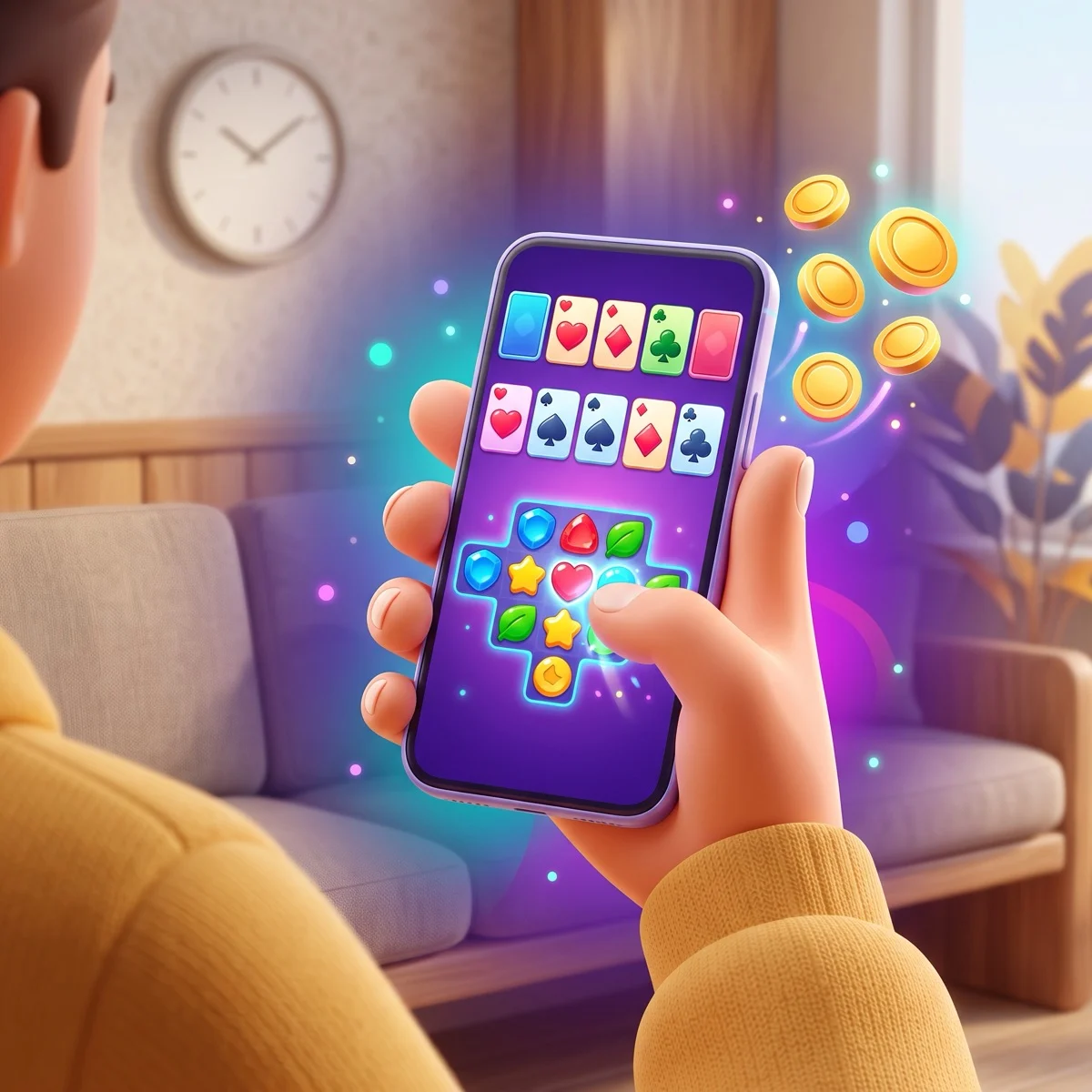
Swipe to match three, watch the board cascade. In its relaxed mode, match-3 is one of the most satisfying ways to kill 90 seconds, and you can drop it on any swipe. Try a round on Sugar Cash.
Bingo
Tap the numbers as they're called and race a pattern. Bingo is tap-only and easy to glance away from, which makes it a natural for a busy waiting room. Start in the free rooms on Bingo Prizes.
One step up: bubble shooter (a quick aim, still drop-friendly)
Bubble shooter is still one-thumb and portrait, but a good bank shot rewards half a second of aim, so it's "glance-and-commit" rather than truly eyes-off. It's great for a short burst, just not something you can play while reading the room. If you like it, brush up with our bubble shooter strategy and play on Bubble Prizes.
What to skip while you're next in line
Be honest about the two-handed games. 8 Ball Pool and carrom need a precise aim or a controlled flick, which really wants two hands and a steady moment. They're a joy when you've got both hands and a confirmed block of time, but they're the wrong call when you might be interrupted on the next shot. Know the difference and you'll never blow a game because a receptionist looked up.
Here's how the picks stack up on the two things that decide a waiting-room game: whether you can run it with one thumb, and whether you can quit mid-round with nothing lost.
| Game | One thumb? | Drop mid-round with zero loss? | Best for |
|---|---|---|---|
| Solitaire | Yes, drag | Yes, self-paced | Any wait |
| Word Search | Yes, one swipe | Yes, calmest of all | Any wait |
| Block Puzzle | Yes, drag | Yes, no clock | Any wait |
| Untimed match-3 | Yes, swipe | Yes, on any swipe | Short gaps |
| Bingo | Yes, tap | Yes, easy to glance away | Any wait |
| Bubble shooter | Yes, but aims | Mostly, glance-and-commit | A quick burst |
| 8 Ball Pool / Carrom | No, two hands | Risky, needs a steady moment | A confirmed block |
The reason these fit is arithmetic. Your wait is usually short, but not tiny, and it varies a lot by where you are. Here's the range of typical in-office waits, so you can see why "room for a couple of quick rounds" is the right mental model.
How Long You Usually Wait (Minutes, In-Office)
Source: PatientPoint nationwide patient wait-time survey, 2024.

What are the best one-handed games to play while waiting? Solitaire, word search, block puzzle, untimed match-3 and bingo, because each runs on one thumb and can be dropped mid-round with nothing lost. Two-handed games like pool and carrom need a steady aim and don't fit a queue. With an average wait of 13.3 minutes (PatientPoint, 2024), there's room for two or three short, pausable rounds.
Can You Play Cash Games in Short Bursts?
Yes and no, and the difference is the whole point. Several of these one-thumb puzzles are free skill games that also run real-cash tournaments, so the same dead minutes can return a few dollars instead of nothing. The catch is simple and non-negotiable: the cash rounds are timed and can't be paused (here's why cash matches can't be paused). Free mode you can drop the instant you're called. A cash bracket you cannot. So the honest rule is to enter a cash round only when you already know your window is safe.
Here's how the format works. These are skill-based tournaments, not games of chance: you practice free, then an optional small entry puts you in a short timed bracket where the better player, not the luckier one, tends to win. A waiting room is the most interruptible place you'll ever sit. So treat free mode as free skill practice. It makes you sharper for the cash rounds you enter later, from the couch, with your window fully your own. That's not a downgrade. It's the smart way to use the time.
The mistake we see over and over. Someone opens a timed cash tournament while they're next in line, gets called on move three, and forfeits both the round and the entry. It's the single most common way people lose a little money to their own good intentions. The fix costs nothing: in a waiting room, play the free mode you can abandon on any tap, and only enter a cash bracket right after you've been told a wait time you can actually trust.
Keep the earnings in perspective, too. This is a few dollars of fun, not a paycheck; for the real math, see how much you can realistically earn. Paid rooms use entry fees, so you can also lose, and the whole category is worth understanding before you spend, which we cover in puzzle games that pay real money. Cash contests aren't legal in every state, so check whether skill games are legal where you live first.
Practice Free While You Wait, Compete When You're Ready
Atay's puzzles, solitaire, word search, block puzzle, match-3 and bingo, are free to play and built for one thumb. Cash rooms are optional and skill-based, with a low cash-out: skill, not gambling.
Browse Atay Games FreeCan you play cash games in short bursts? In short bursts yes, but not interruptible ones. Free practice mode pauses anytime; a real-cash tournament is a timed 2 to 5 minute round you can't pause. Because a waiting room is the most interruptible place there is, use free mode as practice and save cash brackets for a window you fully control, like right after a wait time is quoted.
How Long Is Your Wait? Match the Game to the Gap
Match the game to how long, and how certain, your window is. A line about to move needs a game you can abandon on the next tap; a confirmed wait can take a full round. The certainty matters as much as the minutes, because a cash round is only safe when you know the wait won't be cut short. The problem isn't going away, either: as of 2025, it takes an average of 31 days to schedule a new-patient appointment across major U.S. cities, up 19% since 2022 (AMN Healthcare, via Forbes, 2025). Harder to get an appointment usually means longer waits once you're there.
So use this quick map. It sorts your gap by both length and certainty, and tells you when a cash round is even worth considering.
| You've got | Certainty of the window | Best fit |
|---|---|---|
| 60 to 90 seconds (line about to move) | Low, interruptible any second | One quick free round you can abandon on the next tap: a bubble round, one word search |
| 2 to 5 minutes, confirmed uninterrupted | High, you were just told a wait time | A single timed cash bracket, knowing it can't be paused |
| 10 to 15 minutes (typical office wait) | Interruptible any second | Free-mode solitaire or block puzzle, zero loss if you're called |
Notice the load-bearing word in the middle row: confirmed. A cash tournament is only a good idea when the window is genuinely yours. Right after a receptionist says "about a twenty-minute wait," a 3-minute bracket is safe. Standing next in line with your name likely up next, it isn't. When in doubt, one game you can drop beats five you keep re-downloading. Working nights instead? See our guide to games for night-shift breaks.
How do you match the game to your wait? Sort by length and certainty. Under 90 seconds and interruptible, play one quick free round you can abandon on the next tap. A confirmed 2 to 5 minute window is the only time a timed cash bracket is safe, since it can't be paused. A typical 10 to 15 minute office wait suits free-mode solitaire or block puzzle you can drop instantly.
How Do You Set Up for Comfortable One-Thumb Play?
You don't need to spend a cent, and you don't need much setup either. Pick one calm, one-thumb game you already like, keep it on your home screen so it's one tap away, and stay in free practice mode whenever you might be interrupted. Since Americans check their phones about 186 times a day (Reviews.org, 2026), the goal isn't more screen time, it's making the idle minutes you already spend feel less wasted.
A few comfort pointers make one-handed play easier. Turn on your phone's one-handed or reachability mode so the top of the screen drops within thumb range. Bump up text size in accessibility settings; most games inherit it. And if you're on Android, note that real-money games often aren't in the Google Play Store for policy reasons, so install from the developer's own official site rather than a random mirror. We explain the why and the safe how in why real money games aren't on Google Play. Prefer to keep it purely free and pressure-free? That's completely fine, and you can browse all the games and stay in practice mode as long as you like. For more downtime ideas, our guides to games to play while watching TV and fun games for when you're bored cover the couch and the everything-else gaps. Between classes counts too: see money-making games for college students.
How do you set up for one-thumb play? Keep one calm, one-handed game a tap away on your home screen, and stay in free practice mode whenever you might be interrupted. Turn on your phone's one-handed reachability mode and larger text for comfort. On Android, install real-money games from the developer's official site, not the Play Store, which restricts them, and never from a random mirror.
Frequently Asked Questions
What games can you play with one hand?
Portrait, tap-or-single-swipe puzzles: solitaire, word search, block puzzle, untimed match-3 and bingo. About 49% of people already play one-handed (Hoober, 2013), and these need only one thumb, so you can run every control without shifting your grip.
What can I do in a waiting room on my phone?
Play a game you can drop the second you're called. A one-thumb puzzle beats a two-handed or timed game. The average in-office wait is 13.3 minutes (PatientPoint, 2024), room for two or three short rounds of solitaire, word search or block puzzle.
Are there mobile games you can pause anytime?
Yes. The free practice modes of puzzle games pause instantly and pick up where you left off. The honest exception is timed cash tournaments, which can't be paused mid-round, so save those for a window you control and use free mode when you might be interrupted.
What's a good game to play while waiting at the doctor or DMV?
Solitaire, word search or block puzzle in free mode: one thumb, no timer, and you can drop it the instant your name is called with zero loss. The typical office wait is around 13.3 minutes (PatientPoint, 2024), so a calm, pausable puzzle fits far better than anything with a clock.
Can you play skill cash games in short bursts?
In short bursts yes, but not interruptible ones. A cash round is a timed 2 to 5 minute tournament you can't pause. Enter one only when you know the wait won't be cut short. Otherwise practice free and keep the cash rounds for when your window is your own. See realistic earnings.
The Bottom Line on Waiting-Room Games
Waiting is constant, and one hand is usually all you've got. So the best waiting-room game isn't the flashiest one. It's the one that passes a single test: you can play it with one thumb, and drop it the second your name is called without losing a thing. Solitaire, word search, block puzzle, untimed match-3 and bingo clear that bar with room to spare. The two-handed and timed games don't, and pretending otherwise just costs you a round. Five things to carry into the next queue:
- One thumb, drop it anytime. That's the whole test. If it needs two hands or punishes stopping, it's the wrong game for a waiting room.
- You've got about 13.3 minutes. The average office wait is room for two or three short, pausable rounds.
- Solitaire, word search, block puzzle, match-3 and bingo win. Bubble shooter's close; pool and carrom are two-handed, save them for the couch.
- Free mode pauses, a cash round doesn't. Enter a timed cash bracket only on a window you know won't be interrupted.
- Match the game to the gap. Length and certainty both decide the pick.
Sources
- Steven Hoober, UXmatters, How Do Users Really Hold Mobile Devices? (field study of 1,333 users: 49% one-handed, 36% cradled, 15% two-handed; 90% of two-handed use is portrait), 2013, retrieved 2026-07-23, uxmatters.com
- PatientPoint, Average Patient Wait Time Today (nationwide survey, n=11,009: average in-office wait 13.3 minutes in 2024, up from 12.8; by specialty roughly 10.5 to 21 minutes), 2024, retrieved 2026-07-23, patientpoint.com
- Reviews.org, Cell Phone Usage Statistics (Americans check their phones about 186 times a day; 84.6% within 10 minutes of waking), 2026, retrieved 2026-07-23, reviews.org
- AMN Healthcare, Survey of Physician Appointment Wait Times (average 31 days to schedule a new-patient appointment across major U.S. cities, up 19% since 2022), 2025, via Forbes, retrieved 2026-07-23, forbes.com
- Smashing Magazine, The Thumb Zone: Designing for Mobile Users (roughly three-quarters of screen touches are made with the thumb; the reachable "thumb zone" concept), 2016, retrieved 2026-07-23, smashingmagazine.com
- EEDAR (presented at GDC), via Game Developer, Killing Time Is the No. 1 Reason People Play Mobile Games (about 74% of North American players cite passing time as a top reason), 2016, retrieved 2026-07-23, gamedeveloper.com
About this guide. This is an independent, good-faith guide based on public research and widely reported figures as of July 2026; statistics change, so verify current details on the sources linked above. The phone-grip study is a well-known 2013 field observation, cited here with its date. Nothing here is financial or legal advice. Atay Games publishes skill-based real-cash games and competes in the broader mobile-gaming space, so treat any recommendation as our perspective. Atay's cash tournaments are skill-based contests, not games of chance, and are entertainment with optional upside, not an income source; most players win small amounts, and paid contests aren't available in every U.S. state, so check your local eligibility and play responsibly.
Make the Next Wait Disappear, One Thumb at a Time
Solitaire, word search, block puzzle, match-3 and bingo on Atay are free to play, built for one hand, and easy to drop the second you're called. Cash rooms optional, skill-based, low cash-out: skill, not gambling.
Play Atay Games Free