I run player trust at Atay Games, so let me answer the real question first. If you've seen the ads, you've wondered the same thing everyone wonders: is this real, or am I about to feed $5 to a bot? Both can be true at once — which is exactly why how you play and where you play both matter. Cash solitaire is genuinely a skill game: every player in your bracket gets the identical shuffle, and the highest score wins. The skill gaming market reached roughly $47.3 billion in 2025 (Grand View Research, 2024), and the most popular solitaire-cash app holds a 4.6-star rating across 330,000+ App Store reviews (Apple App Store, 2026). The demand is real. The catch is that not every platform plays fair — and one of the biggest is in court over it right now.
- It's the clock, not the cards. Every player gets the identical deck. Your score is card points plus a time bonus — and the time bonus is usually the biggest single piece. Finishing fast beats finishing complete.
- The scoring is simple. Roughly 10 points per card sent to a foundation, 5 points for a deck-to-column move, 5 for revealing a hidden card, then a large per-second time bonus (PlayingCardDecks, 2025).
- The real risk is your opponent. AviaGames (Solitaire Clash) faces an active class action alleging its "skill" matches use bots, and the U.S. Supreme Court declined to hear its appeal in May 2026 (BusinessWire, 2026). Pick a platform with verified human opponents.
- Earnings are modest. Casual players net about $50–$200 per month; top players can win up to ~$139 in a single tournament (Side Hustle Nation, 2026). Treat it as entertainment with upside.
- It's legal in 35+ states under the predominance test; nine restrict or ban it: AZ, AR, CT, DE, LA, MT, SC, SD, TN (Artaev at Law, January 2024).
How Does Solitaire for Real Cash Actually Work?
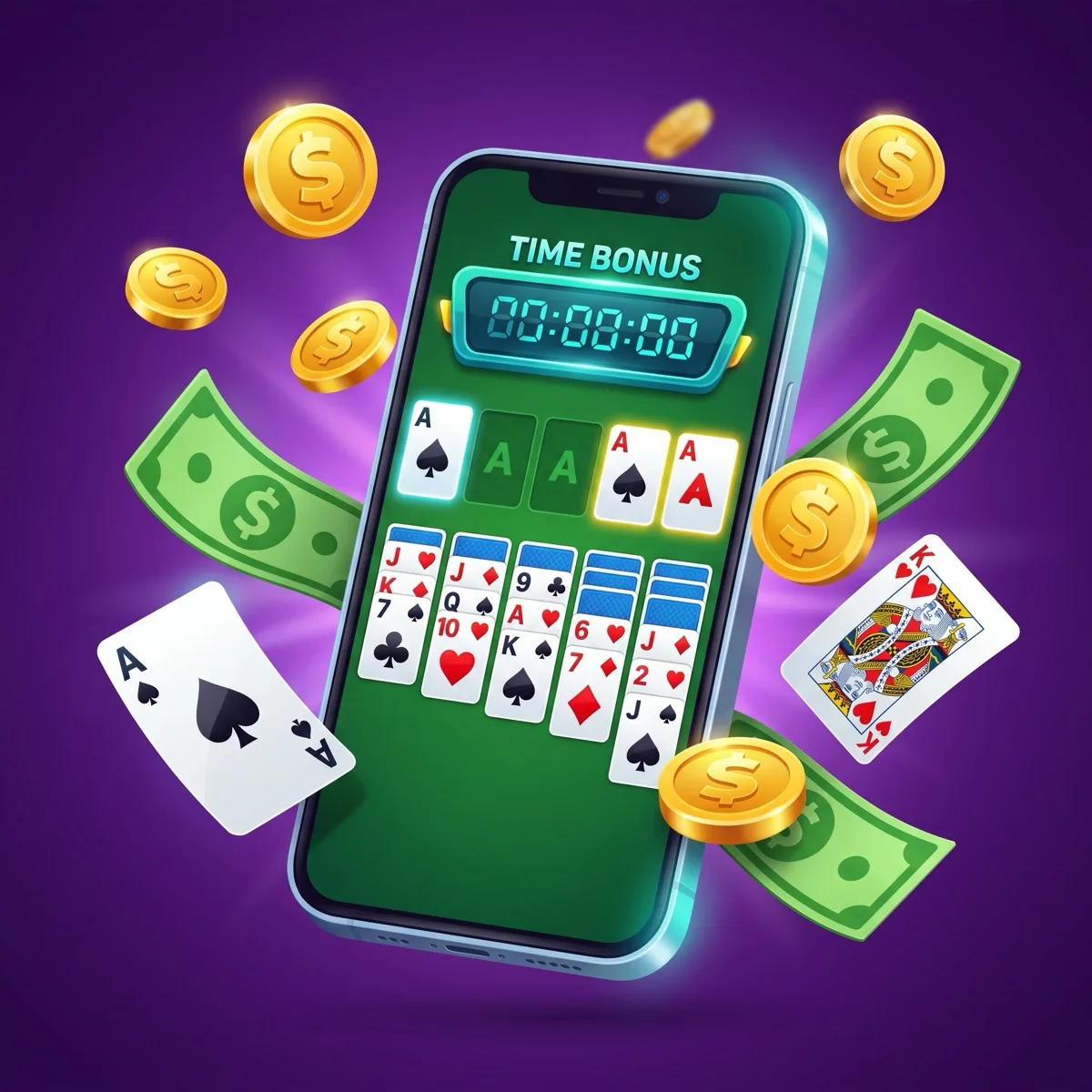
In a real-cash solitaire tournament, every player in your bracket gets the exact same card shuffle and a fixed time limit. You play standard Klondike solitaire, earn points for cards moved and revealed, and collect a time bonus for finishing fast. Whoever posts the highest score wins the cash prize. Because the deck is identical for everyone, the outcome is decided by skill and speed — not which cards you happened to be dealt.
That identical-board design is the whole foundation of fairness here. Think about it: if you and I are racing the same shuffle, neither of us can blame a bad deal. The faster, smarter player wins. It's the same reason a footrace is fair and a coin flip isn't.
Practice mode vs. cash tournaments
Every legitimate platform lets you play free first. Practice tournaments use virtual currency — gems, tickets, or "Z credits" depending on the app — so you can learn the scoring and the pace before a dollar is at stake. Cash tournaments charge a small entry fee (often $0.60 to a few dollars) and pay a prize pool to the top finishers. My advice to every new player is the same: stay in practice mode until your scores stop climbing.
Head-to-head vs. multiplayer brackets
Two formats dominate. Head-to-head pits you against one opponent on the identical board — highest score takes the pot. Multiplayer brackets drop you into a field of 5, 10, or more players, paying out the top few places. Brackets have bigger prizes but steeper odds; head-to-head is the cleaner place to learn.
How the platform makes money
Let's be transparent, because this is where trust lives. Operators take a cut of the entry fees — that's the business model, plainly stated in most reviews (Millennial Money, 2026). If ten players each pay $1 and the prize pool is $8, the house keeps $2. There's nothing shady about that as long as it's disclosed and the matches are genuinely skill-based. The problem starts when the "opponents" aren't real — which we'll get to.
In a real-cash solitaire tournament, every player gets the identical card shuffle and the same time limit, so the highest score wins on skill rather than luck. Operators take a cut of entry fees as their revenue (Millennial Money, 2026). Practice mode uses virtual currency; cash tournaments charge a small entry fee and pay a prize pool to top finishers.
Play Solitaire cash tournaments →
Solitaire Cash Rules and Scoring Explained
Cash solitaire uses standard Klondike rules with a tournament scoring layer on top. You earn roughly 10 points for each card sent to a foundation pile, 5 points for moving a card from the deck to a tableau column, and 5 points for revealing a face-down card — then a time bonus is added for every second left on the clock (PlayingCardDecks, 2025). The exact values vary slightly by app, but one truth holds across all of them: the time bonus is large enough that finishing 30 seconds sooner usually beats clearing a few extra cards.
The Klondike board, fast
If you haven't played in a while: you've got the stock (the draw pile), seven tableau columns where you build downward in alternating colors, and four foundation piles where you build each suit upward from ace to king. Win the game by getting all 52 cards onto the foundations. Simple to learn, genuinely hard to master under a clock.
The point values that matter
- Foundation move — ~10 points. Every card you promote to a suit pile. This is your highest-value action.
- Deck-to-tableau move — ~5 points. Playing a drawn card onto a column.
- Revealing a hidden card — ~5 points. Flipping a face-down tableau card.
- Time bonus — variable, often the largest single component. Points scale with seconds remaining when you finish.
Anatomy of a Winning Score — Where the Points Come From
Source: Atay Games illustrative model based on standard Klondike tournament scoring (PlayingCardDecks, 2025). Figures are illustrative, not a fixed per-app formula.
Why the time bonus dominates
Here's the mental shift that turns losing players into winning ones. New players treat solitaire cash like a puzzle to solve completely. Winners treat it like a race. The points you bank from cards are real, but they're capped — there are only 52 of them. The time bonus has no cap until the clock runs out. Every second you save compounds.
Solitaire cash scoring awards roughly 10 points per foundation card, 5 points per deck-to-tableau move, and 5 points per revealed card, plus a per-second time bonus (PlayingCardDecks, 2025). The time bonus is typically the single largest component of a winning score, which is why finishing fast usually beats clearing every card.
7 Strategies to Win Solitaire Cash Tournaments
The fastest way to climb a solitaire cash leaderboard is to optimize for the clock, not for clearing every card. Experienced players win only about 15–25% of Klondike deals on a physical deck, a rate that roughly doubles with digital undo and hint features (PlayingCardDecks, 2025). In a cash tournament you don't need to win every board — you need to out-score your bracket. These seven habits do that.

- Scan the whole board first. Before your first move, read every visible card and the columns. A two-second plan beats ten seconds of undo-regret later.
- Expose face-down cards early. Every hidden card you flip adds options. Prioritize the moves that reveal the most.
- Send aces and twos up immediately. They clog the tableau and never help you down there. Promote them the instant you can.
- Empty a column for a king. An open column is the most valuable real estate on the board — it's the only place a king can move.
- Don't over-draw the stock. Cycling the deck burns seconds. Work the tableau fully before you go fishing.
- Drill the format until it's automatic. Pattern recognition is the skill that compounds. Free practice tournaments cost nothing but time.
- Treat the time bonus as the prize. When you can either clear two more cards or just finish, finish. The clock usually pays better.
How much is the clock actually worth?
This is the part nobody quantifies, so here's our own model. Take one board, cleared the same way, and change only the finish time. The card points stay flat; the time bonus does all the work. The gap between a fast finish and a slow one can swing your score by hundreds of points — often the difference between first and out of the money.
Same Board, Different Finish Time — Total Score
Source: Atay Games illustrative time-bonus model. Card points held constant; only seconds-remaining vary. Illustrative, not a per-app guarantee.
Those seven habits are the foundation. To go a level deeper on scoring, our solitaire cash tournament strategy breaks down the advanced tactics that squeeze more points from every deal, from the anchor-card trade-off to banking the time bonus on a dead board.
For tactics that carry across every skill game we make — bankroll discipline, bracket selection, tilt control — see our broader guide to skill-based cash game tips to win.
To win solitaire cash tournaments, optimize for the clock: scan the board first, expose face-down cards early, promote aces and twos immediately, empty a column for a king, and avoid wasted moves. Experienced players clear only 15–25% of Klondike deals on a physical deck (PlayingCardDecks, 2025), so out-scoring your bracket matters more than clearing every board.
Are Solitaire Cash Opponents Real or Bots?
It depends entirely on the platform — and this is the most important thing in this whole guide. In 2023, AviaGames, the maker of Solitaire Clash and Pocket7Games, was hit with a class action alleging its "skill-based" cash matches secretly pit players against bots designed to win (ClassAction.org, on Pandolfi v. AviaGames, 2023). A federal jury later found AviaGames willfully infringed a rival's peer-matching patent, and in May 2026 the U.S. Supreme Court declined to hear the company's bid to force the bot case into private arbitration (BusinessWire, 2026). The lesson is blunt: before you deposit, confirm the platform matches you against verified human opponents.

What the lawsuits actually allege
The complaint's claim is specific and worth understanding. Players say the app lets you win early — small payouts that feel like proof the game is beatable — then, once you're invested and depositing, quietly steers you into matches against bots tuned to beat you (ClassAction.org, 2023). If true, that's not a skill game at all. It's a slot machine wearing a card-game costume — which is exactly the legal distinction that decides whether a cash game is even allowed.
How to tell if you're playing a human
You can't always see your opponent, so look for structural signals instead. Does the operator publish how matchmaking works? Does it guarantee identical boards? Is there a named, identifiable parent company you could actually take to court — or a shell? Does support answer payout questions, or ghost you? Apps confident their opponents are real tend to say so plainly. Apps that aren't tend to bury the question in arbitration clauses.
How Atay Games handles it
I'll be direct about my own employer: Atay runs verified human-only matchmaking, with no bots filling cash brackets. That's the entire reason this section exists — it's the one thing I'd check on any platform before depositing, including ours. You can read exactly how we verify every opponent is human and the fair-play and anti-bot safeguards we run. And if you're weighing the AviaGames-owned apps specifically, our 10 best alternatives to Pocket7Games breaks down the trust rubric in detail.
On some solitaire cash platforms, your opponent may not be human. A class action alleges AviaGames matched players against bots in supposedly skill-based games (Pandolfi v. AviaGames, 2023), and the U.S. Supreme Court declined to hear the company's arbitration appeal in May 2026 (BusinessWire, 2026). The safest choice is a platform with verified human-only matchmaking and a transparent operator.
Is Solitaire Cash Legit and Legal?
Yes — skill-based cash solitaire is legitimate and legal in 35+ US states under the "predominance test," which treats games where skill outweighs chance as non-gambling (Artaev at Law, January 2024). Nine states ban or heavily restrict it: Arizona, Arkansas, Connecticut, Delaware, Louisiana, Montana, South Carolina, South Dakota, and Tennessee. But "legit" and "fair on every platform" are different questions — the bot litigation above is proof. Legitimacy comes down to a transparent operator, verifiable payouts, and human opponents.

The skill-vs-chance predominance test
Most state courts ask one question: is the outcome determined predominantly by skill or by chance? In Klondike, skill matters a lot and is measurable: your decisions (what to reveal, what to promote, how fast to move) change how often you win. Luck in the deal remains, because face-down cards stay hidden, and same-deal tournament rules decide who played a given deal better. That's the case cash solitaire rests on, though states use different tests and we found no court ruling on solitaire itself. For the evidence, see Is solitaire skill or luck?
States where you can't play for cash
If you live in one of the nine restrictive states, a legitimate app will block cash entry cleanly rather than take your money and hope. That clean block is itself a green flag — it means the operator is paying attention to the law. Our state-by-state legality guide tracks the rules as they change, and for the bigger-picture question, our pillar on whether real cash skill games are legit covers the trust signals in depth.
What you'll owe in taxes
Winnings are taxable income. Cross $600 in cumulative platform winnings in a calendar year and the platform issues a 1099-MISC under IRS Topic 419; below that, you still self-report. None of this is unique to solitaire — it's the same framework that covers any taxable side activity. Our guide to taxes on skill game winnings walks through the reporting mechanics.
Skill-based cash solitaire is legal in 35+ US states under the predominance test, which classifies skill-dominant games as non-gambling (Artaev at Law, January 2024). Nine states restrict or ban it: AZ, AR, CT, DE, LA, MT, SC, SD, TN. Winnings above $600 per year trigger a 1099-MISC under IRS Topic 419; sub-$600 winnings still require self-reporting.
How Much Can You Win Playing Solitaire Cash?
Be realistic. Most casual solitaire-cash players earn roughly $50–$200 per month, while top tournament players can win up to about $139 in a single high-stakes tournament (Side Hustle Nation, 2026). New players typically post 35–45% win rates with a 10–25% return on entry fees early on, meaning many break even or take a small loss while learning (Millennial Money, 2026). Treat it as skilled entertainment with upside, not a paycheck.
Where Most Solitaire Players Land — Monthly Earnings
Source: Composite of Side Hustle Nation, 2026 and Millennial Money, 2026 player reports. Distribution is illustrative.
You can't win without risking your own fees
Here's the honest caveat the ads skip: you cannot earn cash without depositing and risking your own money in entry fees. Anyone promising "free money" is misleading you. The realistic frame is a hobby that can pay for itself — and occasionally a bit more — if you're genuinely good and disciplined about which brackets you enter.
How withdrawals work
Reputable platforms pay out through PayPal, Apple Pay, or bank transfer, usually within a few business days once your identity is verified. That verification (KYC) step matters: finish it before your first withdrawal request so your money isn't stuck in "review." For a deeper breakdown of realistic earnings across every Atay title, see our guide on how much you can earn playing skill games.
Most casual solitaire-cash players earn $50–$200 per month, and top players can win up to roughly $139 in a single tournament (Side Hustle Nation, 2026). New players post 35–45% win rates with a 10–25% return on entry fees while learning (Millennial Money, 2026). You cannot earn without risking your own entry fees, so treat it as entertainment with upside.
Which Solitaire Cash App Should You Play in 2026?
The big names are Solitaire Cash (Papaya Gaming) and Solitaire Clash (AviaGames) — both heavily advertised, and the latter named in the bot litigation above. Solitaire Cash alone holds a 4.6-star rating across 330,000+ App Store reviews (Apple App Store, 2026), so the format clearly has fans. For players who want the identical-board tournament with verified human opponents and no bots, Atay Games' Solitaire Real Cash is the safer pick: the same Klondike-tournament mechanics, a transparent operator, and human-only matchmaking.
Solitaire Cash (Papaya Gaming)
The category's popularity leader, with deep review density and polished UX. Papaya's apps are widely used and pay real winnings. The honest gap, the same one I'd flag on any competitor: Papaya doesn't publish opponent-verification methodology, so you're trusting the brand rather than a disclosed process.
Solitaire Clash (AviaGames)
Popular and well-marketed — but this is the app at the center of the bot class action (Pandolfi v. AviaGames, 2023), with the Supreme Court declining the company's arbitration appeal in May 2026 (BusinessWire, 2026). The allegations are unproven in court, but they're serious enough that I'd want the opponent question answered before depositing.
Atay Solitaire Real Cash
Same classic Klondike-tournament format, with verified human-only opponents, identical boards, and a named operator you can actually reach. I work here, so weigh that — but the rubric is public and the opponent guarantee is the differentiator, not a slogan. For a head-to-head on the field, see our scored ranking of the best solitaire apps that pay real money, the 7 alternatives to Solitaire Cash, our best real cash games of 2026 pillar ranks winners across every genre, and you can browse all Atay cash games to compare.
The main solitaire cash apps are Solitaire Cash (Papaya Gaming), with a 4.6-star rating across 330,000+ App Store reviews, and Solitaire Clash (AviaGames), named in an active bot class action (Apple App Store, 2026; BusinessWire, 2026). For verified human-only opponents on the same Klondike-tournament format, Atay Games' Solitaire Real Cash is the transparent-operator alternative.
Play Atay Solitaire cash tournaments →
Frequently Asked Questions
How do you play solitaire for real money?
You enter a timed Klondike tournament where every player gets the identical card shuffle. Build the four foundation piles by suit, earn points for cards moved and revealed, and collect a time bonus for finishing fast. The highest score in your bracket wins the cash prize. Because the deck is identical for everyone, skill and speed decide the outcome, not luck.
Is Solitaire Cash legit or rigged?
Skill-based cash solitaire is legitimate and legal in 35+ US states under the predominance test (Artaev at Law, 2024). However, AviaGames, maker of Solitaire Clash, faces an active class action alleging its skill matches secretly use bots, and the U.S. Supreme Court declined to hear the company's appeal in May 2026. Choose a platform that guarantees verified human opponents before depositing.
Are solitaire cash opponents real people or bots?
On some platforms, not always. A class action alleges AviaGames matched players against bots in supposedly skill-based games (Pandolfi v. AviaGames, 2023). The safest choice is a platform with verified human-only matchmaking and no bots, such as Atay Games. Look for an explicit anti-bot guarantee and a transparent, named operator before you pay an entry fee.
How much money can you win playing solitaire cash?
Most casual players earn about $50–$200 per month, and top tournament players can win up to roughly $139 in a single tournament (Side Hustle Nation, 2026). New players see 35–45% win rates early with a 10–25% return on entry fees, so many break even while learning. Treat it as skilled entertainment with upside, not income.
What is the best strategy to win solitaire cash tournaments?
Optimize for the clock. Scan the whole board before your first move, expose face-down cards early, send aces and twos to the foundation immediately, empty a column for a king, and avoid wasted moves. The time bonus usually outweighs clearing every card, so finishing fast often beats finishing complete. See our skill-game winning tips for more.
Is playing solitaire for cash legal in my state?
In most of the US, yes. Skill-based cash games are legal in 35+ states under the predominance test (Artaev at Law, 2024). Nine states ban or restrict them: Arizona, Arkansas, Connecticut, Delaware, Louisiana, Montana, South Carolina, South Dakota, and Tennessee. Check our state-by-state guide before depositing.
The Bottom Line on Solitaire Cash in 2026
Cash solitaire is a genuine skill game. Every player races the identical shuffle, and your score is card points plus a time bonus that usually decides everything. Learn the scoring, drill the time-bonus habit, and you'll out-place most of your bracket. But the cards were never the real risk.
Three things to carry into your first tournament:
- Play the clock, not the board. Finishing fast beats finishing complete. The time bonus is the biggest slice of a winning score.
- Pick your opponent before your app. The defining 2026 story in this category is bot litigation. Choose a platform with verified human players and a named operator you can reach.
- Budget it like entertainment. The $50–$200/month range is real for casual players. The "free money" pitch isn't. Never deposit more than you'd spend on a night out.
Sources
- Grand View Research, Skill Gaming Market Size And Share Industry Report, 2030, 2024, retrieved 2026-06-07, grandviewresearch.com
- PlayingCardDecks, 10 Steps to Winning Klondike Solitaire, 2025, retrieved 2026-06-07, playingcarddecks.com
- ClassAction.org, AviaGames Hit with Class Action Over Alleged Use of Bots in Online "Skill-Based" Games (on Pandolfi v. AviaGames, 5:23-cv-05971), 2023, retrieved 2026-06-07, classaction.org
- BusinessWire, SCOTUS Denies AviaGames Certiorari on Arbitration Issues, May 27, 2026, retrieved 2026-06-07, businesswire.com
- Side Hustle Nation, Is Solitaire Cash Legit? Win Up to $139 Per Tournament, 2026, retrieved 2026-06-07, sidehustlenation.com
- Millennial Money, Is Solitaire Cash Legit? 2026 Review, 2026, retrieved 2026-06-07, millennialmoney.com
- Apple App Store, Solitaire Cash: Win Real Money (rating and review count), 2026, retrieved 2026-06-07, apps.apple.com
- Artaev at Law, Are Skill-Based or Pure Skill Real-Money Games Legal?, January 2024, retrieved 2026-06-07, artaevatlaw.com
- Internal Revenue Service, Topic No. 419, Gambling Income and Losses, 2025, retrieved 2026-06-07, irs.gov/taxtopics/tc419
Legal and financial disclaimer. This article is for general informational purposes only and does not constitute legal or financial advice. Allegations referenced in pending litigation are unproven claims. Skill gaming laws vary by state and change over time. Earnings figures are illustrative ranges drawn from documented player reports, not income guarantees. Individual results depend on skill level, practice consistency, tournament selection, and stake amounts. Never deposit money into a gaming platform that you cannot afford to lose. If you have specific legal questions, consult a qualified attorney in your state. Responsible play resources: National Council on Problem Gambling at ncpgambling.org or 1-800-522-4700.
Ready to Play Solitaire for Real Cash?
Start free in practice mode, drill the time-bonus habit, then enter a cash tournament. Identical boards, real human opponents — never bots.
Play Solitaire Real Cash