
You've got fifteen quiet minutes and a phone, and the internet is screaming that you can make $500 a day from your couch. You can't. But you can earn a little, honestly, in the pockets of downtime that come with parenting. This is the honest version: a few real dollars for naptime and after-bedtime play, not a paycheck, not a hustle, and definitely not the scam the ads are selling. I run player trust at Atay, so I'll be blunt about the numbers. Here's what money-making games actually look like for a stay-at-home parent, which ones fit which moments, and how to keep it fun instead of a headache.
- It's fun money, not a paycheck. Casual play earns roughly $5–$50 a month. Anyone promising "$500 a day" is running a scam.
- Two lanes. Rewards apps pay you to play (low, no risk, kid-friendly). Skill-cash games pay more per active minute but use real entry fees.
- Match the game to the moment. Rewards apps when kids are up and you can't focus; short skill matches at naptime.
- The audience is huge. 87% of moms are active gamers (Microsoft Advertising, 2024), so you're not alone in this.
Can Stay-at-Home Parents Really Make Money Playing Games?
Yes, a little. It's fun money, roughly $5 to $50 a month for casual play, not a paycheck (The Penny Hoarder, 2026). And the audience is very real. In 2024, Microsoft Advertising reported that 87% of moms are active gamers, with about 74% of gamer moms playing every day (Microsoft Advertising, 7 Facts About the 87% of Moms Who Game, 2024). Millions of parents already play. The only question is how to do it without getting burned.
Let's kill the myth first. Those "make $500 a day playing games from home" ads? Pure fantasy. No legitimate mobile game pays normal players anywhere near that. Real earnings are modest and honest, and any app claiming otherwise is a red flag, not an opportunity. We break down the actual numbers in our guide to how much you can earn playing skill games. If you're in a different season of life, we have honest guides for other players too, like brain games for seniors and retirees.
This is also not a moms-only thing, for the record. Dads make up about 18% of stay-at-home parents in the US (Pew Research Center, 2023), and that share keeps growing. Whatever your household looks like, the downtime math is the same.
Stay-at-home parents can earn modest fun money playing games, roughly $5 to $50 a month for casual play, not a paycheck. The audience is large: Microsoft Advertising reported in 2024 that 87% of moms are active gamers, and about 74% of gamer moms play daily. Any app promising "$500 a day" is a scam. (Microsoft Advertising, 2024; The Penny Hoarder, 2026)
Why Do Games Fit Stay-at-Home Parent Life?
Because parent downtime comes in short, unpredictable, one-handed windows, and mobile games are built for exactly that. Naptime, after bedtime, a waiting room, the ten minutes before school pickup: casual mobile sessions run just a few minutes, so a game you can start, pause, and abandon fits where a job or a scheduled gig simply can't (data.ai, State of Mobile, 2025).

Think about how your day actually breaks up. You rarely get a clean, uninterrupted hour. You get scattered ten-minute gaps, often with one hand busy holding a baby or a snack. A game that needs your full focus for 45 minutes is useless to you. A game that fits a two-minute gap, and doesn't punish you for stopping mid-round, is gold. That's the whole reason this works for parents when other side gigs don't.
We ran a realistic 20-minute naptime window, playing short skill matches one-handed. We finished six 2 to 3-minute rounds before the "someone's awake" interruption, without ever feeling stuck mid-game. The lesson: the games that work aren't the flashiest or highest-paying. They're the ones you can drop instantly and pick back up, which is exactly what a parent's schedule demands.
Games fit stay-at-home parent life because parent downtime comes in short, unpredictable, one-handed windows, and casual mobile sessions last only a few minutes. A game you can start, pause, and abandon fits naptime, bedtime, and waiting rooms where a scheduled job or gig cannot. The best money games for parents are the ones you can drop and resume instantly. (data.ai, State of Mobile, 2025)
What Are the Two Kinds of Money Games?
There are two lanes, and mixing them up is how parents end up disappointed. Rewards apps pay you just for playing: low earnings, no financial risk, easy to interrupt. Skill-cash games pay real prizes in short competitive matches: more per active minute for a good player, but with real entry fees. Neither is "better." They fit different moments.
Rewards Apps vs. Skill-Cash Games, for Parents
Sources: The Penny Hoarder, 2026; NerdWallet, 2025; Atay Games FAQ.
Money games come in two lanes. Rewards apps pay you just for playing, with a low ceiling of about $10 to $20 a month, no financial risk, and easy interruption, so they suit kids-around time. Skill-cash games pay real prizes in short matches, more per active minute for skilled players, but use entry fees, so they fit a focused naptime window and a set budget. (The Penny Hoarder, 2026; NerdWallet, 2025)
Which Money Games Work Best When the Kids Are Around?
When you can't fully focus, stay in the rewards lane: apps that pay you for playtime you can interrupt without losing anything. Expect roughly $10 to $20 a month at about 30 minutes a day, cashed out via PayPal or gift cards (NerdWallet, 2025). An interruption costs you nothing, which is the whole point when a toddler is in the room.
What to look for in a kids-around game
- Playtime rewards, not competition. You earn points for minutes played, so stopping mid-session doesn't cost you a prize.
- No entry fees. These apps are free, so there's nothing to lose when the day derails.
- Casual, low-focus gameplay. Match-3, idle, and simple puzzle games you can play half-distracted.
The honest catch is the ceiling. Rewards apps pay little, and the "goals" can feel far away. Treat them as background pocket change, not a target. Our roundup of rewards apps like Mistplay covers the better options and their real payout rates.
For time with kids around, rewards apps work best because they pay you for interruptible playtime and cost nothing to stop. Expect roughly $10 to $20 a month at about 30 minutes a day, redeemable via PayPal or gift cards, per NerdWallet. Look for playtime rewards rather than competition, no entry fees, and casual, low-focus gameplay you can do half-distracted. (NerdWallet, 2025)
Which Money Games Pay More at Naptime and After Bedtime?
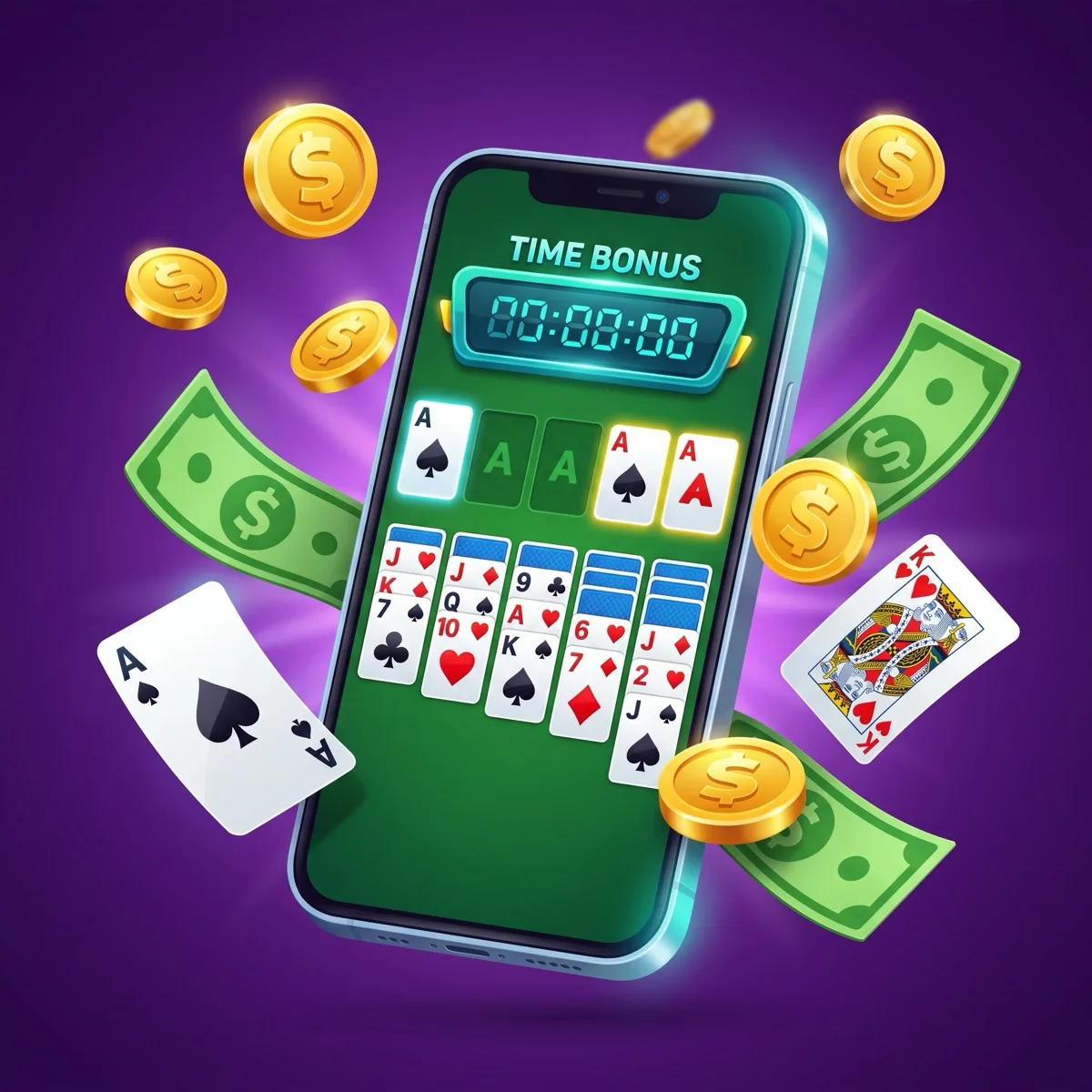
When you get a real quiet window and can concentrate, skill-cash games pay more per active minute. And if you work nights, see our night-shift guide. These are short 2 to 5-minute matches of solitaire, bubble shooter, word games, or bingo where skill, not luck, decides the payout. You start with free practice, then a small cash entry, often $1 on Atay, once you're confident (Atay FAQ).
Skill games that fit a short parent window
- Solitaire. A calm, familiar single-player-feel game with quick rounds. Great for winding down at nap or bedtime. Solitaire Real Cash.
- Bubble Prizes. Fast, satisfying, and easy to pick up half-awake. Rounds end in a couple of minutes. Bubble Prizes.
- Word Search Cash. A quiet, low-stress brain workout that suits a coffee break. Word Search Cash.
- Bingo Prizes. Quick, lively daubing rounds if you want a little more energy. Bingo Prizes.
Because these use real entry fees, you can lose, so a firm budget matters (more on that below). But minute for focused minute, they pay better than rewards apps, and matching real human opponents makes them feel like a game, not a chore. If payout speed matters to you, our highest-paying mobile games roundup ranks them.
At naptime and after bedtime, skill-cash games pay more per active minute than rewards apps. Short 2 to 5-minute matches of solitaire, bubble shooter, word games, or bingo pay real prizes based on skill, not luck. On Atay, you practice free, then enter cash matches from $1. They use real entry fees, so a firm budget matters. (Atay FAQ, 2026)
How Much Can a Stay-at-Home Parent Really Earn?
Honestly, not much, and that's okay. Casual play across the category runs $5 to $50 a month, and skill-gaming works out to about $0.10 to $0.80 an hour for casual players (NerdWallet, 2025). Skilled, consistent players earn more per active minute, but let's be clear: this is coffee-and-treat money, not income. Treat it as play that happens to pay.
Realistic Monthly Earnings vs. the Scam Claim
Sources: NerdWallet, 2025; The Penny Hoarder, 2026.
What moves the number? Your skill, your time, and which lane you pick. A focused player who sticks to games they're genuinely good at will out-earn a distracted one, but the ceiling stays low for everyone playing casually. If you want a realistic target rather than a fantasy, our post on making an extra $50 a week from your phone sets honest expectations.
Realistic earnings for a stay-at-home parent are modest: casual play runs about $5 to $50 a month, and skill-gaming works out to roughly $0.10 to $0.80 an hour for casual players, per NerdWallet. Skilled players earn more per active minute, but this is coffee money, not income. Any "$500 a day" claim, about $15,000 a month, is a scam. (NerdWallet, 2025)
How Do You Do It Safely and Sanely?
Three simple rules keep this fun instead of a problem: play free first, set a hard budget you never chase, and use only legit apps with named payout methods and real support. Do those three things and money games stay a pleasant break, not a stressor.

The three rules, in plain terms
- Practice before you pay. Every legit skill app offers free play. Build your skill first, and only enter a cash match when your results are consistently good.
- Budget hard, and never chase losses. Decide a small amount you're fine losing, treat it like the cost of a coffee, and stop there. Never use money the household needs, and never try to "win it back."
- Use legit apps only. Named payout methods, real support, honest earnings. If an app promises "$500 a day," has no support, or asks you to pay a fee to withdraw, walk away. Our guides to whether real cash skill games are legit and whether Atay Games is legit show what to check, and our guide to spotting fake money game apps has the full red-flag checklist.
One more honest note, parent to reader: play in your downtime, not the time your kids need from you. A few minutes at naptime is a nice reset. Doom-scrolling a game while a toddler tugs your sleeve isn't. You already know the difference. Back in school yourself? Our companion guide covers money-making games for college students.
To play money games safely, follow three rules: practice free before paying, set a hard budget you never chase, and use only legit apps with named payout methods and real support. Never use money the household needs, and never try to win back a loss. If an app promises "$500 a day" or charges a fee to withdraw, it's a scam. Play in your downtime, not your kids'.
Frequently Asked Questions
Can a stay-at-home parent make money playing games?
Yes, but it's modest fun money, not a paycheck. Casual play earns roughly $5 to $50 a month. The audience is real: 87% of moms are active gamers (Microsoft Advertising, 2024), so millions of parents already have the habit. The trick is doing it on a budget, with legit apps.
How much can a stay-at-home parent realistically make?
Honestly, not much, and that's fine. Skill-gaming works out to about $0.10 to $0.80 an hour for casual players (NerdWallet, 2025), and rewards apps pay roughly $10 to $20 a month at 30 minutes a day. Skilled players earn more per minute, but nobody pays the bills with this.
What money games work best with kids around?
Rewards apps. They pay you points for playtime you can pause and abandon without losing anything, so an interruption costs nothing. Expect about $10 to $20 a month at 30 minutes a day, redeemable via PayPal or gift cards. Save the focused, competitive games for naptime.
What games pay more during naptime?
Short skill-cash matches. Games like solitaire, bubble shooter, word games, or bingo run 2 to 5 minutes and pay real prizes based on skill, not luck, so they pay more per active minute for a focused player. They use real entry fees, so play free first and set a firm budget.
Are money-making games for moms a scam?
The category is real and legit apps pay, but the marketing is full of scams. Any app or ad promising you can make $500 a day playing games is lying; no legitimate mobile game pays normal players at that level. Use apps with named payout methods, real support, and honest earnings.
Do you have to spend money to earn from games?
No. Rewards apps are free, and skill-cash games like Atay's offer free practice tournaments so you can learn before risking a cent. Cash entry is optional. If you do play for cash, use a small, strict budget you never chase, and treat any winnings as a bonus, not income.
The Bottom Line: Play That Happens to Pay
Money-making games are a real, honest little perk of stay-at-home life, as long as you keep the expectations honest too. It's coffee money for your naptime and after-bedtime windows, not a paycheck, and anyone promising more is selling you a scam.
Three things to remember:
- Match the game to the moment. Rewards apps when the kids are up and you can't focus; short skill matches at naptime.
- Keep the number honest. Roughly $5–$50 a month casual. Real, small, and fine.
- Play free, budget hard, stay legit. Practice before you pay, never chase losses, and skip any app that promises the moon.
Got a quiet ten minutes coming up? Try a free practice match, no deposit and no pressure. Browse all Atay skill games →
Sources
- Microsoft Advertising, 7 Facts About the 87% of Moms Who Game, February 2024, retrieved 2026-07-09, about.ads.microsoft.com
- Pew Research Center, Almost 1 in 5 Stay-at-Home Parents in the US Are Dads, August 2023, retrieved 2026-07-09, pewresearch.org
- NerdWallet, Game Apps That Pay Real Money, 2025, retrieved 2026-07-09, nerdwallet.com
- The Penny Hoarder, Games That Pay Real Money: Legit Apps to Try, 2026, retrieved 2026-07-09, thepennyhoarder.com
- Atay Games, Frequently Asked Questions, 2026, retrieved 2026-07-09, ataygames.com/faq (first-party).
Earnings and responsible-play disclaimer. This article is for general informational purposes only and is not financial advice. Earnings from games are modest and vary widely; treat them as entertainment, not income. Skill-cash games involve real entry fees and the risk of loss, are for adults (18+ or 17+ per app rating), and availability depends on your state or region. Never deposit money you can't afford to lose, and never spend money your household needs. Responsible-play resources: National Council on Problem Gambling at ncpgambling.org or 1-800-522-4700.
Play in the Pockets of Your Day
Free practice tournaments for naptime and after bedtime, real-cash matches where legal, and short 2 to 5-minute rounds built for a parent's schedule. A $5 minimum cash-out, most payouts in minutes, no fees.
Browse All Atay Skill Games