You've seen it: a thumb sliding across a phone, cash exploding across the screen, a caption saying someone just won $10,000 playing a game you've never heard of. So are those "win money playing games" ads real, or is it all a con? The honest answer isn't "it's all a scam," and it isn't "download these 14 apps." The ad is making two separate promises, one about the game and one about the money, and they're true, stretched, or flat-out fake in very different amounts. Here's how to tell them apart, what regulators have actually ruled, and what real money games pay once you strip away the fantasy.
- The ads are frequently deceptive. The UK's Advertising Standards Authority has banned "win money" and casual-game ads for showing gameplay almost no one reaches (ASA, 2020–2024).
- The "$10,000" is bait. Real earnings run about $1 to $3 an hour, not a jackpot.
- Fake "get paid to play" scams are exploding. The FTC logged roughly 20,000 gamified money-scam reports in H1 2024, with losses over $220M (FTC, 2024).
- But the category is real. You can win real cash on skill games; you just win modest, honest amounts.
- The hard tell of a scam: you never pay a fee to unlock legitimate winnings.
Before we get into the evidence, here's the whole thing in one table. When you see a "win money" ad, this is what each part usually means and what to check before you believe it.
| What the ad shows | What's usually true | What to check |
|---|---|---|
| Slick "pull the pin" or puzzle gameplay | Often isn't the real game at all | Do the app's store screenshots match the ad? |
| "$10,000!" and cash raining down | A rare best case, if real at all | Is a typical payout named, or just the jackpot? |
| "No skill or money needed" | Real cash games need skill; free ones pay little | Does it explain how you'd actually get paid? |
| "Everyone's winning" | Survivorship bias; losers aren't filmed | Are the reviews about payouts or complaints? |
| "Instant payout, just unlock it" | A classic fee-to-withdraw trap | Does it ever ask you to pay first? (Never OK) |
So, Are "Win Money Playing Games" Ads Real?
Mostly no, and partly yes. Most "win money" ads exaggerate or outright fake what you'll experience. The giant cash pile is bait, and the gameplay in the clip frequently isn't the real game. But the category underneath is real: you genuinely can win real cash on skill-based games. You just win small, honest amounts, never the cash-raining fantasy on screen. The trick is that a single ad makes two claims, and they fail independently. The gameplay can be faked while the app is real, and the money can be technically real while being wildly overstated.
That's the frame worth keeping as you scroll past these ads. We're not here to yell "scam" at everything or to sell you a download. We're here to sort what's real from what's marketing, using what regulators have actually found. And they've found plenty: in one famous case, the gameplay in the ad reflected an experience that only about 0.03% of players ever reached (ASA, 2020).
Are "win money playing games" ads real? Mostly exaggerated or fake, but the category is real. Regulators have officially banned specific ads for showing gameplay almost no one experiences, and fake "get paid to play" scams are rising fast. Yet real skill games do pay modest amounts, roughly $1 to $3 an hour, so the honest answer is neither pure scam nor easy money.
Why Does the Game Never Look Like the Ad?
Because in a huge number of cases, the footage in the ad isn't the real game. This is so common that regulators have formally banned specific ads over it. The clip shows a satisfying "pull the pin" rescue puzzle or a barrel-shooting brain-teaser, you install it expecting that, and instead you get a match-three board or a city-builder. The flashy puzzle was the hook, not the product.
What the regulators actually ruled
The clearest proof comes from the UK's Advertising Standards Authority. In September 2020 it banned ads for Playrix's Homescapes and Gardenscapes because the pin-pulling minigame in the ads only appeared at higher levels that reportedly around 0.03% of players ever reached, while the real game is a match-three puzzle. Crucially, the ASA ruled that a small-print disclaimer like "Not representative of actual gameplay" did not make the ad acceptable (ASA, 2020). In April 2024 it banned an ad for Evony: The King's Return that showed a sniper shooting numbered barrels, when the game's core is city-building. The ASA concluded the ad "did not reflect the game's core playing experience and was therefore misleading," a breach of CAP Code rule 3.1 (ASA ruling, Top Games Inc, 2024).
It isn't a handful of one-offs, either. The ASA has upheld similar "non-representative gameplay" rulings against several studios over the years, and a 2025 Penn State study published by the ACM catalogued five distinct techniques games use to misrepresent themselves in ads, from disguising the gameplay to faking the reward (Moradzadeh & Kou, ACM, 2025). So if the game never looks like the ad, you're not imagining it. That's the design.
Why doesn't the game match the ad? Because the footage often isn't the real game. The UK's ASA banned Playrix's Homescapes and Gardenscapes ads in 2020, finding the advertised minigame appeared only at levels roughly 0.03% of players reached, and ruled a "not representative" disclaimer insufficient (ASA, 2020). It banned an Evony ad in 2024 for the same reason: the ad didn't reflect the core game.
What Are the Three Kinds of "Win Money" Ads?
Almost every "win money playing games" ad falls into one of three buckets, and knowing which bucket you're looking at tells you exactly what to expect. Get this taxonomy straight and most of the confusion disappears.
Type A: Real-money skill games
You play a game of skill, solitaire, bubble shooter, bingo, pool, and can optionally enter cash tournaments against other players for a real prize. These are legit, but the payouts are modest: think a few dollars, not thousands. It's skill, not gambling, and legality varies by state. The ad's crime here is usually exaggeration, not fraud, showing a jackpot when the reality is pocket money. To understand how the prizes are funded, see where the prize money actually comes from.
Type B: Rewards and points apps
You earn points for playtime and redeem them for gift cards or small cash. Real, but low and usually capped. The best-known example limits redemptions to around $550 a year under its own published economy disclosure, and pays mostly in gift cards rather than the cash the ad implies. It's honest money for time you'd spend anyway, not a paycheck. We break the archetype down in our honest review of rewards apps like Mistplay.
Type C: Fake-gameplay and "get paid to play" scams
This is the fraud bucket. It includes the ASA-banned fake-gameplay ads and, worse, the "task" or "get paid to play" scams that eventually ask you to pay to unlock your supposed earnings. These are exploding. The FTC logged roughly 20,000 gamified money-making scam reports in the first half of 2024 alone, up from about 5,000 in all of 2023 and essentially zero in 2020, with reported losses topping $220 million in just six months (FTC, 2024). The FTC has also acted against deceptive in-game reward systems directly, settling in 2021 with the mobile ad company Tapjoy after users complained the rewards they were promised for completing offers never showed up (FTC, 2021).
"Get Paid to Play" Scam Reports Are Exploding
Source: FTC Data Spotlight, "Paying to get paid", December 2024.
"Win money" ads come in three types: real skill games (legit but modest), rewards apps (real but low and capped, gift-card-first), and fake-gameplay or "get paid to play" scams (never real). The scam bucket is growing fastest: the FTC logged roughly 20,000 gamified money-scam reports in H1 2024, up from about 5,000 in all of 2023, with over $220 million lost (FTC, 2024).
Is the "$10,000 Payout" Real?
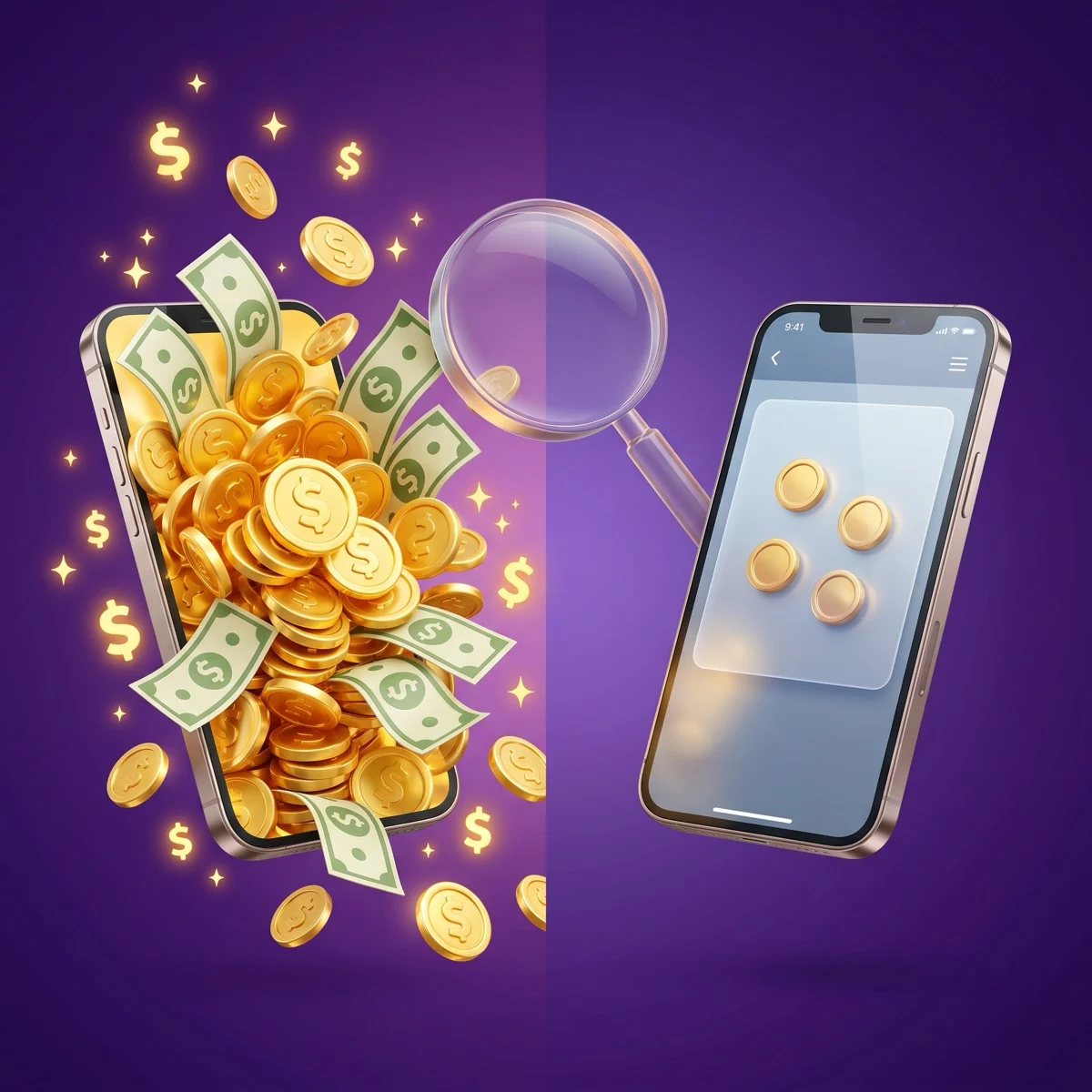
Almost never as advertised. The cash-raining "$10,000!" image is jackpot bait. Real money games pay real but small, and the ad shows you the one-in-a-thousand best case, then implies it's typical. Personal-finance outlets that actually test these apps put realistic earnings at roughly $1 to $3 an hour, and often less, or about $10 to $50 a month for an average user (NerdWallet; MoneyMagpie, 2024–2026). That's real money, and it's fine as fun, but it isn't the fantasy on screen.
There's also a piece of arithmetic the ads never mention. On paid-entry tournaments, the platform pools your entry fees and keeps a cut before paying the winners, so you can lose money even while "winning" plenty of matches. If you win fewer than roughly 55% of your cash games (a rough rule of thumb, since the exact break-even depends on the platform's cut), you can quietly go underwater over time. That isn't a scam; it's just how a rake works, and it's why "everyone in the ad is winning" is survivorship bias. Nobody films the players who lost. For the full mechanics, see where cash tournament prize money comes from and how much you can realistically earn.
Ad Promise vs. Real Payout (Per Hour)
Source: NerdWallet and MoneyMagpie, 2024–2026 (reported ranges).
Is the "$10,000 payout" real? Almost never. That's jackpot bait; realistic earnings are roughly $1 to $3 an hour per finance outlets that test money games (NerdWallet; MoneyMagpie, 2024–2026). On paid tournaments a platform keeps a cut of pooled entry fees, so a low win rate can leave you underwater even when you win matches. The winners get filmed; the losers don't.
Skip the Fantasy, Keep the Real Part
Atay's Solitaire, Bubble Prizes, and Word Search are free to play, with optional real-cash tournaments against real people. Honest, modest payouts based on skill, not an ad's cash-raining promise: skill, not gambling.
Browse Atay Games FreeHow Can You Tell a Real Offer From a Fake Ad?
You can filter most bait in about 60 seconds, before you ever install anything. The trick is to interrogate the ad itself with a few quick checks, rather than trusting the clip.
- Does the ad match the store listing? Open the app's App Store or official-site page and scan the screenshots and reviews. If the advertised gameplay or prize appears in zero store screenshots, the ad is faking it. This is the single most reliable tell for the gameplay lie.
- Does it name a real payout method and a minimum? Legit apps name how you get paid (PayPal, Visa, bank) and a minimum cash-out. Bait just flashes "instant $10,000" with no mechanism behind it.
- Does it ever ask you to pay to unlock winnings? This is the hardest tell of a scam. You never pay a fee, a "tax," or a "verification deposit" to release real winnings (FTC). If money has to flow from you to them before you can collect, walk away.
- Does it dangle a bonus code? A code rarely adds withdrawable money. Here's how to judge a "free bonus code" offer.
- Who's the developer, and where's the download from? A named developer with a real support channel is a green flag. The red flag isn't installing from outside an app store (real-money games often aren't on Google Play for policy reasons). It's downloading from an anonymous mirror instead of the developer's own official site.
If the ad passes those checks and you install, the job shifts from vetting the ad to vetting the app: recorded matches, named payouts, a real cash-out history. That's a separate checklist, and we've written it out in full: how to spot fake money game apps. One honest note so you don't over-correct: a low-paying but real app, or a slow-but-genuine payout, isn't a scam. A scam is an app that structurally won't pay, or one that asks you to pay first.
How do you tell a real offer from a fake ad? Check it before installing: does the advertised gameplay appear in the app's store screenshots, does it name a real payout method and minimum, and does it ever ask you to pay to unlock winnings? You never pay a fee to collect legitimate prizes (FTC). If money flows from you to them first, walk away.
What Do Real Money Games Actually Look Like?
Strip away the ad and here's the real thing. An honest real-money game is usually a free-to-play skill game where you can optionally enter cash tournaments and win modest, real payouts based on how well you play, not on luck, and not on a jackpot. It names its developer, names its payout methods, sets a low minimum like $5, records matches so results are verifiable, and scores you on skill. No cash raining from the sky, just a fair contest with a small upside.
That's the category Atay plays in, and it's worth being just as honest about it as about everyone else. Our cash tournaments are skill-based contests, not games of chance. They're entertainment with an optional small upside rather than an income source, and most players win small amounts. It's skill, not gambling, which is a real legal distinction worth understanding (see the difference between skill games and online gambling), and paid contests aren't available in every state, so always check that it's legal where you live first. If you're still weighing whether the whole category holds up, we made that case separately: are real cash skill games legit.
What does a real money game look like? A free-to-play skill game with optional cash tournaments, a named developer, named payout methods, a low minimum around $5, recorded matches, and skill-based scoring, paying modest, honest amounts rather than a jackpot. It's skill, not gambling, most players win small, and paid contests aren't legal in every state, so check yours first.
Frequently Asked Questions
Are those "win money playing games" ads real?
Mostly exaggerated or fake, but the category behind them is real. Regulators have officially banned specific "win money" and casual-game ads for showing gameplay almost no one experiences. Real skill games do pay, but modest amounts, roughly $1 to $3 an hour, not the jackpot the ad implies.
Why doesn't the game ever look like the ad?
Because the footage often isn't the real game. The UK's ASA banned Playrix and Evony ads for exactly this. In the Playrix case the advertised minigame only appeared at higher levels that reportedly about 0.03% of players reached, and a "not representative of actual gameplay" disclaimer did not make it acceptable (ASA, 2020).
Do you really win $10,000 playing games?
Almost never. The cash-raining $10,000 image is jackpot bait. Realistic earnings are a few dollars an hour, and on paid-entry tournaments you can lose money if your win rate is low, because the platform keeps a cut of every entry fee it pools. See where the prize money comes from.
Are these money-game ads a scam?
Some are. The FTC logged roughly 20,000 gamified money-making scam reports in the first half of 2024, with losses over $220 million (FTC, 2024). The clearest tell: if an app ever asks you to pay a fee to unlock your winnings, it's a scam. Learn the rest in how to spot fake money game apps.
Which games actually pay real money?
Real-money skill games and low-paying rewards apps do; fake-gameplay and task-scam ads don't. Check that the app names a real payout method and a minimum, and that the advertised gameplay actually appears in its store screenshots before you install. Rewards apps like Mistplay pay but stay low.
The Bottom Line: Real Category, Mostly Fake Ads
So, are those "win money playing games" ads real? The honest verdict is that the ads are mostly exaggerated or faked, and sometimes outright scams, but the thing they're selling exists. You can win real cash on skill games; you just win modest, honest amounts, never the cash-raining fantasy. Already installed a few? Here's how to clean out the win-money apps on your phone. Keep the two-claims frame in your pocket, and you'll never be fooled by one of these clips again. Five things to carry with you:
- The ad makes two claims. Judge the gameplay and the money separately, because they fail separately.
- Regulators agree the ads lie. The ASA has banned "win money" and casual-game ads for showing gameplay almost no one reaches.
- The "$10,000" is bait. Real earnings are about $1 to $3 an hour, not a jackpot.
- You never pay to get paid. A fee to unlock winnings is the surest sign of a scam.
- But the category is real. Honest skill games pay modest cash, name their payouts, and match their store listing.
Sources
- Advertising Standards Authority (UK), Entertainment: Mobile and app-based games (Playrix Homescapes/Gardenscapes ruling, 30 Sep 2020; advertised minigame reached by ~0.03% of players; "not representative" disclaimer ruled insufficient), retrieved 2026-07-15, asa.org.uk
- Advertising Standards Authority (UK), Ruling on Top Games Inc (Evony: The King's Return, 3 Apr 2024; CAP Code rule 3.1, ad "did not reflect the game's core playing experience"), retrieved 2026-07-15, asa.org.uk
- Federal Trade Commission, Data Spotlight: Paying to get paid, gamified job scams drive record losses (~20,000 reports in H1 2024 vs. ~5,000 in 2023; over $220M lost in H1 2024), December 2024, retrieved 2026-07-15, ftc.gov
- Federal Trade Commission, FTC Requires Mobile Advertising Company Tapjoy to Stop Misleading Users About Game Rewards, January 2021, retrieved 2026-07-15, ftc.gov
- Federal Trade Commission, Prize and grant scams (you never pay a fee to collect legitimate winnings), retrieved 2026-07-15, consumer.ftc.gov
- Moradzadeh & Kou, Penn State, Proceedings of the ACM on Human-Computer Interaction (five techniques used to misrepresent mobile games in ads), 2025, via TechXplore
- NerdWallet and MoneyMagpie, tested reviews of games that pay real money (realistic $1–$3/hour, ~$10–$50/month), 2024–2026, retrieved 2026-07-15, nerdwallet.com, moneymagpie.com
About this guide. This is an independent, good-faith explainer based on public regulatory rulings, FTC data, and widely reported reviews as of July 2026; figures and rulings change, so verify current details on the sources linked above. Named ads and companies are described only as regulators have formally ruled; this is not an accusation against any app not named in a ruling. Atay Games publishes skill-based real-cash games and competes in the broader mobile-gaming space, so treat the closing recommendation as our perspective. Atay's cash tournaments are skill-based contests, not games of chance, and are entertainment with optional upside, not an income source; most players win small amounts. Paid contests aren't available in every U.S. state; check your local eligibility, and play responsibly.
Want the Honest Version of "Win Money Playing Games"?
No cash-raining fantasy, just a fair contest of skill with a small, real upside. Atay's puzzles are free to play, tournaments are optional, and your skill sets the ceiling: skill, not gambling.
Play Atay Games Free