By our geometry, a 60° cut doubles every aiming error you make. That single number explains more missed carrom shots than any advice to "practice your angles", and almost nobody publishes it. Most striker guides stop at "understand angles" and "control your force". This one shows the numbers behind both.
Players miss for three fixable reasons: a stroke that's pushed instead of flicked, a cut that's thinner than it needs to be, and far more power than the pot requires. This guide covers carrom striker technique in the order you'd learn it: the hand position, the flick, straight and cut aiming, rebounds, power, what carries over to a phone, and a 15-minute routine.
A quick disclosure: I lead player trust at Atay Games, which publishes the carrom game linked at the end of this guide. This is a technique guide, not an app ranking. If you're still choosing where to play, start with our roundup of carrom apps.
- Anchor, then flick. Palm edge on the board, fingertip behind the striker. ICF Law 33 says the striker "shall be struck and not pushed".
- Take the straighter pot. By our idealized geometry, a 60° cut doubles your aim error. At 90°, the coin can't go.
- Bank with a mirror, then calibrate. Reflect the target across a line one striker radius inside the frame, not the frame itself.
- Hit softer. Even the longest straight pot from your base line needs no more than about 54 to 63% of your top speed (idealized).
How Should You Hold Your Hand Before You Flick?
Rest the edge of your palm flat on the board and put your striking fingertip right behind the striker, touching it if you can. That's the anchor taught on carrom.co.uk's "Improving Your Game" page, and it's what turns a shove into a flick. Under the Laws of Carrom, the striker must also touch both base lines while you take the stroke (ICF Law 130).
Why does the anchor matter so much? Your arm is heavy and wobbly compared with one fingertip. Pin the hand, and the only thing moving at release is a finger traveling a centimeter or two. Every extra joint that moves adds its own small error. The ICF striker is small, no more than 4.13 cm across and 15.00 g, so a few millimeters of drift at the start show up at the far end of the board. You'll see exactly how much in the aiming section.
Pick one of three core styles
carrom.co.uk's "Striking Styles" page lists seven named styles. Most players settle on one of these three:
- Index finger. The index finger flicks forward while the thumb and the base of the palm rest on the board. It's the easiest style to control, which makes it a good default.
- Long finger (scissors). The index finger holds the middle finger back, then lets it go. It stores more energy, so it suits long pots and breaks.
- Thumb. The thumb flicks sideways or backwards while a finger holds it back. It's for back shots, where your rules allow them.
Try each one for a few sessions, then commit. Switching styles mid-game resets your feel for power. Keep your wrist loose, your eyes over the line of the shot, and your anchor hand still until the striker has gone.
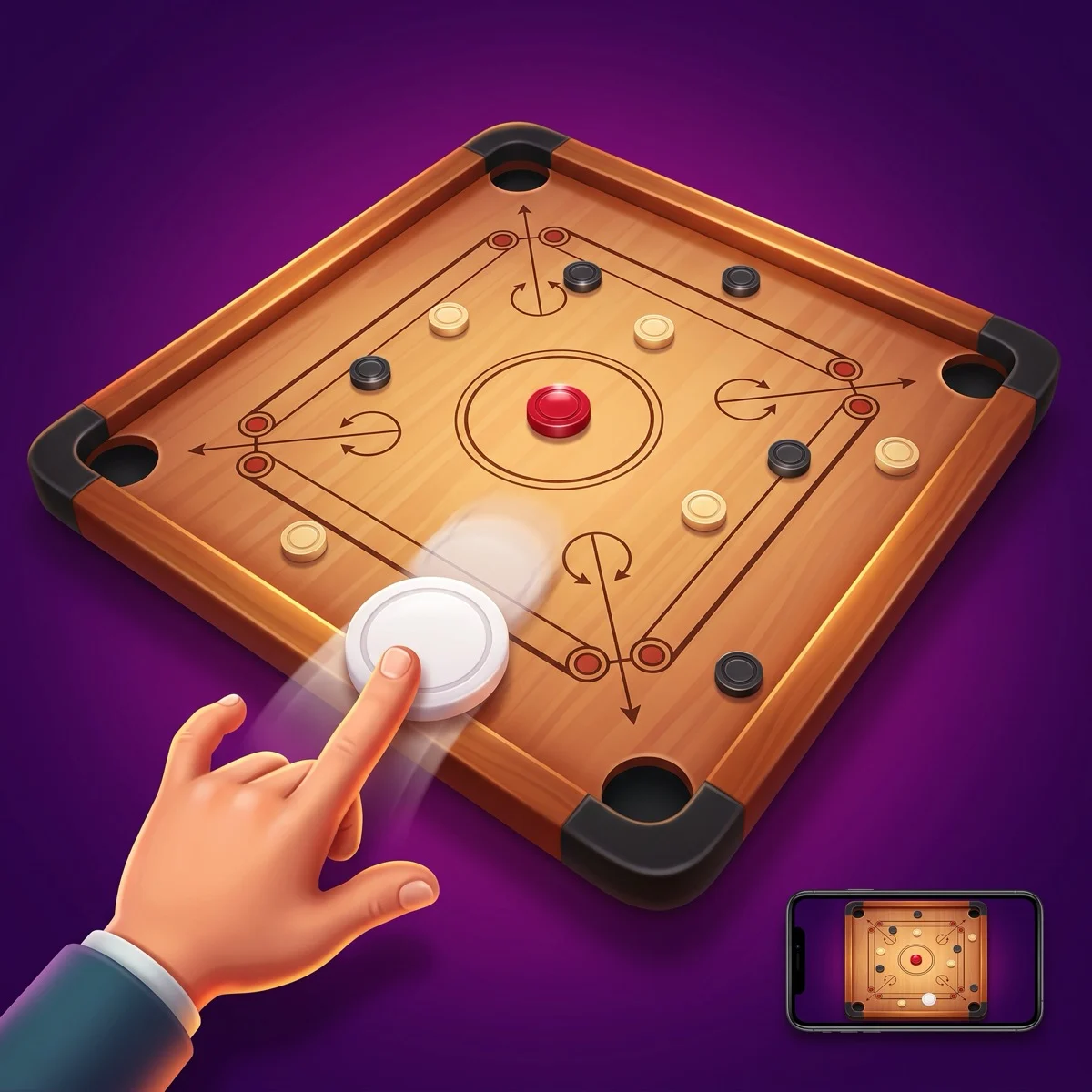
The anchor. Steady your striking hand on the board with the edge of your palm, and place your fingertip right behind the carrom striker, touching it if possible. The ICF striker is at most 4.13 cm wide and 15.00 g, so small hand movements matter. ICF Law 130 also requires the striker to touch both base lines during a stroke.
Why Does a Finger Flick Beat Pushing With Your Arm?
A flick stores energy against a latch and releases it in milliseconds, so it's faster and easier to repeat than an arm push. In 2021, a Georgia Tech team found that a finger snap, the same spring-and-latch trick, lasts about 7 milliseconds and peaks at 7,800° per second (Acharya and colleagues, Journal of the Royal Society Interface). Pushing is also against the rules.
Look closely at the scissors style and you'll see a finger snap pointed at a striker. The index finger is the latch. The middle finger is the spring, loaded as you press it against the latch. When the latch slips, the stored energy goes all at once. According to Georgia Tech's summary of the study on ScienceDaily, snaps reached rotational accelerations of 1.6 million degrees per second squared, almost three times a professional pitcher's arm. The researchers measured snaps, not carrom flicks, but the mechanism is the same.
A push is worse. The shoulder, elbow and wrist all move, and each adds a little sideways drift and uneven speed. You can't load a push against a latch, so you have to build speed during the stroke itself, which is exactly when accuracy suffers.
Friction mattered too. Snaps slowed down when subjects covered their fingertips with rubber or metal. The researchers described a middle zone: too little friction stores too little energy, and too much wastes it. For carrom, that argues for clean, dry fingertips and a light contact with the striker, not a sticky grip.
The laws settle it anyway. ICF Law 33 says the striker "shall be struck and not pushed", and Law 34 says the stroke is made with the finger, with or without support from other fingers. So keep the follow-through short, don't lift the anchor hand, and let the finger do the work.
Flick, don't push. A carrom flick is a spring-and-latch launch, like a finger snap. In 2021, Georgia Tech researchers measured snaps at about 7 milliseconds and 7,800° per second, with medium fingertip friction working best. An arm push can't store energy that way, and ICF Law 33 rules it out: the striker "shall be struck and not pushed".
How Do You Aim a Straight Shot and a Cut Shot?
Draw an imaginary line from the pocket through the center of the coin (the Laws call it a carrom man) and out the back. The spot on that line where the striker's center sits when it touches the coin is your "ghost striker" point, so aim the striker's center there. If the pocket-coin-striker angle is 90° or less, carrom.co.uk notes, the coin can't be pocketed at all.
Straight shots
On a straight shot, striker, coin and pocket sit on one line. The ghost point is directly behind the coin, one striker radius plus one coin radius back. With maximum-size ICF pieces, that's about 3.7 cm between centers. carrom.co.uk suggests a practice trick: stretch a string from the pocket's center through the striker's center, fixed to the frame with Blu-Tack, to check your line.
Cut shots, and why thin cuts miss
On a cut, the striker meets the coin at an angle, and the coin leaves along the line joining the two centers at contact. That's where the trouble starts. Any sideways error at contact gets multiplied by one divided by the cosine of the cut angle. By our idealized geometry from ICF maximum sizes, a 1 mm error sends the coin about 1.6° off line on a straight shot, 3.1° at a 60° cut and 6.1° at 75°.
What does that look like on the board? For a coin 50 cm from the pocket, 1.6° is about 1.4 cm sideways. That still drops into a pocket with a 2.2 cm radius. At a 60° cut, the same 1 mm puts the coin about 2.7 cm off, so its center never crosses the hole.
How the cut angle multiplies your aiming error
Thin cuts also cost pace. The coin only gets the cosine share of a full hit's speed, so at 60° it leaves at half speed, and the striker has to arrive twice as fast for the same distance. That's the geometry behind carrom.co.uk's advice that a cut needs "a bit more force" than a straight shot. And more force, as the power section shows, means more scatter.
So here's the practical rule: if a straighter pot exists, take it, even if it's longer. By the same geometry, a straight pot twice as long carries about the same directional risk as a 60° cut, and it needs less power.
Settle your eyes before you flick
Aim also depends on where your eyes are at release. In 2016, a meta-analysis in the Journal of Sport and Exercise Psychology (Lebeau and colleagues, "Quiet Eye and Performance in Sport") found that experts hold a longer final "quiet eye" fixation than novices, a large effect (d = 1.04). Quiet-eye training also improved performance across nine intervention papers (d = 0.84). The same steady-aim habit pays off in 8 ball pool matches. Before each flick, rest your eyes on the contact point for a beat, then release.
Why thin cuts miss. In carrom, the coin leaves along the line joining the striker and coin centers at contact, so a sideways aiming error grows by one over the cosine of the cut angle. By our idealized geometry from ICF equipment sizes, a 60° cut doubles any aiming error and a 75° cut nearly quadruples it. At 90°, the coin can't be pocketed.
How Do Rebound Shots Off the Frame Work?
Use the mirror method. Picture the frame as a mirror, find the target's reflection behind it, and aim straight at that reflection. Where your line meets the mirror is the bounce point. Treat it as a starting line, though. Billiards instructor Dr. Dave Alciatore writes that basic kick systems like this one "provide a point of reference only". He tells players to adjust for speed.
Where the mirror line really sits
Here's a detail most rebound tips skip: don't mirror across the frame itself. The striker's center turns around one striker radius before the frame, at the moment its edge touches the wood. So the true mirror line sits about 2 cm inside the frame, half of the 4.13 cm maximum striker width. Reflect your target across that line, not the frame edge.
Does 2 cm matter? In our idealized worked example, mirroring across the frame edge shifted the striker's path a full striker width, 4.13 cm, sideways at the target. A planned full hit became a thin clip about 3.3 cm off the coin's center, just inside the 3.7 cm limit where the two touch at all.
The mirror method for a one-rail rebound
When to bank, and why you calibrate
When is a rebound the right call? Mostly when another piece blocks the direct line, or when your coin sits tight to your own base line. Start with one-rail banks. A two-rail shot stacks a second bounce's error on top of the first.
Real frames aren't perfect mirrors. In 2010, an engineering model of billiard balls hitting a cushion (Mathavan, Jackson and Parkin, Proceedings of the IMechE, Part C) found that bounce angle and speed change with the ball's incoming speed and spin. Carrom frames differ in detail, but the lesson carries over. If the frame gives back only part of the striker's speed across it, the rebound comes off flatter, closer to the frame. In our idealized example, a frame that returns 80% of that speed turns a 45° approach into a 39° exit.
Apps add their own physics. One App Store reviewer of our own carrom game wrote in December 2025 that the striker's return off the frame was "not in proper line", and the game's June 2026 update notes list "improved physics". We can't promise that any app's engine matches wood. So calibrate: in free play, bank ten one-rail shots at soft, medium and hard power, and note where the striker lands against your mirror line.
The mirror method. To aim a carrom rebound, reflect the target across a line one striker radius, about 2 cm, inside the frame, then aim at the reflection. Where the aim line crosses that mirror line is the bounce point. Speed and spin shift real rebounds, so treat the line as a reference and calibrate with soft, medium and hard banks.
How Hard Should You Hit the Striker?
Softer than you think. The ICF board spec requires at least 3.5 runs of a 15 g striker struck with maximum force. By our idealized calculation from that spec, even the longest straight pot from your base line needs no more than about 54 to 63% of your top striker speed. Anything past that mostly buys scatter, plus a striker that follows the coin in.
How we worked out the power budget
Here's the method in brief. A sliding disc travels a distance that grows with the square of its speed. The ICF spec says a hardest-possible strike must carry the striker at least three and a half runs from your base line to the opposite frame, about 60 cm each. The longest straight pot from your base line runs about 61 cm to the far pocket on your side and 82 cm to the far diagonal corner. Take the square root of each ratio and you get 54% and 63% of top speed. That's only 29 to 39% of your hardest flick's energy.
Treat those as ceilings. The 3.5 runs is a minimum, so a real board may give you even more room. And with a coin in the path, the pot needs less, because the coin leaves faster than the striker arrives.
carrom.co.uk's force drill (flick off the opposite frame and stop on your opponent's base line) works out to about 58% of top speed on the same model. So the drill is a fair rehearsal of the pace you'll actually need.
Why the striker follows the coin in
The ICF striker can weigh 15.00 g, 2.7 to 2.9 times a carrom man (5.25 to 5.50 g). In an idealized head-on hit, assuming a restitution of 0.8 to 1.0, the striker keeps 46 to 53% of its speed and the coin leaves at 132 to 148% of it. The striker then chases the coin down the same line. At 4.13 cm, it's 93% as wide as the 4.45 cm pocket, so it fits.
The power budget: how much speed a pot actually needs
The good news hides in the same math. Pace the shot just hard enough to drop the coin, and the striker slides only 10 to 16% as far as the coin after contact. To follow it in, the striker would need 2.5 to 3.2 times that minimum speed at contact. Striker-in is an overhitting problem. It's a costly one, too: under ICF Law 72(a), pocketing the striker alone costs your turn and one of your pieces.
Watch coins sitting in the pocket mouth. There, the striker needs only a short slide to follow the coin in, so use your gentlest touch. The other fix is a hair of cut. With no friction between the pieces, a 10° cut sends the striker 18 to 21° off the coin's line (idealized) while raising your aim error by just 1.5%. By our geometry, that carries the striker's center wide of the pocket. The exception is a coin already sitting in the mouth, where soft pace is the only fix.
Why more force means more scatter
Why not hit hard just to be safe? Because force costs consistency. In motor-control research, the variability of a quick force rises roughly in step with the force itself across the sub-maximal range (Schmidt and colleagues, Psychological Review, 1979). Sherwood and Schmidt found the exception (Journal of Motor Behavior, 1980): at near-maximal forces, variability levels off and then falls. That's no loophole in carrom, because a near-maximal flick is exactly the overhit that sends your striker after the coin. Control beats power here, and the same discipline shows up in the habits that win any skill game.
The power budget. By our idealized calculation from the ICF board spec of 3.5 runs at maximum force, the longest straight pot from a carrom base line needs no more than about 54 to 63% of top striker speed. After a full head-on hit, the 15 g striker keeps 46 to 53% of its speed, so overhitting sends it after the coin, which ICF Law 72(a) penalizes.
Which Carrom Skills Carry Over to a Phone, and Which Don't?
The geometry carries over completely; the hand mechanics don't. As of September 2026, Miniclip's Carrom Pool listed more than 500 million Google Play downloads, so a lot of carrom now happens on glass. Cut angles, mirror rebounds, the power budget and follow-through behave the same on a screen. Grip styles and finger flicks have no touchscreen equivalent.
| Skill | On a board | In an app | Transfers? |
|---|---|---|---|
| Anchor hand | Palm edge flat on the board | Brace the phone on a table, or rest both elbows | The purpose does |
| Flick style | Index, scissors or thumb | No equivalent | No |
| Ghost-striker aim | Aim the striker's center at the ghost point | Same geometry | Yes |
| Cut-angle risk | 60° doubles aim error (idealized) | Same geometry | Yes |
| Mirror rebounds | Mirror line about 2 cm inside the frame | Same idea; the physics engine may differ | Mostly; calibrate |
| Power budget | Finger force | Whatever power control your app uses | Yes |
| Pre-shot eye routine | Eyes still on the contact point | Same | Yes |
The purpose behind the anchor does survive. Give the game one stable, repeatable input on every shot. Brace the phone, use the same finger each time, and make your power input the same smooth motion rather than a quick jab. How aim and power are set varies by app, so check your game's tutorial or practice mode before you trust any rule of thumb, including ours.
One warning. Search results for carrom tips are full of aim-assist mods and "auto-aim" tools. Using them breaks fair-play rules on skill platforms, and confirmed cheating can get an account banned. Our explainer on how Atay keeps matches fair covers what gets flagged. Skill raises your odds; nothing guarantees a win.
Board to phone. Carrom geometry transfers to any app: ghost-striker aiming, the cut-angle penalty, mirror rebounds and the power budget all apply on a screen. Grip styles and finger flicks don't, but their purpose does: one stable, repeatable input every shot. Miniclip's Carrom Pool listed more than 500 million Google Play downloads in September 2026.
What's a Good 15-Minute Striker Practice Routine?
Four short drills cover it: a force drill, a five-in-a-row drill and a nine-coin row drill, all adapted from carrom.co.uk, plus a rebound calibration set. carrom.co.uk's benchmark is refreshingly simple: if you can pocket the striker on five consecutive attempts, you can make it travel where you want. Track one number per drill so progress is visible.
| Drill | Minutes | What it trains | Pass mark |
|---|---|---|---|
| 1. Force drill. From your base line, flick off the opposite frame so the striker stops on your opponent's base line. | 4 | Power control | 3 of 5 stop on the line |
| 2. Five in a row. From your base line, pocket the striker itself in a far pocket. | 3 | Straight aim | 5 in a row |
| 3. Nine-coin row. Nine coins in a row, parallel to and about two striker widths in front of your base line. Pocket them all into the top pockets. | 4 | Cut aiming and pace | All nine |
| 4. Rebound set. One-rail banks at soft, medium and hard power toward one marked target. | 4 | Mirror calibration | Note the drift at each power |
In an app, run the same logic in a free or practice mode, wherever your game offers one. Practice modes cost nothing, so there's no reason to learn a new physics engine in a match that counts. Our comparison of free games and paid-entry tournaments covers when paying to play makes sense. Keep the same one-number log, on paper. A week of those numbers tells you more than a month of casual games.
The routine. A 15-minute carrom striker session covers four drills: a force drill off the opposite frame to your opponent's base line, five striker pots in a row, a nine-coin row, and a rebound calibration set. carrom.co.uk's benchmark: pocket the striker on five consecutive attempts and you control its direction. Log one number per drill.
Is Carrom a Game of Skill, and What Does That Mean in an App?
Yes, carrom is decided by skill: aim, pace and shot choice, the things this guide trains. Under the Laws of Carrom, a game runs to 25 points or eight boards (ICF Law 56), which gives consistent technique plenty of shots to show. Skill-based platforms rely on that to run matches as contests rather than gambling in most US states.
In skill-based formats, where cash play is available, platforms such as Skillz, now operated by Firy Inc. (NYSE: FIRY, formerly SKLZ), use skill-based matchmaking to pair players of similar ability. Better technique moves you up that ladder. It doesn't make every match winnable, because your opponents are improving too.
Keep the money side in proportion. Skill games pay a few dollars, not an income, and any paid entry can be lost. Our guide to what players can realistically earn has the honest version. Cash play on skill platforms is 18+, and availability depends on where you live, so check whether skill gaming is legal in your state before you enter anything.
On Android, Atay's games install as an APK from the official download link on each Atay game page, not from Google Play. Here's why real-money games aren't on Google Play.
Skill, in proportion. Carrom is decided by aim, pace and shot choice, which is why skill-based platforms can run it as a contest rather than gambling in most US states. Better striker technique raises your odds against similarly matched players. It doesn't guarantee wins, skill games pay a few dollars rather than an income, and cash play is 18+ and state-dependent.
Frequently Asked Questions
Which finger is best for flicking a carrom striker?
There's no single best finger. The index finger gives the most control on forward shots, the scissors style (index finger holding the middle finger back) adds power, and the thumb handles back shots where your rules allow them. carrom.co.uk lists seven styles. Pick one you can repeat, and anchor your palm every time.
How do you aim a rebound shot in carrom?
Use the mirror method. Reflect the target across a line about 2 cm inside the frame, one striker radius, and aim at that reflection. Where your aim line crosses the mirror line is the bounce point. Speed and spin shift real rebounds, so calibrate with soft, medium and hard banks before you rely on it.
Why does my striker keep going into the pocket?
Usually because you're hitting too hard. An ICF striker can weigh 15 g, nearly three times a carrom man, so after a full straight hit it keeps roughly half its speed and follows the coin (idealized). At 4.13 cm it also fits the 4.45 cm pocket. Hit softer or add a slight cut. Law 72(a) costs you the turn and a piece.
How hard should you hit the carrom striker?
Softer than most players think. By our idealized calculation from the ICF board spec, even the longest straight pot from your base line needs no more than about 54 to 63% of your top striker speed. Extra pace adds scatter and makes it more likely that the striker follows the coin into the pocket.
Is it legal to push the striker in carrom?
Not under the Laws of Carrom. ICF Law 33 says the striker 'shall be struck and not pushed', and Law 130 requires it to touch both base lines while you take the stroke. Carrom apps replace the flick with touch controls, so check your game's own rules screen for how shots are taken.
The Bottom Line
Striker skill comes down to a few habits you can train, and each one has a number behind it:
- Anchor and flick, never push. A flick is a spring-and-latch launch, and Law 33 requires it.
- Aim through the ghost striker and take the straighter pot. A 60° cut doubles your error (idealized).
- Bank with the mirror, then calibrate. Mirror across a line 2 cm inside the frame, and test it at three speeds.
- Hit well under full power. Even the longest straight pot needs no more than about 54 to 63% of top speed (idealized), and overhitting sinks your striker.
- Practice for free, and log one number per drill.
Want somewhere to run the four drills? Try them in free play in Atay's Carrom game, calibrate your rebounds against the mirror line, and check inside the app which modes are available on your device.
- International Carrom Federation, "Laws of Carrom": striker at most 4.13 cm and 15.00 g; carrom men 3.02 to 3.18 cm and 5.25 to 5.50 g; Laws 33, 34, 72(a) and 130. Copy hosted at iakc.org
- Indian Carrom Federation, "Laws of Carrom": playing surface 73.50 to 74 cm (A.1), the 3.5-run striker requirement (A.1), 4.45 cm pockets (A.3), 47 cm base lines 10.15 cm from the frame (A.4), and game length (Law 56). indiancarrom.co.in
- carrom.co.uk, "Improving Your Game" (undated): hand anchoring, the 90° rule, the string method, cut shots needing more force, and the force, five-in-a-row and nine-coin drills. carrom.co.uk
- carrom.co.uk, "Striking Styles" (undated): seven named striking styles. carrom.co.uk
- R. Acharya, E. J. Challita, M. Ilton and M. S. Bhamla, "The ultrafast snap of a finger is mediated by skin friction," Journal of the Royal Society Interface 18(184), 2021, doi:10.1098/rsif.2021.0672. Figures via Georgia Institute of Technology, "'Oh, snap!' A record-breaking motion at our fingertips," ScienceDaily, November 17, 2021. sciencedaily.com
- J. C. Lebeau and colleagues, "Quiet Eye and Performance in Sport: A Meta-Analysis," Journal of Sport and Exercise Psychology 38(5), 441 to 457, 2016. journals.humankinetics.com
- R. A. Schmidt, H. Zelaznik, B. Hawkins, J. S. Frank and J. T. Quinn, "Motor-output variability: A theory for the accuracy of rapid motor acts," Psychological Review 86(5), 415 to 451, 1979. semanticscholar.org
- D. E. Sherwood and R. A. Schmidt, "The relationship between force and force variability in minimal and near-maximal static and dynamic contractions," Journal of Motor Behavior 12(1), 75 to 89, 1980. doi.org
- S. Mathavan, M. R. Jackson and R. M. Parkin, "A theoretical analysis of billiard ball dynamics under cushion impacts," Proceedings of the IMechE, Part C 224(9), 1863 to 1873, 2010 (billiards, used as an analogy). journals.sagepub.com
- Dr. Dave Alciatore, "Mirror Kick and Bank Shot Aiming System" (undated). drdavepoolinfo.com
- Apple App Store, "Carrom Board Online Skill Game" by ATAY GAMES LTD: version 1.21 update notes (June 9, 2026) and the customer review dated December 28, 2025. apps.apple.com
- Google Play, "Carrom Pool: Disc Game" by Miniclip.com: 500M+ downloads, listing updated August 31, 2026. play.google.com
- Atay Games, idealized striker geometry (September 2026). Inputs: the ICF maximum sizes and weights above, a 74 cm and a 73.5 cm board, and a 3.5-run minimum at maximum force. Assumptions: smooth discs, no spin, no friction during contact, the same sliding friction for striker and coins (so distance grows with speed squared), frame losses ignored, striker-coin restitution of 0.8 to 1.0, your hardest flick equal to the spec's "maximum force" strike, the striker centered between the two base lines (on the end base circle for the longest pots), and each pocket modeled as a 4.45 cm circle touching both frame edges at its corner. Outputs: the 1/cos cut multiplier, the head-on speed shares, the power budget (an upper bound, since the 3.5 runs is a minimum and the path is counted as if the striker slid all the way), the mirror-line offset and the 10° cut deflection. A calculation, not a measurement.
A note on technique and play. This guide describes technique and idealized physics for physical carrom boards. App controls, rules and physics vary, so confirm them in the game you play. Skill improves your odds but never guarantees a result. Where skill games involve real money, entries can be lost, play is 18+, and availability depends on your state or region. Never play with money you can't afford to lose. If gaming stops being fun, help is available from the National Council on Problem Gambling at ncpgambling.org or 1-800-522-4700.
Put the Drills on the Board
Run the force, five-in-a-row, nine-coin and rebound drills in free play, calibrate your mirror line, and check in the app which modes are available on your device.
Practice in Atay's Carrom